

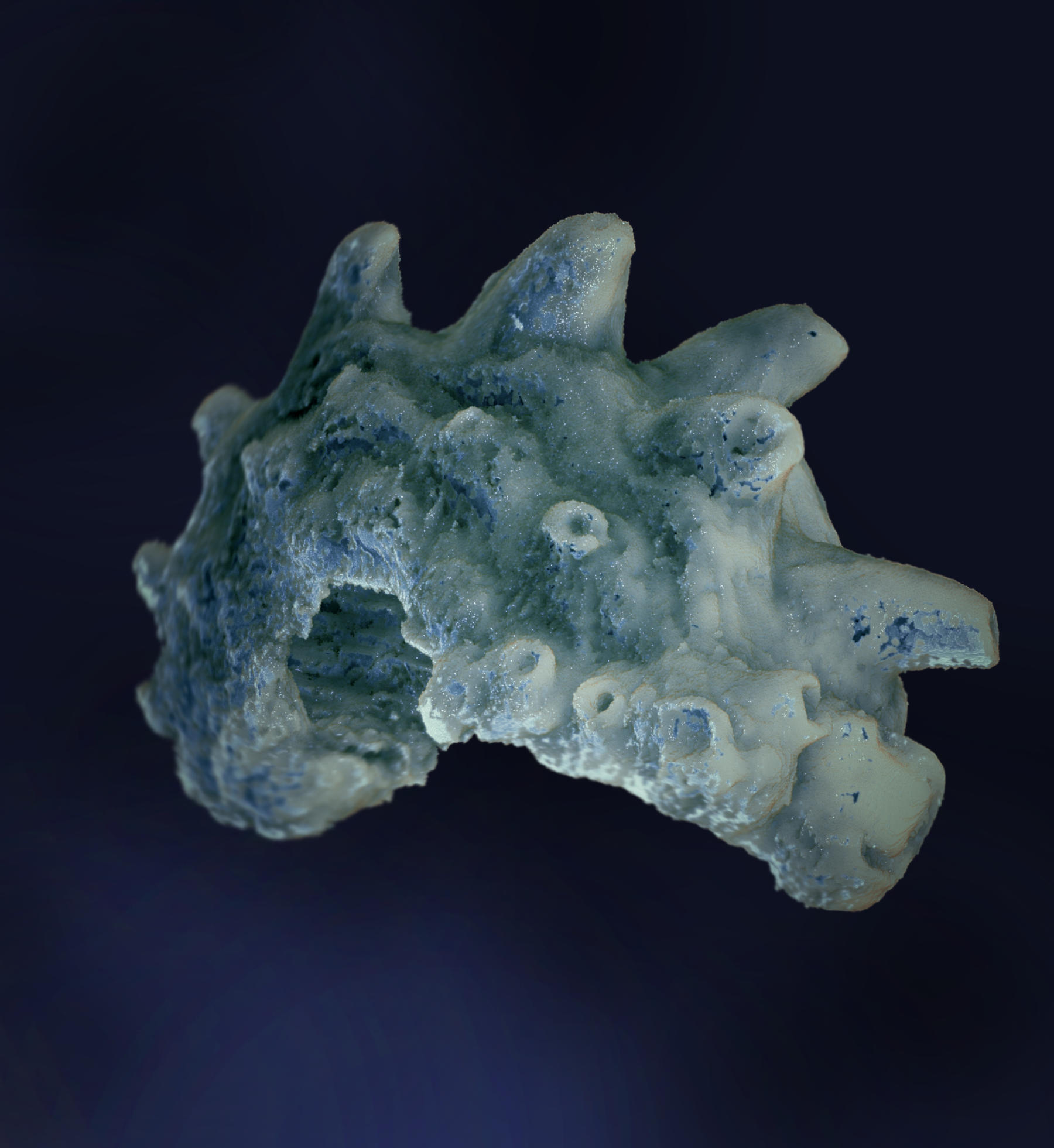


Volumetric reconstruction of a tooth whorl viewed from its lingual side (holotype of Qianodus duplicis). The specimen is just over 2 mm in length. Credit: Zhu, et al.
Rare Chinese fossil teeth have changed scientists’ beliefs about the evolution of vertebrates.
An international team of scientists has found toothed fish remains that date back 439 million years, which suggests that the ancestors of modern chondrichthyans (sharks and rays) and osteichthyans (ray- and lobe-finned fish) originated far earlier than previously believed.
The findings were recently published in the prestigious journal Nature.
A remote location in south China’s Guizhou Province has yielded magnificent fossil findings, including solitary teeth identified as belonging to a new species (Qianodus duplicis) of primitive jawed vertebrate from the ancient Silurian period (about 445 to 420 million years ago). Qianodus, named after the ancient name for the present-day Guizhou, possessed unusual spiral-like dental elements carrying several generations of teeth that were inserted throughout the course of the animal’s life.
A reconstruction of Qianodus duplicis swimming. Credit: IVPP
One of the rarest fossils found at the site ended up being the tooth spirals (or whorls) of Qianodus. Due to their tiny size, which seldom exceeds 2.5 mm, they had to be studied under magnification with visible light and X-ray radiation.
A conspicuous feature of the whorls is that they contained a pair of teeth rows set into a raised medial area of the whorl base. These so-called primary teeth exhibit a gradual growth in size as they approach the inner (lingual) whorl. The distinct offset between the two primary teeth rows is what distinguishes the whorls of Qianodus from those of other vertebrates. Although it hasn’t been previously discovered in the tooth whorls of fossil species, a similar arrangement of nearby teeth rows is also present in the dentitions of several modern sharks.

A virtual section along the length of a tooth whorl in side view (holotype of Qianodus duplicis). The specimen is just over 2 mm in length. Credit: Zhu, et al.
The discovery indicates that the well-known jawed vertebrate groups from the so-called “Age of Fishes” (420 to 460 million years ago) were already established some 20 million years earlier.
“Qianodus provides us with the first tangible evidence for teeth, and by extension jaws, from this critical early period of vertebrate evolution,” said Li Qiang from Qujing Normal University.
Unlike the continuously shedding teeth of modern sharks, the researchers believe that the tooth whorls of Qianodus were kept in the mouth and increased in size as the animal grew. This interpretation explains the gradual enlargement of replacement teeth and the widening of the whorl base as a response to the continuous increase in jaw size during development.
For the researchers, the key to reconstructing the growth of the whorls was two specimens at an early stage of formation, easily identified by their noticeably smaller sizes and fewer teeth. A comparison with the more numerous mature whorls provided the paleontologists with a rare insight into the developmental mechanics of early vertebrate dentitions. These observations suggest that primary teeth were the first to form whereas the addition of the lateral (accessory) whorl teeth occurred later in development.

A reconstruction of Qianodus duplicis, a primitive jawed vertebrate. Credit: Zhang Heming
“Despite their peculiarities, tooth whorls have, in fact, been reported in many extinct chondrichthyans and osteichthyan lineages,” said Plamen Andreev, the lead author of the study. “Some of the early chondrichthyans even built their dentition entirely from closely spaced whorls.”
The researchers claim that this was also the case for Qianodus. They made this conclusion after examining the small (1–2 mm long) whorls of the new species with synchrotron radiation—a CT scanning process that uses high-energy X-rays from a particle accelerator.
“We were astonished to discover that the tooth rows of the whorls have a clear left or right offset, which indicates positions on opposing jaw rami,” said Prof. Zhu Min from the Institute of Vertebrate Paleontology and Paleoanthropology of the Chinese Academy of Sciences.
These observations are supported by a phylogenetic tree that identifies Qianodus as a close relative to extinct chondrichthyan groups with whorl-based dentitions.
“Our revised timeline for the origin of the major groups of jawed vertebrates agrees with the view that their initial diversification occurred in the early Silurian,” said Prof. ZHU.
The discovery of Qianodus provides tangible proof for the existence of toothed vertebrates and shark-like dentition patterning tens of millions of years earlier than previously thought. The phylogenetic analysis presented in the study identifies Qianodus as a primitive chondrichthyan, implying that jawed fish were already quite diverse in the Lower Silurian and appeared shortly after the evolution of skeletal mineralization in ancestral lineages of jawless vertebrates.
“This puts into question the current evolutionary models for the emergence of key vertebrate innovations such as teeth, jaws, and paired appendages,” said Ivan Sansom, a co-author of the study from the University of Birmingham.
Reference: “The oldest gnathostome teeth” by Plamen S. Andreev, Ivan J. Sansom, Qiang Li, Wenjin Zhao, Jianhua Wang, Chun-Chieh Wang, Lijian Peng, Liantao Jia, Tuo Qiao, and Min Zhu, 28 September 2022, Nature.
DOI: 10.1038/s41586-022-05166-2



