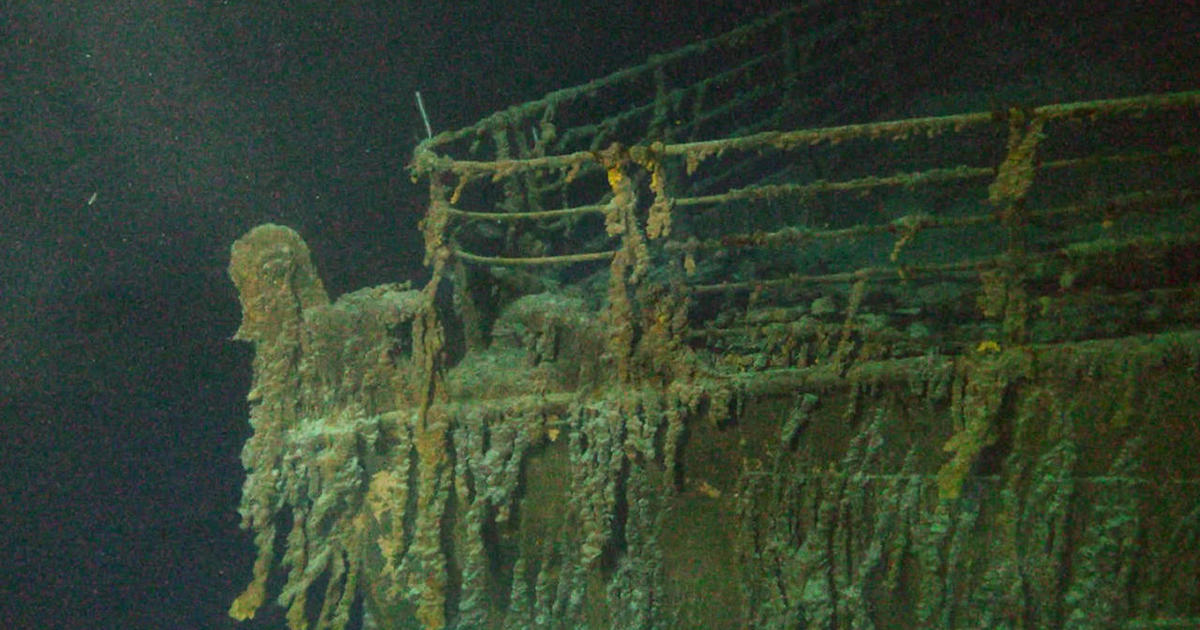
Maybe you’ve heard the story of the Titanic. I think there was a movie about it? For the most part, the only people who’ve ever seen the Titanic since the night of April 15, 1912, when it sunk beneath the North Atlantic, have been scientists. Until now.
Stockton Rush is CEO of OceanGate, a company that offers dives to the Titanic in a one-of-a-kind, carbon-fiber submersible, for $250,000 per person. “It’s a very unusual business,” he said. “It’s its own category. It’s a new type of travel.”
Correspondent David Pogue asked, “Who are the typical clientele for these missions?”
“We have clients that are Titanic enthusiasts, which we refer to as Titaniacs,” Rush replied. “We’ve had people who have mortgaged their home to come and do the trip. And we have people who don’t think twice about a trip of this cost. We had one gentleman who had won the lottery.”
And this summer, Rush invited “CBS Sunday Morning” to come along.
We departed from St. Johns, Newfoundland, Canada, the easternmost tip of North America, about 400 miles from the Titanic site, aboard a chartered oil-rig servicing ship. During our two-day journey into the North Atlantic, we got to know our fellow adventurers. They included everyone from Indian industry mogul Shrenik Baldota (“They call me the wild monk,” he said, “because I look like a monk, I’m very calm, but I have these extreme interests that I do”), to bank executive Renata Rojas (“I’m trying to fulfill a dream; I’ve been wanting to go to Titanic and see with my own eyes since before they found it”).
Rojas has been saving up to see the Titanic for 30 years. “Dreams don’t have a price,” she said. “Some people want a Ferrari. Some people buy a house. I wanted to go to Titanic.”
But the star of the show is the Titan: Stockton Rush’s custom-built submersible, made of five-inch-thick carbon fiber, capped on each end by a dome of titanium.
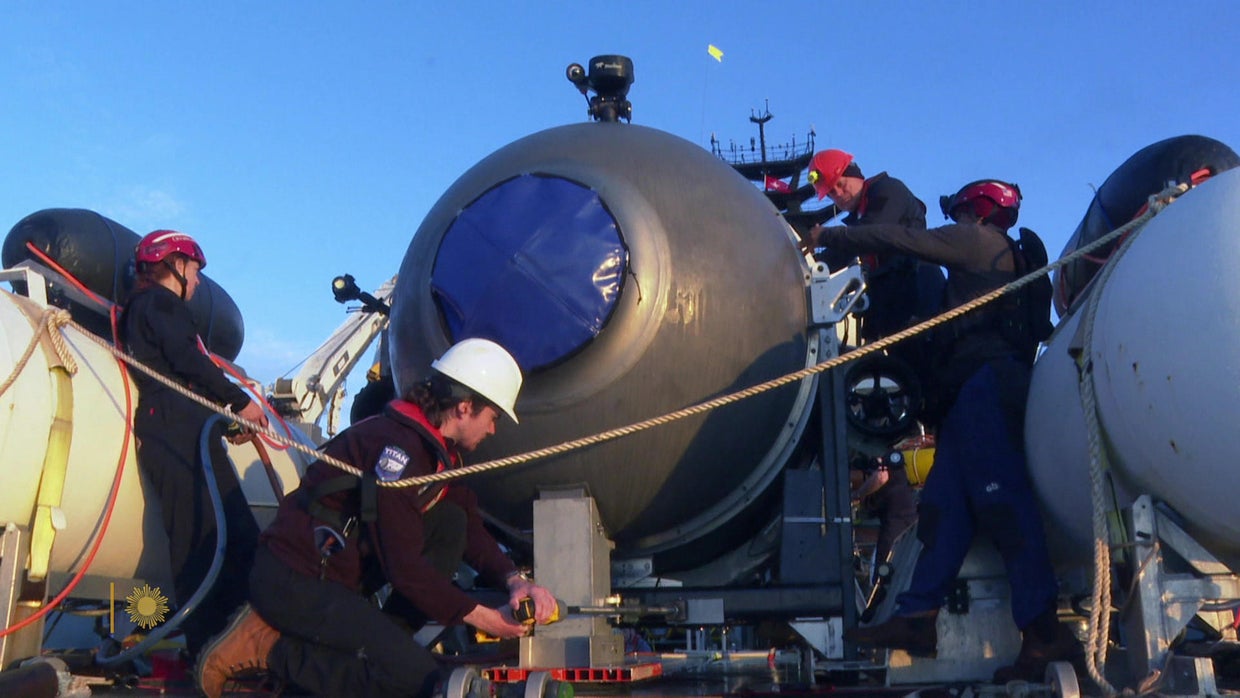
CBS News
If all went well, Pogue would be spending about 12 hours sealed inside on a dive to the Titanic. “Not gonna lie; I was a little nervous,” he said, especially given the paperwork, which read, “This experimental vessel has not been approved or certified by any regulatory body, and could result in physical injury, emotional trauma, or death.” Where do I sign?
This is not your grandfather’s submersible; inside, the sub has about as much room as a minivan. It has one button. “That’s it,” said Rush. “It should be like an elevator, you know? It shouldn’t take a lot of skill.”
The Titan is the only five-person sub in the world that can reach Titanic’s depth, 2.4 miles below the sea. It’s also the only one with a toilet (sort of).
And yet, I couldn’t help noticing how many pieces of this sub seemed improvised, with off-the-shelf components. Piloting the craft is run with a video game controller.
Pogue said, “It seems like this submersible has some elements of MacGyver jerry-riggedness. I mean, you’re putting construction pipes as ballast.”
“I don’t know if I’d use that description of it,” Rush said. “But, there are certain things that you want to be buttoned down. The pressure vessel is not MacGyver at all, because that’s where we worked with Boeing and NASA and the University of Washington. Everything else can fail, your thrusters can go, your lights can go. You’re still going to be safe.”
But when expedition manager Kyle Bingham studied the forecast for our Titanic dive, he concluded the waves would be too big to launch the sub. Our Titanic adventure would have to wait. But Stockton Rush offered our CBS crew a consolation dive to the Continental Shelf, 80 miles way. Apparently, there’s a lot of sheer cliffs underwater to see, shark breeding grounds. They say it’s really cool!
The crew closes the hatch, from the outside, with 17 bolts. There’s no other way out.
Here’s how the launch is supposed to go: The sub is attached to a huge floating platform. Motorboats drag it down the big orange ramp into the sea. The platform submerges to about 30 feet, where the water is much calmer than on the surface. Divers detach the sub from the platform … and away you go!
In theory.
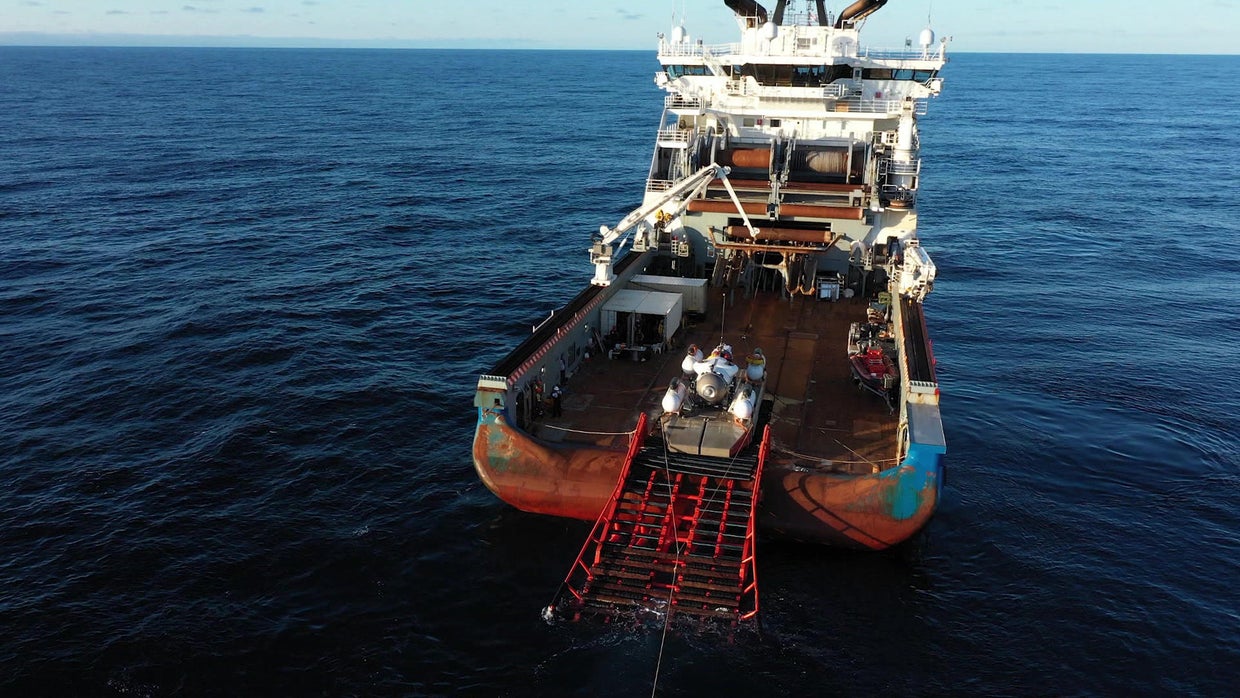
CBS News
Our dive in the OceanGate submersible had made it down only 37 feet when floats came off the platform. And that wasn’t supposed to happen. The mission was scrubbed.
I was crushed. My diving adventures were over.
Renata Rojas said, “Every expedition has its challenges, all of them. I have not been in one expedition where things haven’t had to be adjusted, adapted, changed or cancelled at the end of the day. You’re at the mercy of the weather.”
Rojas speaks from painful experience. Over the years, she’s been booked on three Titanic expeditions. All three were canceled. “You just cry a lot,” she said, “and just keep the dream alive, because it’s something that I have to do.”
Our expedition had to wait out two more days of rough seas.
Fortunately, there’s a lot to do in the North Atlantic, from dancing to channeling your inner Leonardo DiCaprio. (“I’m the king of the surface vessel!”) There’s sea life, ship tours, and atmospheric effects, like a sundog.

CBS News
You can also hang out with scientists. Researchers like deep-sea biologist Steve Ross and ocean archaeologist Rod Mather join every expedition. In effect, the passengers are funding their science.
Pogue asked, “How scientific is this this expedition?”
“I don’t do show science,” Ross said. “Our job is to do real and important and valid work.”
“While you’re down there, will you look for this giant heart-shaped diamond on a chain?”
“I think that’s not there,” Mather replied.
On our sixth day at sea, the weather cleared. The dive was a go!
Titan reported arriving “on bottom,” sitting at 3,742 meters. But that was the last of the good news.
There’s no GPS underwater, so the surface ship is supposed to guide the sub to the shipwreck by sending text messages. Rush recalled, “I said, ‘Do you know where we are?’ ‘100 meters to the bow, then 470 to the bow. If you are lost, so are we!'”

CBS News
But on this dive, communications somehow broke down. The sub never found the wreck.
“We were lost,” said Shrenik Baldota. “We were lost for two-and-a-half hours.”
Rush said he’ll offer those passengers a free do-over next year. And that’s just one cost of doing this business.
Pogue asked, “Are you making money on this operation?”
“Ahhh, no. So, not yet,” he replied. “People might say, ‘Hey, that’s a lot of money, $250,000.’ But we went through over a million dollars of gas.”
It was our last day at sea. There was one last chance to reach the Titanic. And this time good weather and good fortune were aligned. An anchor was spotted.
“Oh my God. There’s the bow, guys! Do you guys see it?”
And there it was. The famous bow, emerging from the darkness.
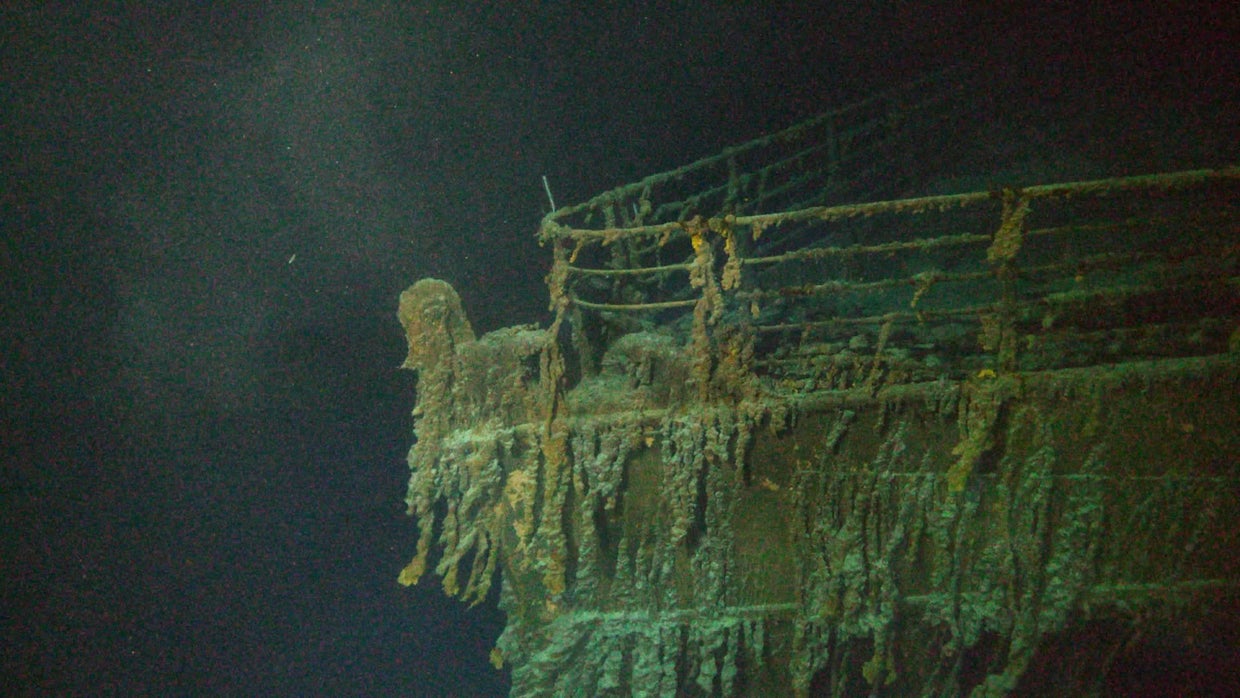
CBS News
The ship’s wheel pedestal, and memorial plaques from old expeditions.
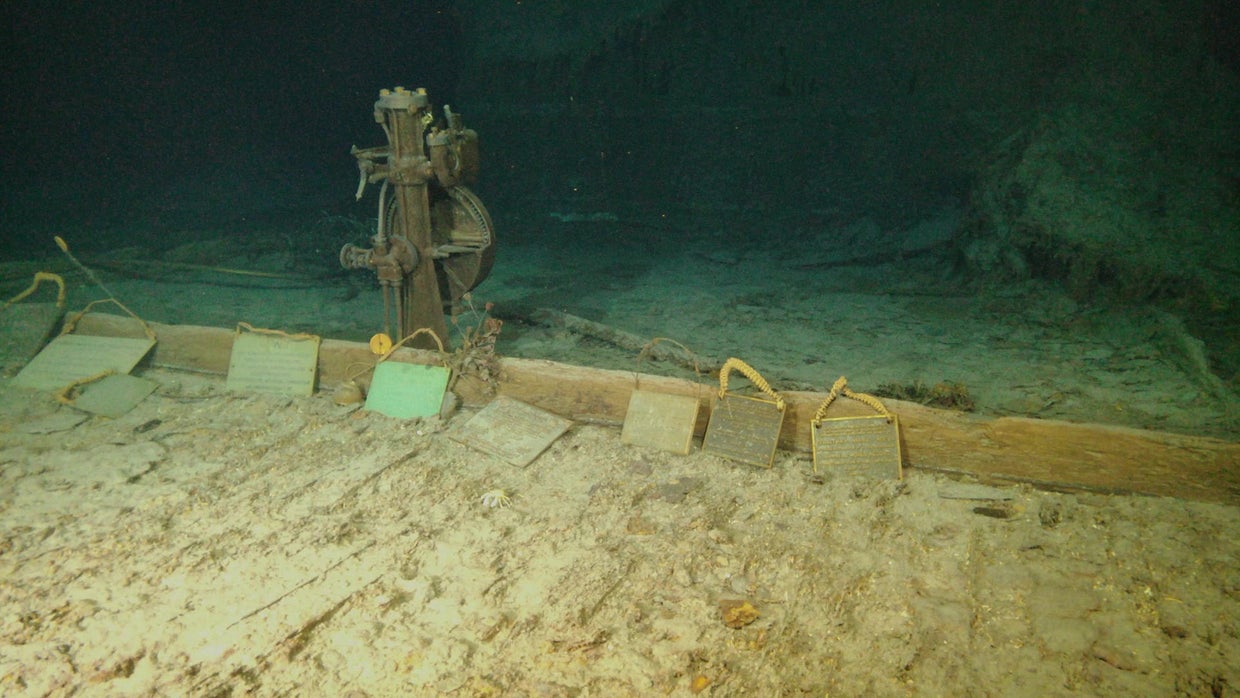
CBS News
The bollards that once secured the ship in port.

CBS News
And the davits that lowered the lifeboats.

CBS News
The hole where a huge smokestack once stood.
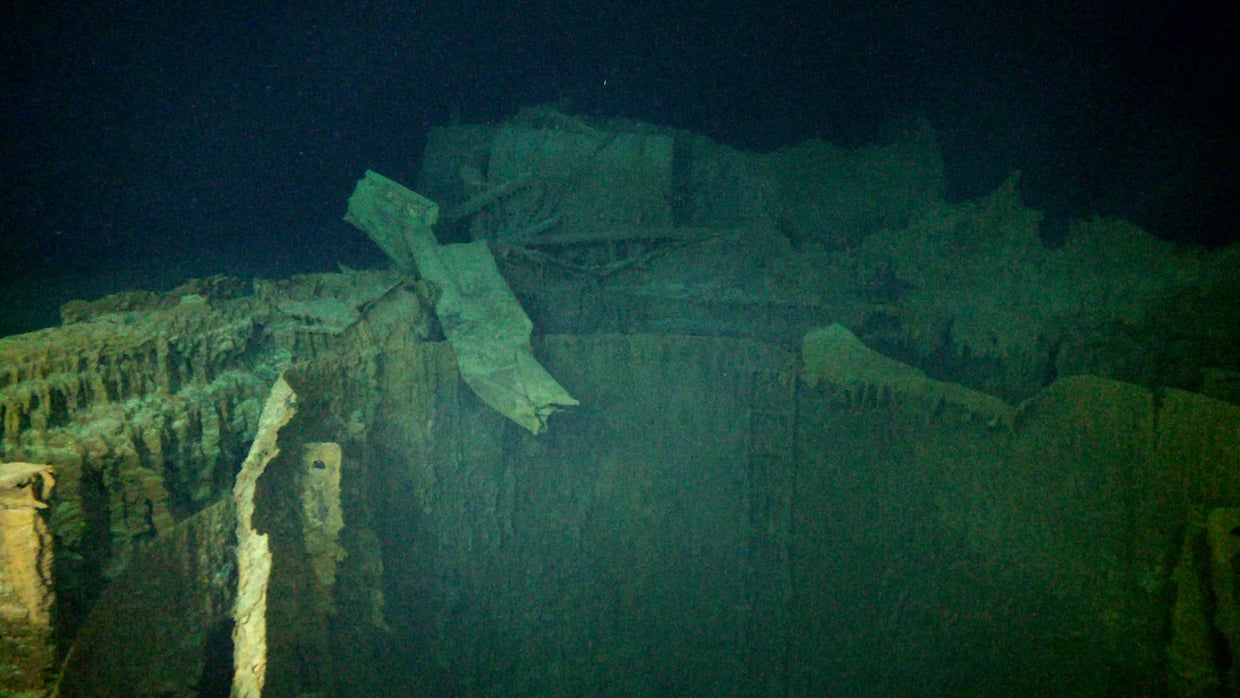
CBS News
And the skylight over the radio room that sent out distress signals.
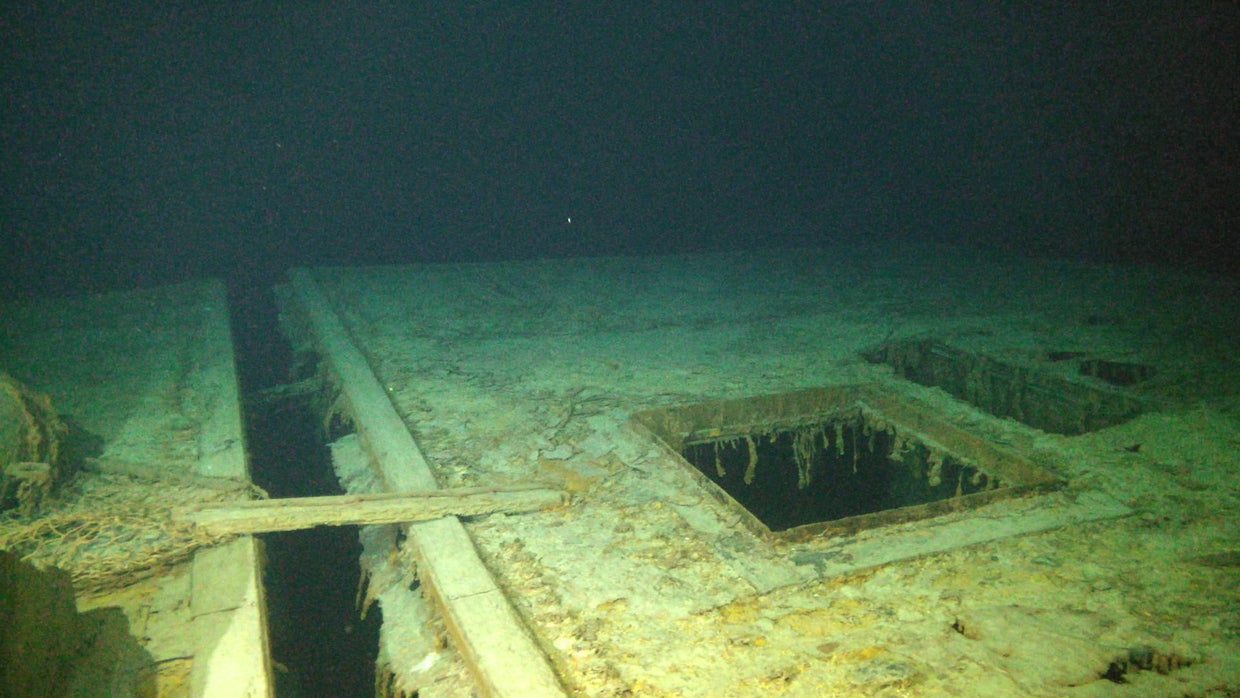
CBS News
Now, Titanic tourism has its detractors. But these expeditions don’t disturb the wreck or retrieve artifacts, and Stockton Rush said that they’re valuable to history: “At some point, there will be no Titanic. It will be eaten by the bacteria. It will be an artificial reef that doesn’t look like the Titanic.”
Renata Rojas would agree. After 30 years of trying, she finally got to see the most famous shipwreck in the world.
Stockton Rush plans to return to the wreck next summer. Until then, the Titanic will once again be alone.
For more info:
Story produced by Anthony Laudato. Editor: Joseph Frandino.
See also: