


Tohoku University researchers have created a theoretical model for energy-efficient, nanoscale computing using spin wave reservoir computing and spintronics technology. This innovation, detailed in npj Spintronics, paves the way for advanced neuromorphic devices capable of high-speed operations and applications in fields like weather forecasting and speech recognition.
Researchers from Tohoku University have created a theoretical framework for an advanced spin wave reservoir computing (RC) system that leverages spintronics. This innovation advances the field toward realizing energy-efficient, nanoscale computing with unparalleled computational power.
Details of their findings were published in npj Spintronics on March 1, 2024.
The Pursuit of Brain-like Computing
The brain is the ultimate computer and scientists are constantly striving to create neuromorphic devices that mimic the brain’s processing capabilities, low power consumption, and its ability to adapt to neural networks. The development of neuromorphic computing is revolutionary, allowing scientists to explore nanoscale realms, GHz speed, with low energy consumption.
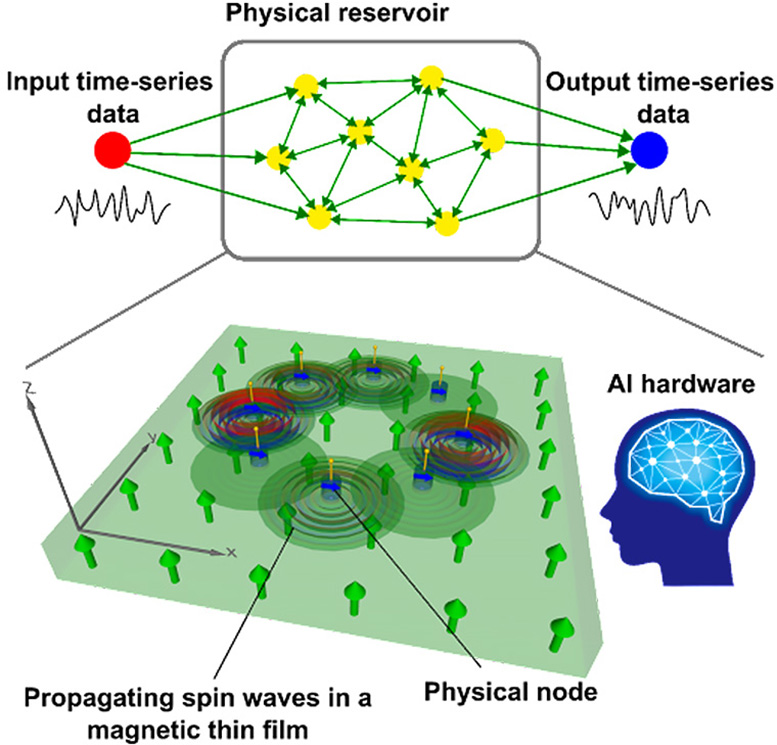
A physical reservoir computer performs a task to transform input data to output data, such as time-series prediction. Magnetic thin film was used for the reservoir part. Information of the input is carried by spin waves and propagated to the output node (shown in blue cylinders in the bottom figure) corresponding to the nodes in the reservoir (shown in yellow in the top figure). Credit: Springer Nature Limited
In recent years, many advances in computational models inspired by the brain have been made. These artificial neural networks have demonstrated extraordinary performances in various tasks. However, current technologies are software-based; their computational speed, size, and energy consumption remain constrained by the properties of conventional electric computers.
The Mechanics of Reservoir Computing
RC works via a fixed, randomly generated network called the ‘reservoir.’ The reservoir enables the memorization of past input information and its nonlinear transformation. This unique characteristic allows for the integration of physical systems, such as magnetization dynamics, to perform various tasks for sequential data, like time-series forecasting and speech recognition.
Some have proposed spintronics as a means to realize high-performance devices. But devices produced so far have failed to live up to expectations. In particular, they have failed to achieve high performance at nanoscales with GHz speed.
“Our study proposed a physical RC that harnessed propagating spin waves,” says Natsuhiko Yoshinaga, co-author of the paper and associate professor at the Advanced Institute for Materials Research (WPI-AIMR). “The theoretical framework we developed utilized response functions that link input signals to propagating spin dynamics. This theoretical model elucidated the mechanism behind the high performance of spin wave RC, highlighting the scaling relationship between wave speed and system size to optimize the effectiveness of virtual nodes.”
Crucially, Yoshinaga and his colleagues helped clarify the mechanism for high-performance reservoir computing. In doing so, they harnessed various subfields, namely condensed matter physics and mathematical modeling.
“By employing the unique properties of spintronics technology, we have potentially paved the way for a new era of intelligent computing, leading us closer to realizing a physical device that can be put to use in weather forecasts and speech recognition” adds Yoshinaga.
Reference: “Universal scaling between wave speed and size enables nanoscale high-performance reservoir computing based on propagating spin-waves” by Satoshi Iihama, Yuya Koike, Shigemi Mizukami and Natsuhiko Yoshinaga, 30 February 2024, npj Spintronics.
DOI: 10.1038/s44306-024-00008-5