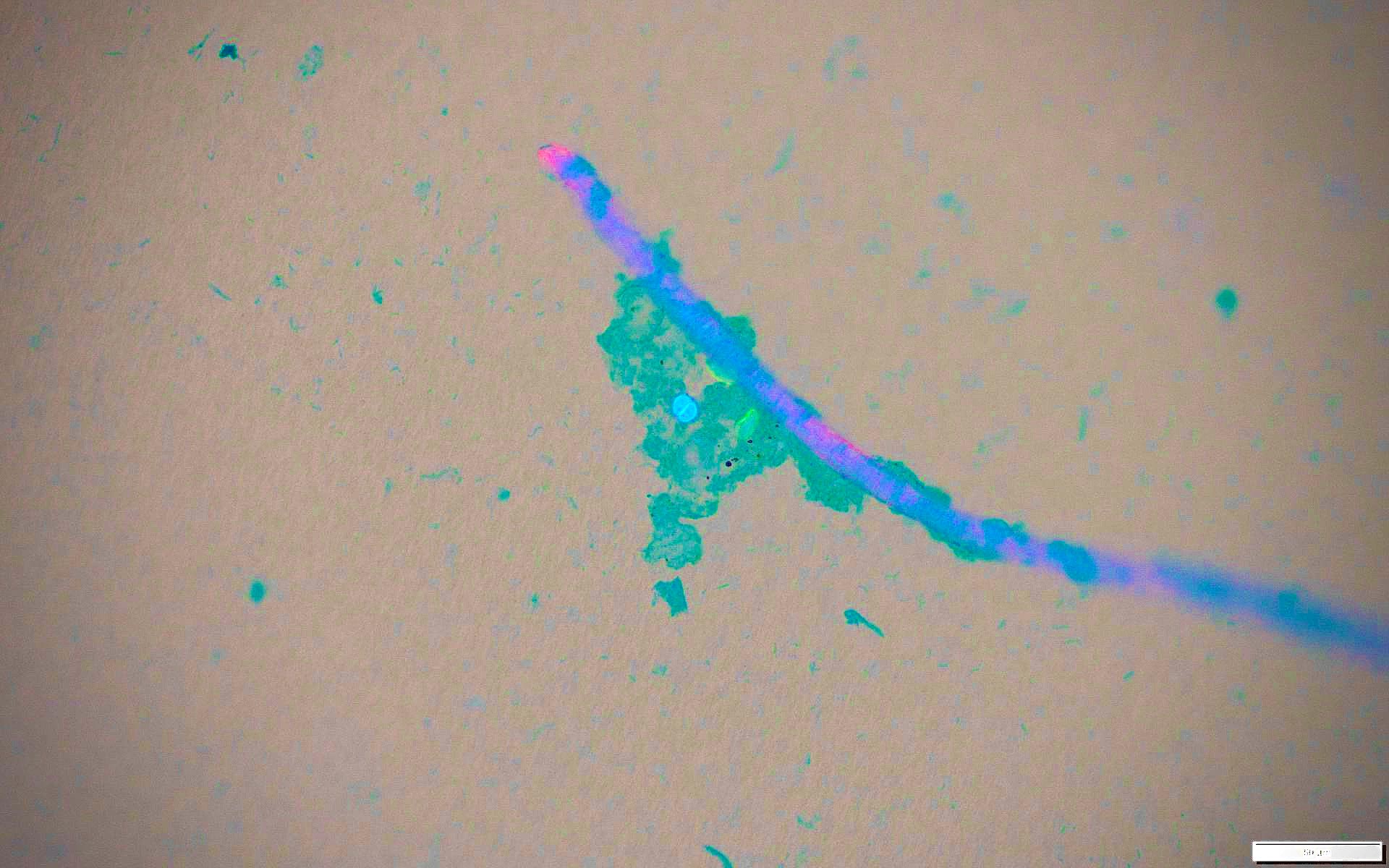


A. piece of microplastic fiber is shown under a microscope with biofilm (fuzzy blue) and T. gondii (blue dot) and giardia (green dot) pathogens. Credit: Karen Shapiro, UC Davis
Pathogens Can Hitch a Ride on Plastic To Reach the Sea
According to a new study by the University of California, Davis, microplastics are a pathway for land-based parasites to reach the ocean, with potential ramifications for human and wildlife health.
The study, published today (April 26, 2022) in the journal Scientific Reports, is the first to connect microplastics in the ocean with land-based pathogens. It found that microplastics can make it easier for disease-causing pathogens to concentrate in plastic-contaminated areas of the ocean.
The pathogens studied—Toxoplasma gondii, Cryptosporidium (Crypto) and Giardia—can infect both humans and animals. They are recognized by the World Health Organization as underestimated causes of illness from shellfish consumption and are found throughout the ocean.
“It’s easy for people to dismiss plastic problems as something that doesn’t matter for them, like, ‘I’m not a turtle in the ocean; I won’t choke on this thing,’” said corresponding author Karen Shapiro, an infectious disease expert and associate professor in the UC Davis School of Veterinary Medicine. “But once you start talking about disease and health, there’s more power to implement change. Microplastics can actually move germs around, and these germs end up in our water and our food.”

A piece of microplastic fiber and pathogens with biofilm (fuzzy blue). The pathogens shown are T. gondii (blue dot) and giardia (green dot). Credit: Karen Shapiro, UC Davis
A human and animal problem
Microplastics are tiny plastic particles smaller than 5 millimeters, no bigger than a grain of rice. They’ve contaminated waters as remote as Antarctica. The study’s findings indicate that, by hitchhiking on microplastics, pathogens can disperse throughout the ocean, reaching places a land parasite would normally never be found.
T. gondii, a parasite found only in cat poop, has infected many ocean species with the disease toxoplasmosis. UC Davis and its partners have a long history of research connecting the parasite to sea otter deaths. It’s also killed critically endangered wildlife, including Hector’s dolphins and Hawaiian monk seals. In people, toxoplasmosis can cause life-long illnesses, as well as developmental and reproductive disorders.
Crypto and giardia cause gastrointestinal disease and can be deadly in young children and people who are immunocompromised.
“This is very much a problem that affects both humans and animals,” said first author Emma Zhang, a fourth-year veterinary student with the UC Davis School of Veterinary Medicine. “It highlights the importance of a One Health approach that requires collaboration across human, wildlife and environmental disciplines. We all depend on the ocean environment.”

Emma Zhang, first author on a study connecting microplastics and pathogens int he ocean, works in the lab at the University of California, Davis. Credit: Courtesy Emma Zhang, UC Davis
Microbeads and microfibers
For the study, the authors conducted laboratory experiments to test whether the selected pathogens can associate with plastics in sea water. They used two different types of microplastics: polyethylene microbeads and polyester microfibers. Microbeads are often found in cosmetics, such as exfoliants and cleansers, while microfibers are in clothing and fishing nets.
The scientists found that more parasites adhered to microfibers than to microbeads, though both types of plastic can carry land pathogens. The wispy particles of microfibers are common in California’s waters and have been found in shellfish.
A pathway for pathogens
The authors say plastic makes it easier for pathogens to reach sea life in several ways, depending on whether the plastic particles sink or float.
Microplastics that float along the surface can travel long distances, spreading pathogens far from their sources on land. Plastics that sink may concentrate pathogens in the benthos environment, near the bottom of the sea. That’s where filter-feeding animals like zooplankton, clams, mussels, oysters, abalone and other shellfish live, increasing the likelihood of their ingesting both plastic and pathogens.
“When plastics are thrown in, it fools invertebrates,” Shapiro said. “We’re altering natural food webs by introducing this human-made material that can also introduce deadly parasites.”
Reducing plastic
Co-author Chelsea Rochman, a plastic-pollution expert and assistant professor of ecology at the University of Toronto, said there are several ways humans can help reduce the impacts of microplastics in the ocean. She notes that microfibers are commonly shed in washing machines and can reach waterways via wastewater systems.
“This work demonstrates the importance of preventing sources of microplastics to our oceans,” said Rochman. “Mitigation strategies include filters on washing machines, filters on dryers, bioretention cells or other technologies to treat stormwater, and best management practices to prevent microplastic release from plastic industries and construction sites.”
Reference: “Association of zoonotic protozoan parasites with microplastics in seawater and implications for human and wildlife health” by Emma Zhang, Minji Kim, Lezlie Rueda, Chelsea Rochman, Elizabeth VanWormer, James Moore and Karen Shapiro, 26 April 2022, Scientific Reports.
DOI: 10.1038/s41598-022-10485-5
Additional co-authors include Minji Kim, Lezlie Rueda, and James Moore of UC Davis, and Elizabeth VanWormer of University of Nebraska.
The study was funded by the Ocean Protection Council and California Sea Grant program, with student financial support provided by the UC Davis School of Veterinary Medicine Students Training in Advanced Research (STAR) program.