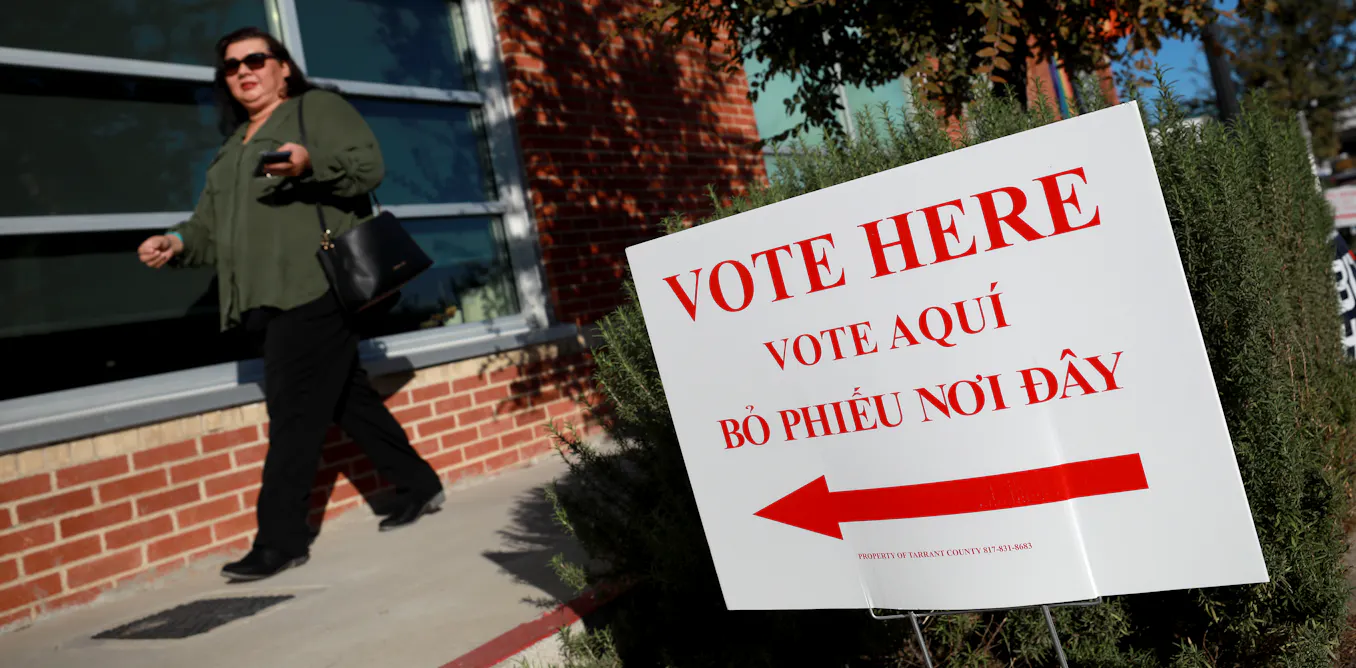
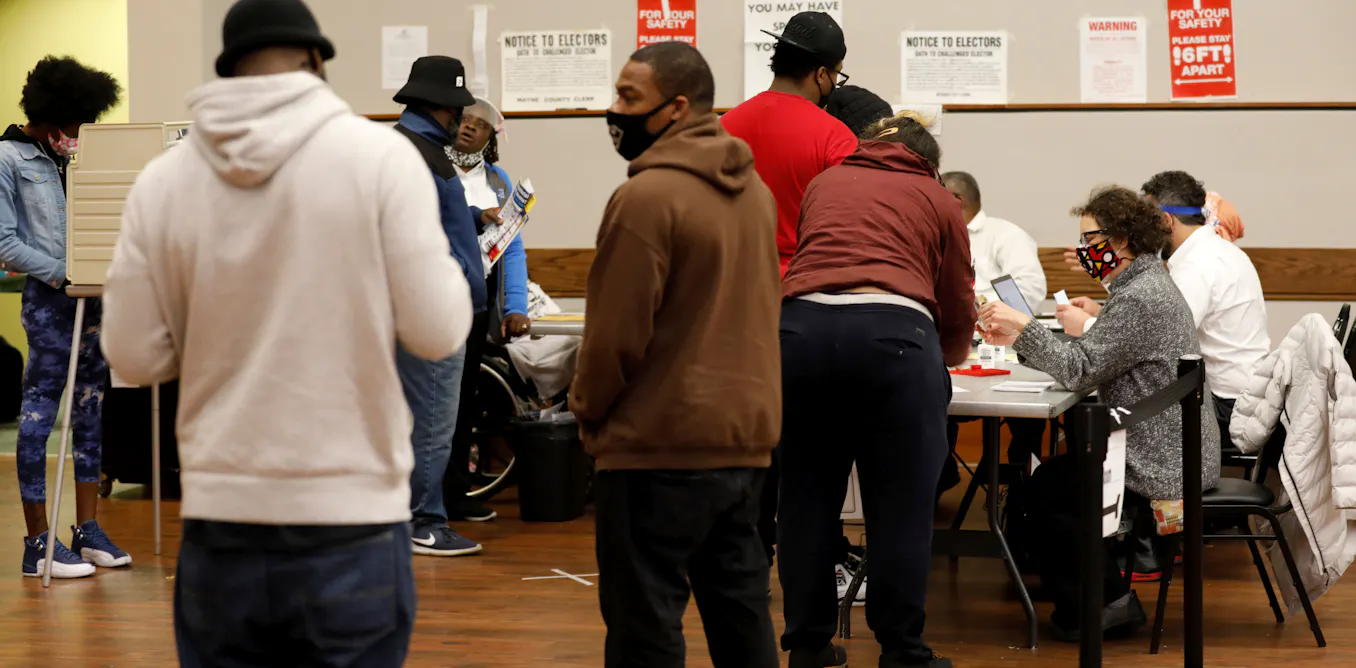

States across the U.S. are drawing new electoral districts for the next decade in a process called redistricting. In some states, districts are drawn by the state legislature; in others, by an independent redistricting commission.
By federal law, congressional districts must be of equal population and must protect minority representation under the Voting Rights Act by guaranteeing that minority voters have an equal opportunity to elect their preferred candidates.
In many states, elections must also be “fair” to political parties or candidates as dictated by explicit provisions on partisan fairness, or implicitly under “free and equal” clauses in state law.
We are two scholars who study redistricting and electoral competition. To understand whether different redistricting institutions deliver fairer or less fair results, we compared the very different paths taken in three competitive states of similar size: North Carolina, Michigan and Virginia.
In North Carolina, as in most states, the state Legislature draws the electoral district maps.
This was the case in Michigan and Virginia as well, until Michiganders in 2018 and Virginians in 2020 voted to amend their constitutions to assign the task of drawing electoral districts to redistricting commissions.
Advocates for those commissions hoped that by being separate from the legislatures, commissions will deliver fairer maps of new voting districts.
We found that while it is possible for commissions to develop fairer results, it is not a given – and it depends at least in part on how the commission is structured.

Stephen Zenner/AFP/Getty Images
What’s a fair map, anyway?
Over the years, various courts and legislatures have sought to define fairness in various ways beyond just equal population across districts.
Mathematical analyses are often key to evaluating a proposed map’s fairness. In 2018, the Pennsylvania Supreme Court issued what is probably the clearest legal standard of mathematical fairness. It requires first identifying a hypothetical electoral map or maps that are politically neutral – and therefore fair and nonpartisan – and then comparing any redistricting plans to such fair maps.
One way to find a hypothetical neutral map is to go back to the origins of American democracy and to look at the original 1776 Pennsylvania Constitution, in which each county, plus the city of Philadelphia, was its own electoral district. Each of these districts received seats in proportion to its population at the time. County lines have long been fixed and were drawn without consideration to today’s partisan interests.
Using this historical precedent as a hypothetical neutral benchmark, one can evaluate the fairness of any proposed redistricting map in two steps:
First, look at precinct-level voting results from a recent election. Add up the votes for each party by county, and find out which party won the most votes in each county. Then, for each party, add up the total population in all the counties in which the party won the most votes. The share of this population over the total population in the state is the neutral benchmark share of seats that the party would have won with these election results, if we had counted votes and had declared winners by county.
Second, look at the same recent election’s precinct-level results, but add up the votes for each party according to the proposed new districts to see how many of these districts the party would win.
Compare the share of new districts a party would win with the neutral benchmark share if we counted by county. The closer the proposed map’s results are to the by-county method, the fairer the proposed map. We use this method to evaluate each state’s map proposals.
North Carolina’s partisan process
In 2020, Joe Biden won the presidential election in 25 of North Carolina’s 100 counties, which contain just over 50% of the state’s population. Donald Trump won the other 75 counties, home to just under half of North Carolinians.
So a neutral congressional redistricting map would deliver just over half of the seats to Democrats, and just under half to Republicans. North Carolina has 14 seats, so with adjustments for rounding, each party should win seven seats under a fair map.
The Republican-dominated state Legislature’s official map was approved by lawmakers on Nov. 4. Looking at the 2020 presidential election results according to that map would have Biden winning in four districts and Republicans winning in 10.
Conducting the same analysis using the results of other recent elections, including the 2016 presidential, gubernatorial and U.S. Senate races, also finds that a neutral map is split evenly, seven and seven – and North Carolina’s proposed map delivers a 10-4 Republican majority.
Virginia’s partisan deadlock
The Virginia Redistricting Commission is bipartisan and political: Democratic and Republican state legislative leaders appoint elected officials for half of the commission seats, and they nominate citizens for the other half, so the commission has eight Democrats and eight Republicans, with half of each pool being professional politicians.
This commission split along partisan lines, and because of disagreements, it was unable to produce any maps. In accordance with the state Constitution, the Virginia Supreme Court took over and will appoint a special official, or several of them, to draw new electoral districts that will, we can hope, be fair.
In Michigan, true independence delivers fairness
The Independent Citizen Redistricting Commission in Michigan is composed of 13 volunteer regular citizens – not politicians – including four who identify as Republican, four as Democratic and five who do not identify with either of the two parties.
The commission released four draft plans back in October and held public hearings to receive comments. The commission then revised its work and on Nov. 15 released three proposed maps, named Apple V2, Birch V2 and Chestnut after trees native to the state. Following a further round of public hearings, the commission will hold a final vote to adopt one of these maps as the official map for congressional elections in Michigan for the next decade.
[Understand key political developments, each week. Subscribe to The Conversation’s politics newsletter.]
Our analysis finds that, in general, all three of these maps are fair. Based on recent past election results in Michigan’s 83 counties, we find that Democratic candidates would win the most votes in 11 counties with 55% of the population, and Republicans would win the most in 72 counties with the remaining 45% of the population. Dividing the state’s 13 congressional seats proportionally would deliver 6.6 seats to Democrats and 6.4 to Republicans.
Of course, actual seats don’t come in fractions. In whole numbers, a neutral real outcome would deliver six Democrats and six Republicans, with the 13th seat a little more likely to be won by a Democrat than by a Republican.
Under Apple V2 and Birch V2, 6.6 seats would be won by Democrats, and under Chestnut, 6.8 would.
In sharp contrast to the partisan maps adopted by legislators in North Carolina, and the failure of Virginia’s politicized commission, we find that in Michigan, an independent commission of citizens has drawn fair congressional maps.