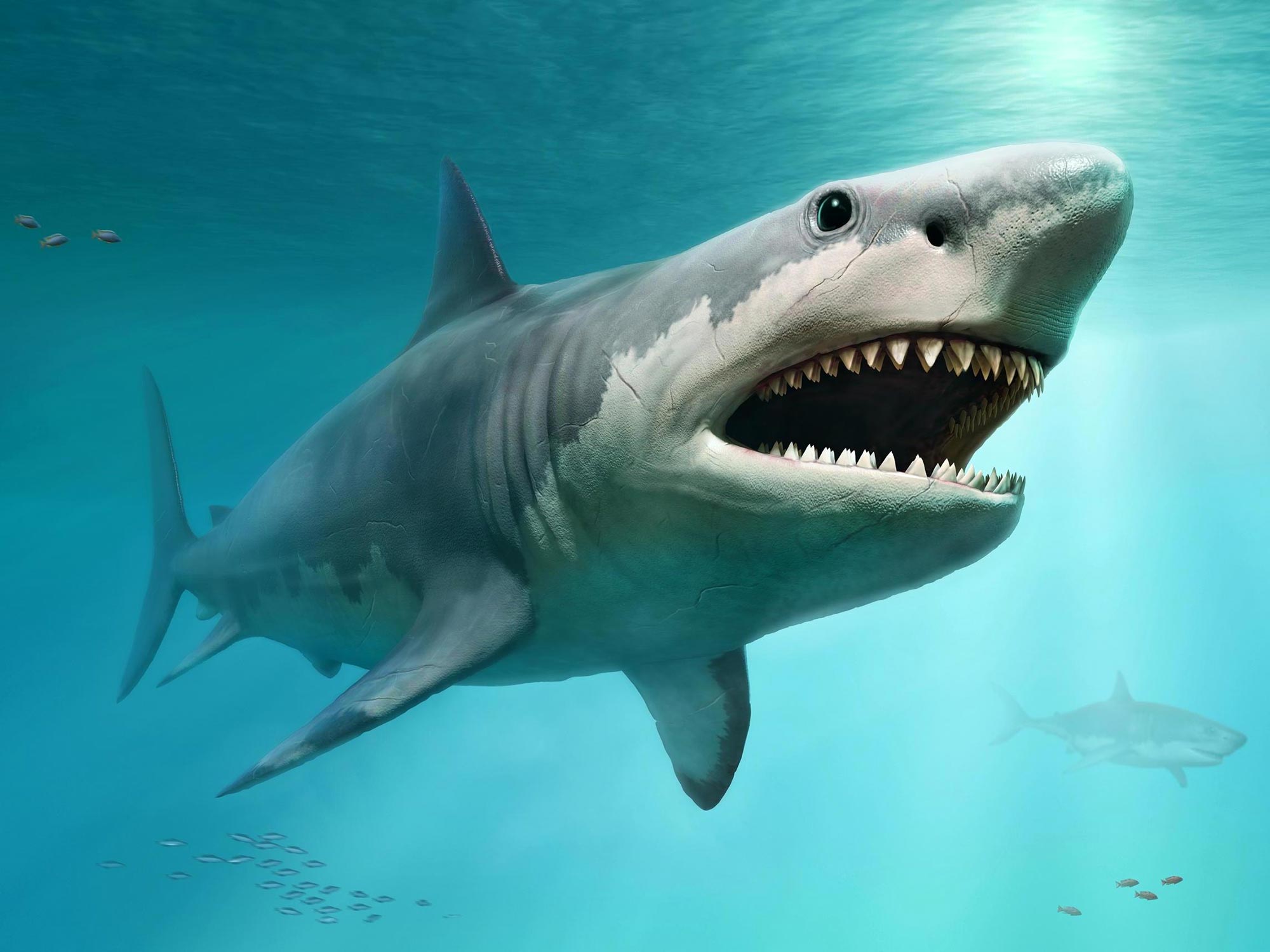

Researchers analyzed zinc isotopes in teeth and discovered that great white sharks make have contributed to the extinction of megalodon.
Scientists investigated the diet of megalodon, the largest shark to have ever lived, using zinc isotopes.
In a new study, researchers compared how high up the food chain megalodon and great white sharks feed, by analyzing the zinc stable isotope ratios in their teeth. They found that there was likely overlap in the prey of both species, and therefore, dietary competition with great white sharks may have contributed to the extinction of megalodon.
Megatooth sharks like, Otodus megalodon, more commonly known as megalodon, lived between 23 and 3.6 million years ago in oceans around the globe and possibly reached as large as 20 meters (66 feet) in length. For comparison, the largest great white sharks today reach a total length of only six meters (20 feet). Many factors have been discussed to explain the gigantism and extinction of megalodon, with its diet and dietary competition often being thought of as key factors.
In this study, researchers analyzed zinc stable isotope ratios in modern and fossil shark teeth from around the globe, including teeth of megalodon and modern and fossil great white sharks. This new method allows scientists to investigate an animal’s trophic level, which indicates how far up the food chain an animal feeds. Zinc stable isotope analysis of tooth enameloid, the highly mineralized part of teeth, is comparable to much more established nitrogen isotope analysis of tooth collagen, the organic tissue in tooth dentine, which is used to assess the degree of animal matter consumption.
However, “on the timescales we investigate, collagen is not preserved, and traditional nitrogen isotope analysis is therefore not possible,” explains lead author Jeremy McCormack, a researcher at the Max Planck Institute for Evolutionary Anthropology and the Goethe-University Frankfurt. “Here, we demonstrate, for the first time, that diet-related zinc isotope signatures are preserved in the highly mineralized enameloid crown of fossil shark teeth,” adds Thomas Tütken, professor at the Johannes Gutenberg University’s Institute of Geosciences.

Tooth size comparison between extinct Early Pliocene Otodus megalodon tooth and a modern great white shark. Credit: © MPI for Evolutionary Anthropology
Comparison of zinc isotope signals in fossil and modern sharks
Using this new method, the team compared the tooth zinc isotope signature of multiple extinct Early Miocene (20.4 to 16.0 million years ago) and Early Pliocene (5.3 to 3.6 million years ago) species with those of modern sharks. “We noticed a coherence of zinc isotope signals in fossil and modern analog taxa, which boosts our confidence in the method and suggests that there may be minimal differences in zinc isotope values at the base of marine food webs, a confounding factor for nitrogen isotope studies,” explains Sora Kim, a professor from the University of California Merced.
Subsequently, the researchers analyzed the zinc isotope ratios in megalodon teeth from the Early Pliocene and those in earlier megatooth sharks, Otodus chubutensis, from the Early Miocene as well as contemporaneous and modern great white sharks to investigate the impact these iconic species had on past ecosystems and each other. “Our results show, that both megalodon and its ancestor were indeed apex predators, feeding high up their respective food chains,” says Michael Griffiths, professor at the William Paterson University. “But what was truly remarkable is that zinc isotope values from Early Pliocene shark teeth from North Carolina, suggest largely overlapping trophic levels of early great white sharks with the much larger megalodon.”

Lead author Jeremy McCormack isolating zinc from shark tooth samples by column chromatography in metal-free clean laboratory. Credit: © MPI for Evolutionary Anthropology
Dietary competition of megalodon with great white sharks
“These results likely imply at least some overlap in prey hunted by both shark species,” notes Kenshu Shimada, professor at DePaul University, Chicago. “While additional research is needed, our results appear to support the possibility for dietary competition of megalodon with Early Pliocene great white sharks.”
New isotope methods such as zinc provide a unique window into the past. “Our research illustrates the feasibility of using zinc isotopes to investigate the diet and trophic ecology of extinct animals over millions of years, a method that can also be applied to other groups of fossil animals including our own ancestors,” concludes McCormack.
Reference: “Trophic position of Otodus megalodon and great white sharks through time revealed by zinc isotopes” 31 May 2022, Nature Communications.
DOI: 10.1038/s41467-022-30528-9