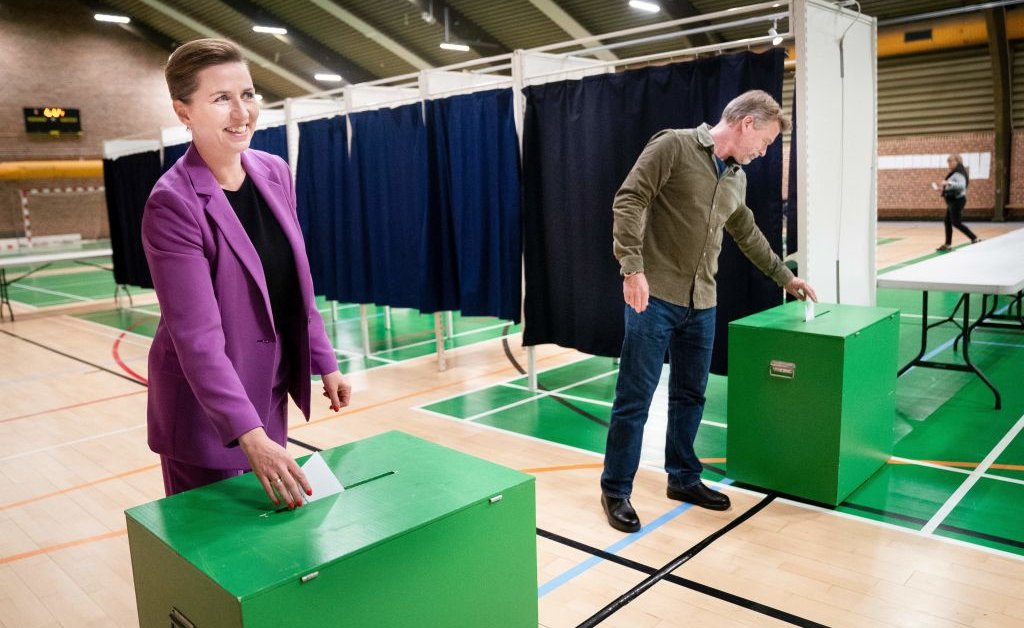

Denmark on Wednesday voted to overturn its opt-out of the E.U.’s common defense policy, reversing three decades of Euroskepticism regarding security matters. The move is the latest sign of the West coalescing in response to Russia’s invasion of Ukraine.
Some 66.9% of voters cast referendum ballots in favor of abandoning the opt-out—first negotiated in 1992—meaning Danish officials can now participate in E.U. defense discussions and the country’s armed forces can deploy on E.U. military operations.
“We now have an even stronger foundation for close Nordic security cooperation in #EU & NATO,” tweeted Danish Foreign Minister Jeppe Kofod in response to the result.
Although Denmark has been an E.U. member since 1973, the nation of 5.8 million has been one of the most hesitant participants. The country has opted out of the euro single currency and common bloc policies on justice and home affairs—as well as, until now, defense—that Danes believed would undermine their sovereignty.
Read More: ‘Victory Is Important on All Fronts.’ Inside the Ukraine Soccer Team’s Bid to Reach the 2022 World Cup
But Russian President Vladimir Putin’s aggression has spurred a rethink. Danish Prime Minister Mette Frederiksen called the referendum just two weeks after Russia’s Feb. 24 full-scale invasion of Ukraine—and despite her Euroskeptic government previously supporting the opt-out and deeming it a significant part of Danish identity.
In the end, 11 of Denmark’s 14 parties—representing more than three-quarters of parliament—urged voters to say “yes” to reverse the opt-out.
“Unfortunately we are looking forward to a time that will be even more unstable than what we experience now,” Danish Prime Minister Mette Frederiksen told reporters after casting her ballot. “I believe it is the right thing for Europe, I believe it is the right thing for Denmark, believe it is the right thing for our future.”
The move comes as Nordic neighbors Finland and Sweden have applied to join NATO, abandoning 75 and 200 years of military neutrality, respectively. Denmark, by contrast, was a founding member of NATO and has long adopted a hawkish military posture, frequently engaging in joint military drills and joining the U.S.-led wars in Afghanistan and Iraq. In this sense, Wednesday’s referendum is closer to correcting an aberration than the momentous U-turns of Finland and Sweden.
Read More: Ukraine Is in Worse Shape than You Think
“Sweden and Finland applying to join NATO is a move of a different magnitude,” says Christine Nissen, a researcher with the Danish Institute for International Studies. “Though the [Denmark referendum] is part of the same story of greater European unity.”
The symbolism is important but there are substantive elements as well. For one, Denmark can now participate in PESCO, or Permanent Structured Cooperation, an enhanced E.U. security framework established in 2017 to enable member states to develop defense capabilities, collaborate on shared projects (including weapons systems), and boost the operational readiness and potency of their armed forces. Still, there’s no obligation for Denmark or any member state to partake in E.U. military operations under the common defense policy.
Denmark has already been a significant contributor to Ukraine’s defense through NATO, even sending heavy weapons such as Harpoon anti-ship missiles. The missiles use active radar homing and fly just above the water to evade defenses—and many consider these weapons offensive rather than strictly defensive. “Basically, everything that can move within the Danish armed forces is deployed as part of the NATO response to bolster the defense on the eastern flank,” says Kristian Soby Kristensen, deputy head of the Centre for Military Studies at the University of Copenhagen.
Read More: Inside Zelensky’s World
Much of the debate around the referendum concerned whether closer alignment with the E.U. on defense might come at the expense of cherished military ties to the U.S., U.K., and NATO. “NATO is the guarantor of Denmark’s security,” Morten Messerschmitt, head of the right-wing Danish People’s Party, who was against dropping the opt-out, argued during a televised debate Sunday “[Denmark’s defensive posture] would be totally different if it were decided in Brussels.”
However, Finland and Sweden’s decision to apply to join NATO reflect the fact that the two blocs are increasingly aligned. Another spur for Denmark to fall in with the E.U. on security was the decision by Germany—Denmark’s closest ally other than the U.S.—to increase its defense spending to 2% of GDP. “Now that Germany is likely to play a much larger role in European security, the perspective is that it will also materialize into a stronger role for the E.U.” says Nissen. “And so, there’s a wish to be a part of that.”
Separate to the referendum, Denmark in March agreed to increase its defense budget to 2% of GDP by 2033.
Of course, removing the opt-out drives a deeper wedge between Copenhagen and Moscow, and risks antagonizing Putin, though that appears of little consequence to either Denmark’s government or people. “It’s gone beyond that—opposition to Russia is strong and heartfelt,” says Kristensen. “The fact that a large country can use its military force to blatantly attack another country goes against everything that Danish foreign and security policy has been built upon for the last 70 years.”
More Must-Read Stories From TIME