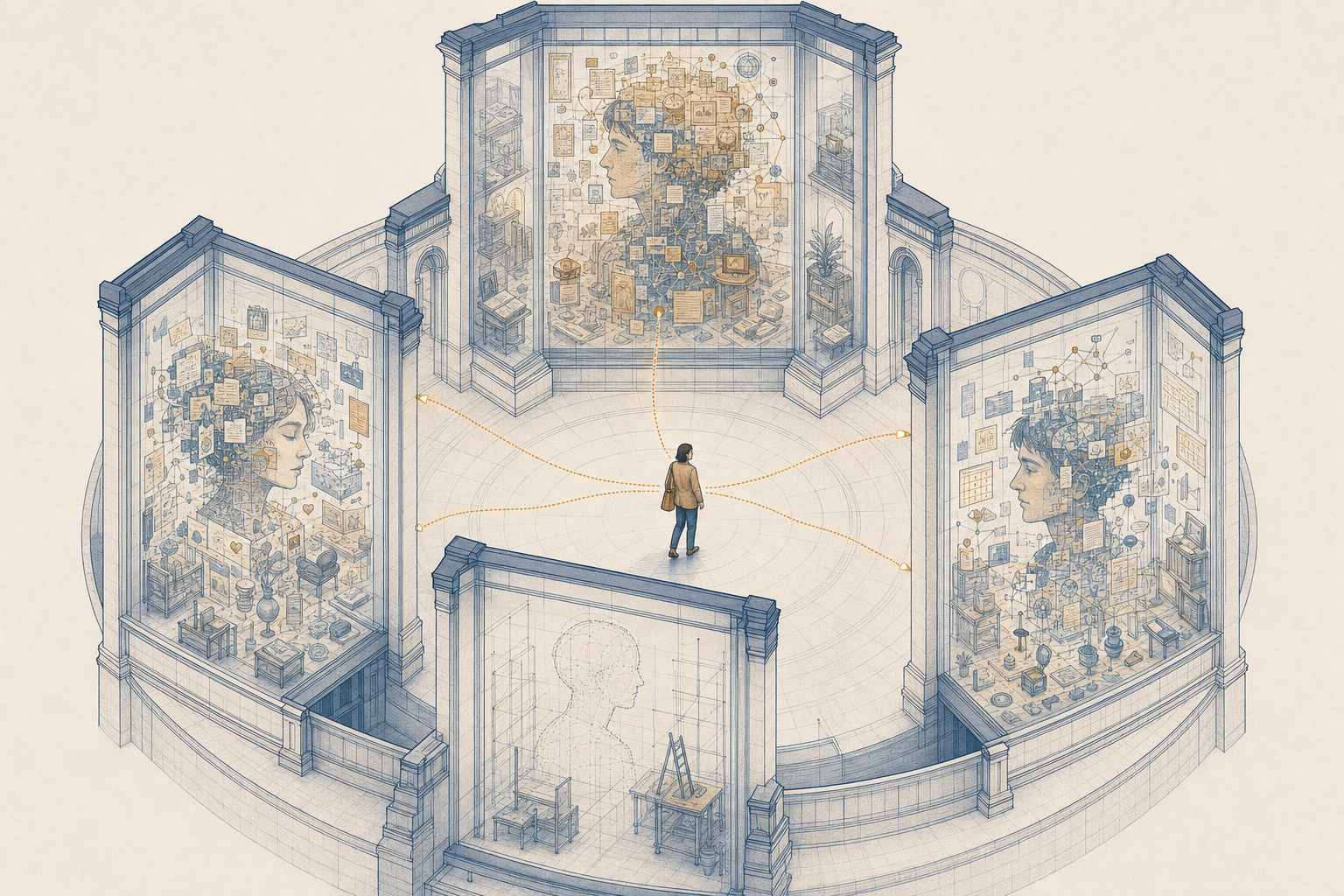

Every agent I use is building a model of me. Claude has learned how I like my prose. ChatGPT remembers what I’m working on. I don’t mind this—every person I have a relationship with carries a model of me in their head, and every company I do business with keeps a profile. Other people’s understandings of me have never been mine to control, after all.
But an agent occupies a different role. It learns my writing style, my preferences, and the shape of my work and life, all to help me with what I do. Yet if I switch products, I have to start over. If I use three agents, each rebuilds from scratch what the others already know. Everything an agent learns lives with its vendor.
It doesn’t need to be this way. What if every person had a canonical, user-controlled repository of context that any agent could request permission to use? What if my context lived not only with the company providing the agent but also in a home under my control? And what if an observation captured by one agent could be proposed to that repository and, once accepted, made available to every other agent I choose?
By user-controlled, I don’t necessarily mean self-hosted. I mean that I can inspect what the repository contains, decide who can read or change it, understand where each piece came from, and export the whole thing in a form I can take elsewhere. Its storage, identity, and synchronization may all be provided by someone else. Control does not require me to operate the infrastructure; it requires that no agent or platform be the only way in—or the only way out.
The repository wouldn’t be a portable copy of any agent’s internal model of me. It would be a legible record of things I have written, facts and preferences I have chosen to keep, as well as observations that agents have proposed and I have accepted, each with its provenance, scope, and history. Agents could consult or add to that record according to their permissions; their private inferences would remain their own.
The dream is not a new one. Tim Berners-Lee’s Solid project has argued for years that personal data should live in pods that people control, and Doc Searls’s VRM project has been making the case for user-driven relationships with vendors for decades. What those efforts never had was mainstream demand. Agents are supplying it: An assistant needs rich personal context to be useful, and each vendor is building that context inside its own walls. Ordinary people now have a reason to want a personal data store, even if nobody will actually call it that.
The hard problem in all this isn’t syncing or storing data. It’s negotiation. Who can read a given part of my context? Who can add to it, change it, or remove it? Which parts of my life can a particular instance of an agent see? How do I make those decisions in a policy-driven way? And how do I manage them from wherever I happen to be?
But before I could work on negotiation, I had to figure out where my context should live. That’s the question I’ve spent the past year on, and I’ve tried three answers.
First answer: The laptop
Immediately after getting access to Claude Code at the start of 2025, I pointed it at an Obsidian vault—a folder full of Markdown files that can be used as a personal wiki. This wasn’t a particularly novel idea. Many of the geeks I know did the same, and the pattern has since spread in many forms. The best-known recent example is probably Karpathy’s LLM Wiki, elegant not just as a design but as a document: You give the description to your agent, and the agent builds a version tailored to you.
A year of using a pile of Markdown text files with agents has taught me five things about what a personal context system has to get right.
Local-first foundations matter. Text files are remarkably legible, portable, and easy to store somewhere I control. Git moves them between computers and remembers every change. But the result is centered on a laptop or desktop and assumes a user comfortable with plain text and version control. Most annoyingly, my context in this form isn’t readily available on my phone, which is the computer that goes with me everywhere. Nor can agents running anywhere other than my laptop reach it.
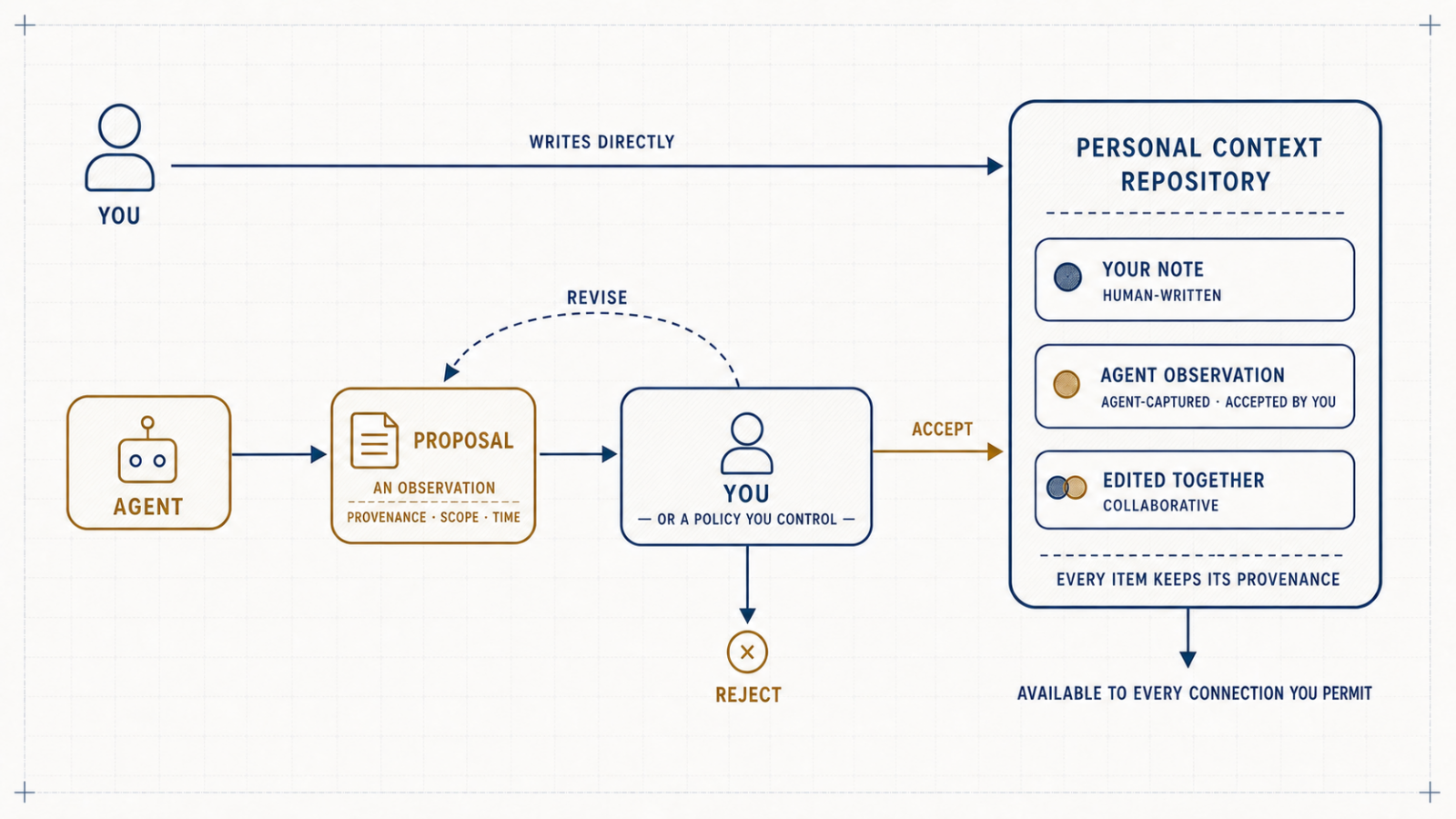
Provenance matters, and so do proposals. Karpathy’s Wiki is almost entirely written (and rewritten) by the LLM. In my own system, I write most things myself and lean on agents to help me edit as well as contribute their observations. I want to know which thoughts are mine, which were captured by an agent, and which we arrived at together. That means an agent’s observation should not automatically enter the repository on the same footing as something I wrote. The default should be a proposal that I—or a policy I control—can accept, revise, or reject. Direct write access is something a trusted agent should earn.
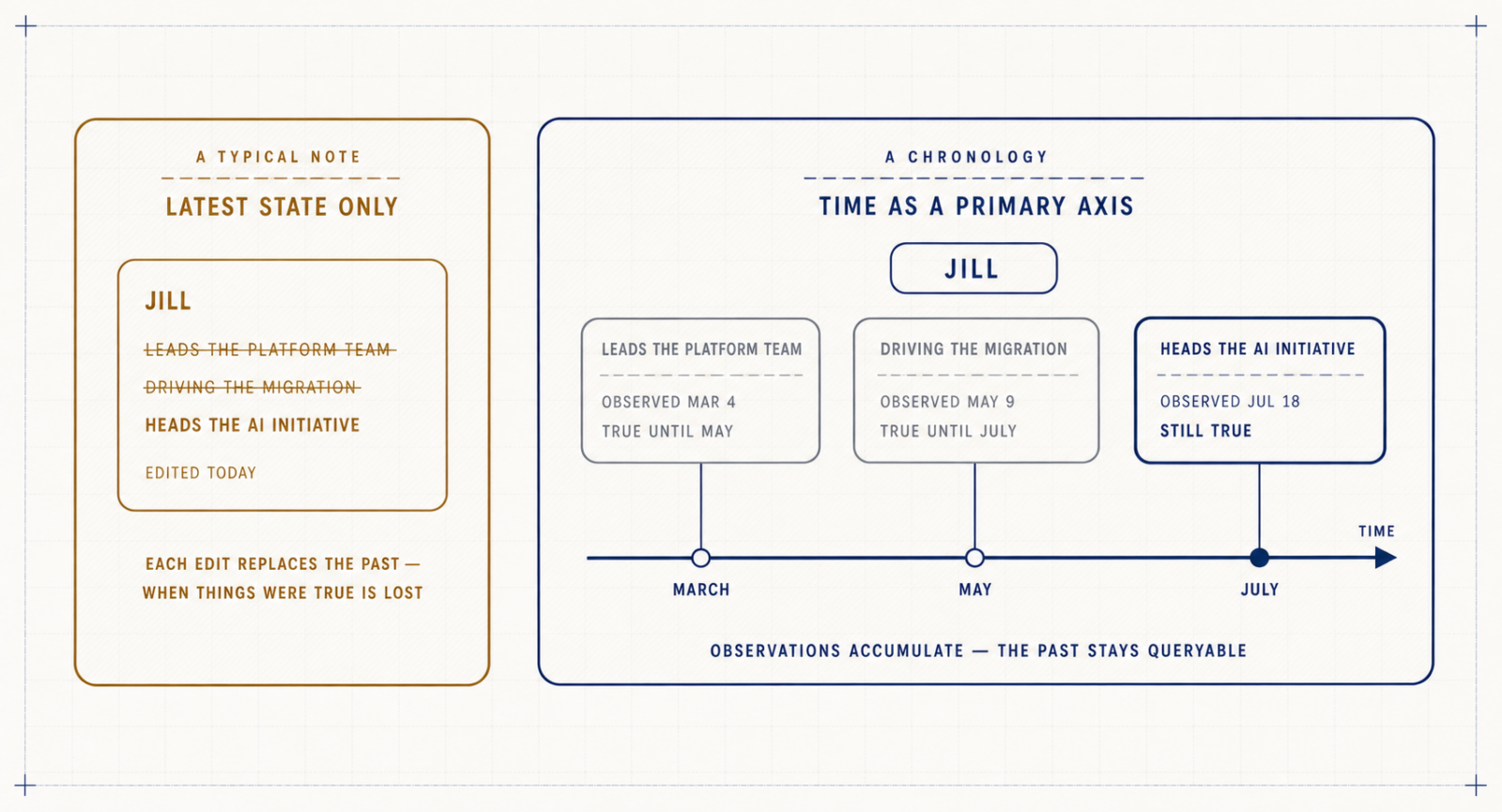
Chronology matters. Wiki links aren’t the only structure in a life. Most of what I record—and much of what agents observe—is anchored in time. Thoughts build on thoughts. Observations about people accumulate meeting by meeting. Some facts fade as they age. Time should be a primary axis of the system, not something reconstructed afterward from file histories and metadata.
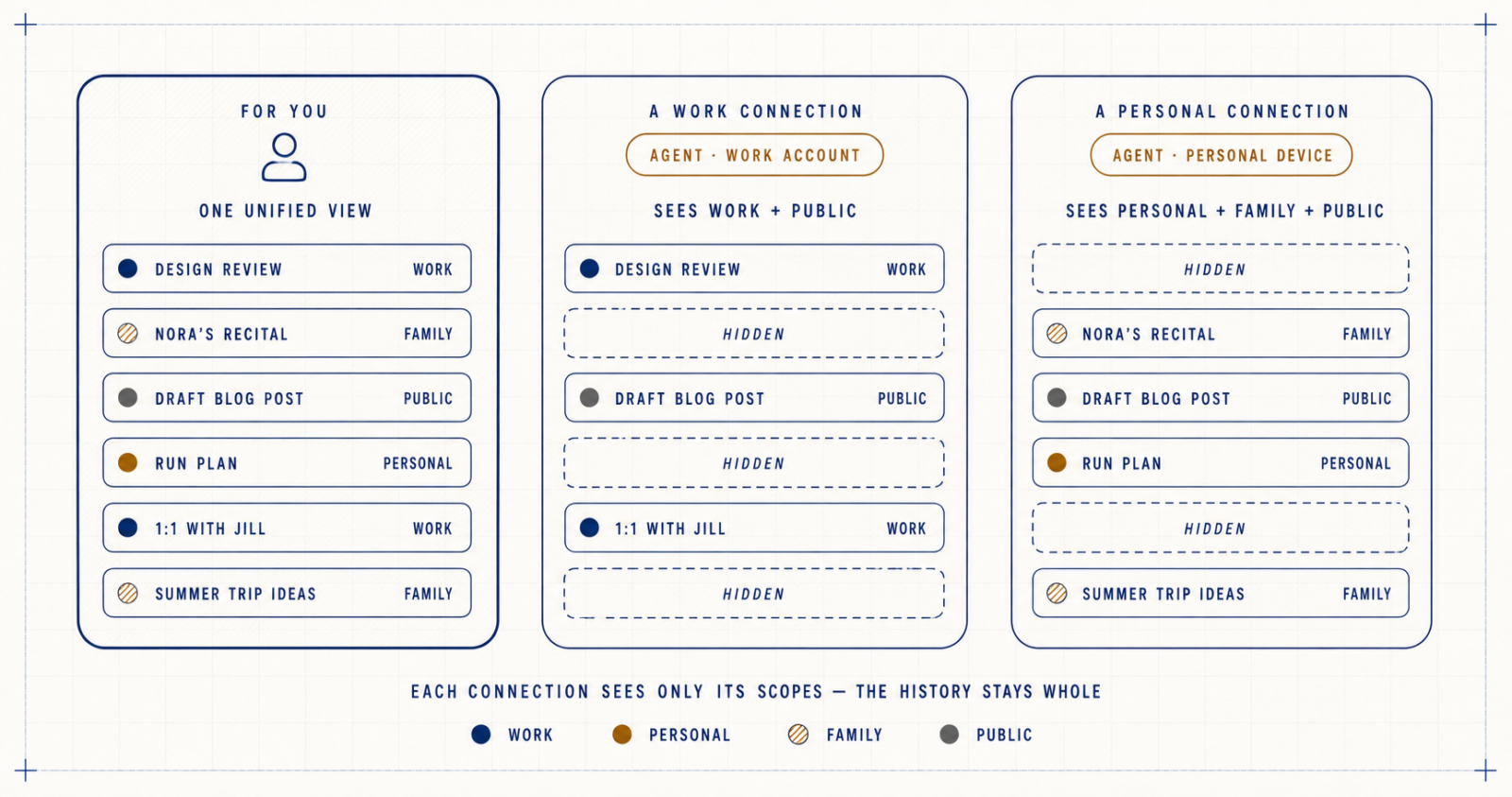
Scopes matter. My context spans work, personal, family, and public life. I want one unified view; no agent should have one. An agent connected through my work account should see work and public context—and nothing about my family. Fully separate silos would protect those boundaries, but they would also shred the single history I want to keep building for decades.
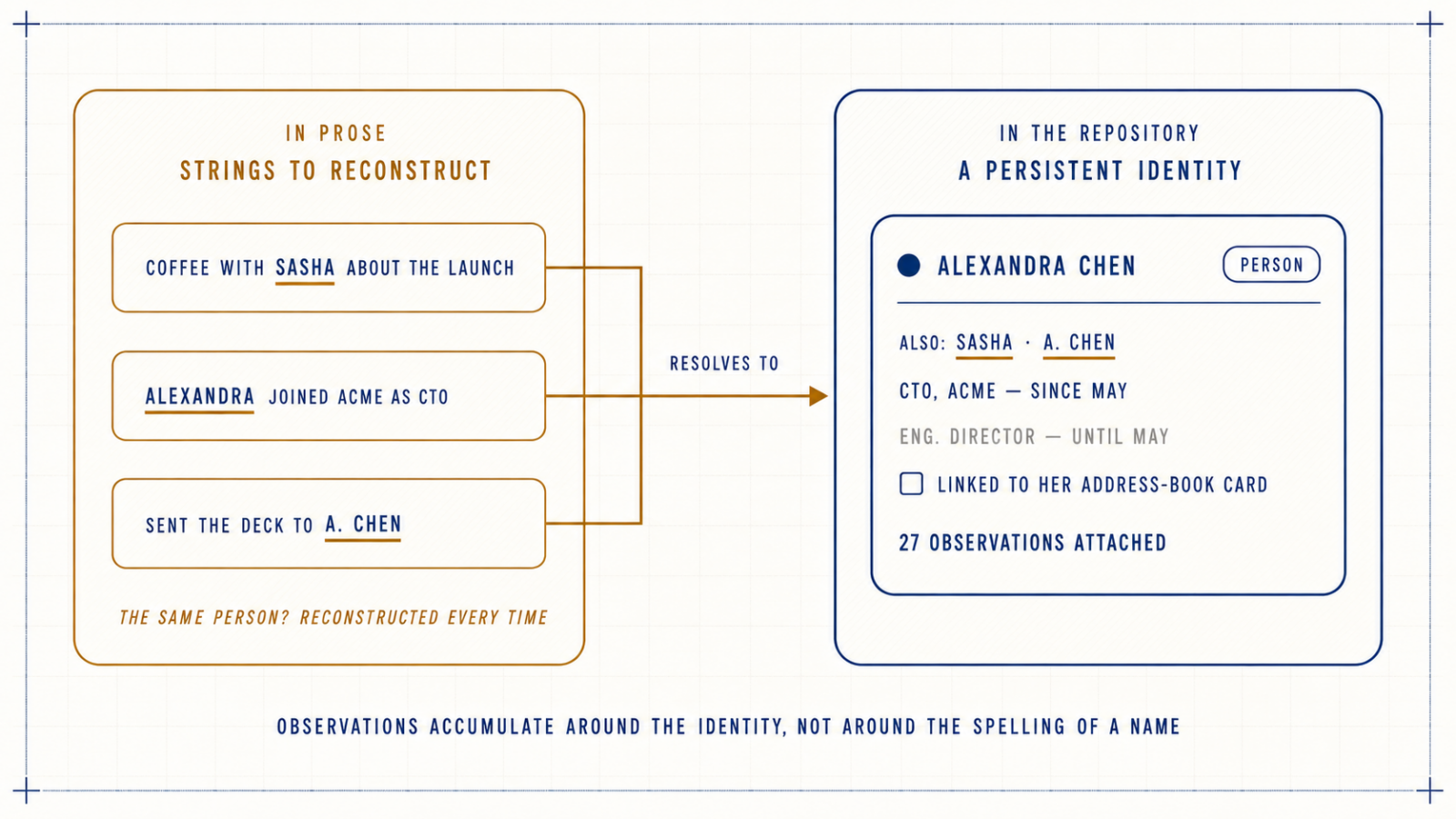
Identity and type matter. LLMs can extract all sorts of meaning from plain text, but some things, such as people, companies, and places, deserve to be typed records rather than mentions in prose. A persistent identity gives observations, relationships, and history an anchor to accumulate around; it can help resolve nicknames and follow changes in roles and titles. An agent can then act on who someone is without reconstructing them from prose every time.
As I learned these lessons, I added tooling and conventions to my personal context repository. It’s surprising how far you can push a directory of Markdown files. Each new affordance, however, turned my simple folder into a more specialized system, and the result only works for geeks like me. It doesn’t work for my family, however. They use agents every day but they are never going to deal with a pile of Markdown files in a Git repo. They want their personal context to be with them, easy to use, and transparent to the rest of their life.
More to the point, the five lessons above describe what a context system must do. They don’t answer where it should live if /home/$USER isn’t the center of your computing life.
Second answer: The web
My next move was to sort out how to make my context available when I wasn’t at my laptop—to me and, just as importantly, to my agents. The obvious next step was reflexive for me as someone who has been building on the web since the mid-1990s: put it on a server behind a URL. I deployed a Cloudflare Worker, uploaded my context, and stood up both a REST API and an MCP server. The improvement was immediate. My context was reachable from my phone and grantable to any agent I chose.
New problems arrived just as fast. I had created a new trust boundary with its own access control mechanism and appointed myself its security team. I was now the operator of a small SaaS with exactly one customer, responsible for its uptime and its backups. And I had traded away local-first, offline editing to get there.
These are solvable problems. Our industry has spent two decades learning to host services, and CRDTs could probably win back offline editing. But as agents gain access to more sensitive data and more power to act on our behalf, the price of getting a boundary wrong keeps rising.
And even with those solved, a deeper problem remains: A stand-alone service sits outside my computing home, apart from the contacts, calendars, messages, files, and system-level agents already inside it. Apple’s Siri AI announcements made that separation vivid, and Gemini’s integration into Google’s ecosystem points the same way. An agent embedded in an ecosystem works with everything inside its trust boundary; my worker would have to rebuild every one of those connections from outside.
Third answer: My pocket
As I tinkered, I kept returning to a simple mental image: my context living on the device in my pocket that goes with me everywhere. Not literally every byte, of course, but within the personal computing ecosystem that phone is the center of—the one that already establishes my identity, synchronizes my devices, stores much of my personal data, and mediates what applications can access. In this sense, a home is not a physical location. It is a trust boundary.
Living inside the boundary doesn’t mean that every application inside gets my context, or that agents outside are shut out. The boundary supplies identity, secure storage, synchronization, and native integration; the context layer still decides what each connection may read, propose, change, or delete. Native agents participate through the platform’s own capabilities, while agents from other companies connect through explicit, revocable permissions.
For me, that home in my pocket is Apple’s ecosystem, with iCloud at its center. For you, it may be Google or Microsoft. The point is not that any one ecosystem is the right home for everyone. It is that most people already have a primary digital home, and that home is the most practical default for their personal context. We shouldn’t need to create a separate service with its own identity. Instead, agents should have a common, permissioned interface to the context where it already lives.
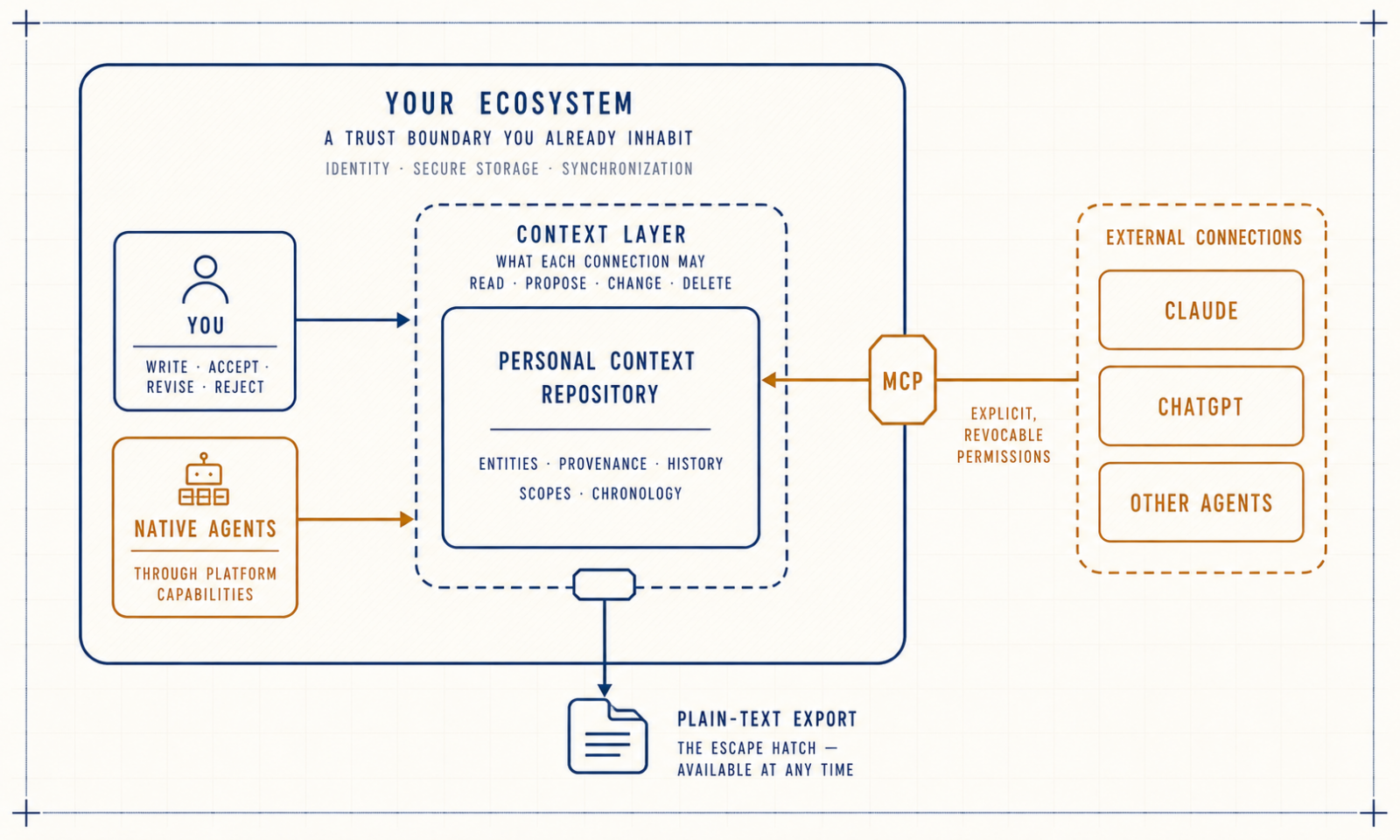
There’s an obvious risk here. A home rooted in a vendor’s ecosystem invites lock-in. The mitigation is straightforward: The whole repository—entities, provenance, and history included—must be exportable at any time as a directory of plain text files that can be taken anywhere. A pile of files in a folder may not be the right solution for live context, but it makes a perfect escape hatch.
I’ve started testing this thesis in a SwiftUI app, and my early prototypes suggest that the architecture is workable: iCloud handles synchronization, and I can expose selected context to authenticated agents through MCP. It’s also shown that working in the Apple developer ecosystem is more annoying than deploying a web app. The remaining work is clear, however. Choosing a home for context is one problem; negotiation—permissions that remain understandable as a repository grows, proposals from multiple agents reviewed and reconciled—is another. That is the hard problem I mentioned before, and it deserves its own deep dive.
The remaining work is clear, however. Choosing a home for context is one problem; negotiation—permissions that remain understandable as a repository grows, proposals from multiple agents reviewed and reconciled—is another. That is the hard problem I mentioned before, and it deserves its own deep dive.
One pattern, many homes
Others are converging on this pattern from different directions. The note-taking app Bear, which stores its notes locally on Apple devices and synchronizes them through iCloud, now exposes them to local agents through MCP; its latest release lets users include or exclude notes by tag when granting access, offering a practical approach to scopes. Craft’s MCP connections likewise let users choose which documents or spaces an agent can access and whether it can read or write them. Reflect has embarked on an open source client using Markdown files that will have an iOS companion app.
These are just a few examples, and there are a lot more out there. What I haven’t yet seen emerge however is the attribution and provenance of items that an agent contributes or edits that I think a durable personal context requires.
Zooming out, here are the principles I think are needed in any system like this, wherever it makes its home:
- Context shouldn’t be captive to any particular agent. A person should be able to change or combine agents without ever starting over.
- Context should be reachable by local and remote agents alike, with appropriate authentication and authorization.
- Permissions should be scoped and revocable. Access should be granted to a specific connection with an agent, limited to a defined subset of the context, and should distinguish between reading, proposing, changing, and deleting.
- Provenance should persist. Every item records where it came from, who or what created it, and how it has changed. The distinction between human-written, agent-captured, and collaborative work should outlive the conversation that produced it.
- Time should be part of the context. The system should preserve when something was observed, when it was true, and how it changed, rather than continually overwriting the past with the present. Database folks will recognize this as bitemporality: the distinction between transaction time and valid time.
- Entities should be first-class. People, companies, places, and other recurring concepts should remain recognizable as names, roles, and relationships change.
- Interoperability should not require uniformity. Different people and companies should be able to build different context systems for different ecosystems and trust boundaries. What they need is agreement on identity, permissions, provenance, and exchange, not one universal application. For the exchange, plain text files with structured metadata are a strong candidate.
Using these principles, personal context can be something a person owns: You can inspect it, grant and revoke access to it, trace where each piece came from, and take the whole of it elsewhere. Every agent may still develop its own understanding of you, but you’ll be able to bring a durable context of your own to the relationship, one that participates in the agentic ecosystem without being subordinate to any vendor in it.
Karpathy’s LLM Wiki is a description, not a tool; it’s meant to be implemented by anyone, in whatever form fits. This essay is offered in the same spirit. The important part isn’t whether the app I’m tinkering with ever ships beyond my own devices. I’m more interested in the dialogue it will take for everyone to have personal context that works for them, in their ecosystem and with the agents they want to use. If we get the pattern right, changing agents won’t mean changing homes. The context they help us build will remain ours.