

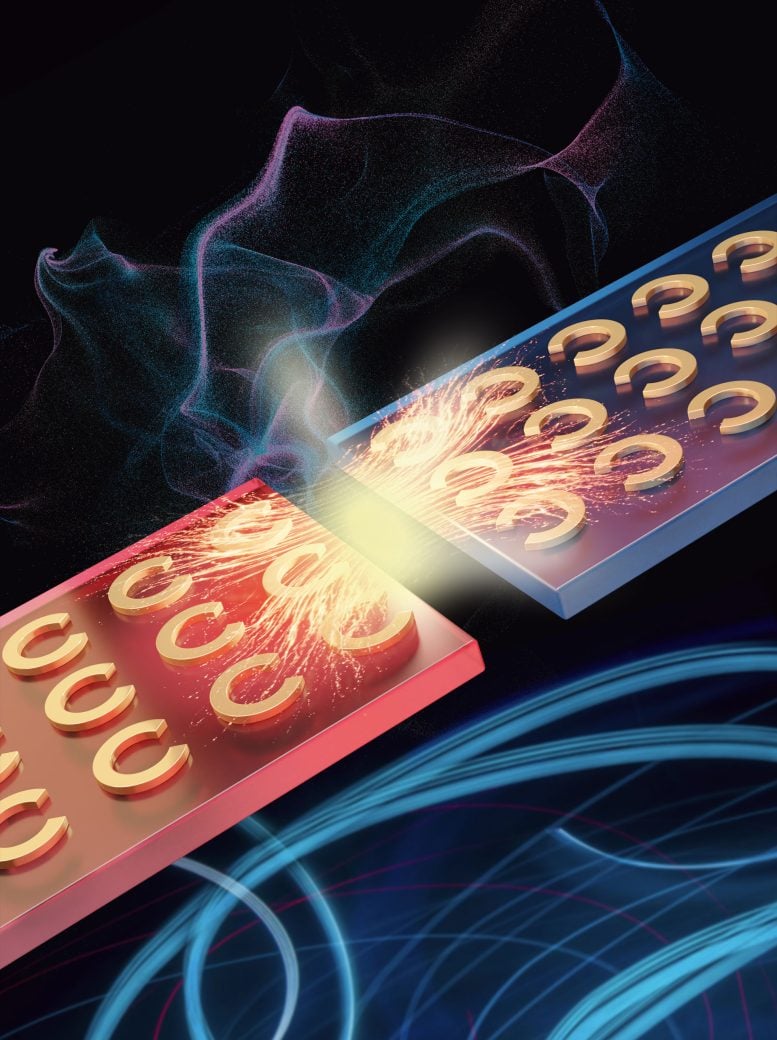
Scientists have demonstrated a new way to dramatically enhance heat transfer across nanoscale gaps using engineered metamaterials.
Heat can cross a tiny vacuum gap far more efficiently than ordinary thermal radiation would suggest. Researchers have now shown that carefully patterned metamaterials can amplify this nanoscale energy flow by as much as four times, offering experimental evidence that heat transfer can be engineered rather than simply managed.
The study, published in Nature by researchers at Carnegie Mellon University, Stanford University, and Purdue University, focuses on near-field radiative heat transfer. This effect appears when two objects are separated by only a few hundred nanometers, allowing electromagnetic interactions that are negligible at larger distances to dominate the exchange of thermal energy.
When Heat Crosses a Nanoscale Gap
At everyday distances, objects primarily exchange heat through familiar processes such as conduction, convection, and thermal radiation. But when surfaces move extremely close together, electromagnetic fields associated with one surface can interact directly with the other. Energy can then cross the gap through near-field effects, producing heat transfer rates that greatly exceed what conventional far-field radiation would allow.
Scientists have studied this phenomenon for years, but the new work demonstrates experimentally that artificial structures can strengthen it even further. The researchers patterned microscopic gold structures onto thin membranes, then positioned two patterned surfaces face to face across a nanoscale gap.
“Unlike conventional materials, metamaterials are built with tiny, repeating patterns that interact with energy in precise ways,” said Sheng Shen, a professor of mechanical engineering at Carnegie Mellon University and senior author of the study. “We patterned microscopic gold structures onto thin membranes and positioned them face-to-face across a nanoscale gap. This increased heat transfer by as much as four times compared to similar setups without metamaterials, which is far beyond what traditional physics would predict at larger distances.”
Resonance Amplifies the Energy Flow
The enhanced transfer does not simply come from providing additional routes for heat. Instead, the patterned gold structures interact with surface phonon polaritons, electromagnetic waves coupled to atomic vibrations near the surface of certain materials.
“Rather than simply adding more pathways for heat, the gold structures interact with naturally occurring energy waves in the material, known as surface phonon polaritons, creating a resonance effect,” said Zexiao Wang, a PhD student in Professor Shen’s research group and co-first author of the study. “These coupled vibrations allow energy to move more freely and efficiently across the gap.”
“It’s a cooperative effect,” Shen said. “The structures and the material amplify each other.”
Designing Heat for Electronics and Energy Systems
Precise control of heat flow could eventually help address one of the central problems in modern electronics. As components become smaller and computing systems become more powerful, removing heat from densely packed devices becomes increasingly difficult. Structures that manipulate thermal transfer at very small scales could provide new approaches to cooling chips and other high-performance systems.
The same physics could also affect technologies that convert thermal radiation into electricity. Thermophotovoltaic systems generate electrical power from light emitted by hot objects, so increasing the efficiency and control of thermal radiation could improve their performance. Infrared sensors may also benefit from stronger or more precisely controlled thermal signals in applications ranging from environmental monitoring to national security.
For now, the results apply to nanoscale structures operating under carefully controlled laboratory conditions.
“If heat can be engineered with the same precision as electricity or light, it may open the door to a new class of technologies built not just to withstand heat, but to harness it,” Shen said.
Reference: “Metamaterial-enhanced near-field radiative heat transfer” by Zexiao Wang, Renwen Yu, Hakan Salihoglu, Xiao Luo, Zhuo Li, Hyeonggyun Kim, Xiu Liu, Tianyi Huang, Yibai Zhong, Shanhui Fan and Sheng Shen, 27 May 2026, Nature.
DOI: 10.1038/s41586-026-10595-4
This work is supported by the Defense Threat Reduction Agency, the National Science Foundation, and the Air Force Office of Scientific Research. Sheng Shen and Shanhui Fan are the corresponding authors. Zexiao Wang, Renwen Yu, and Hakan Salihoglu contributed equally to this work.
Never miss a breakthrough: Join the SciTechDaily newsletter.
Follow us on Google and Google News.