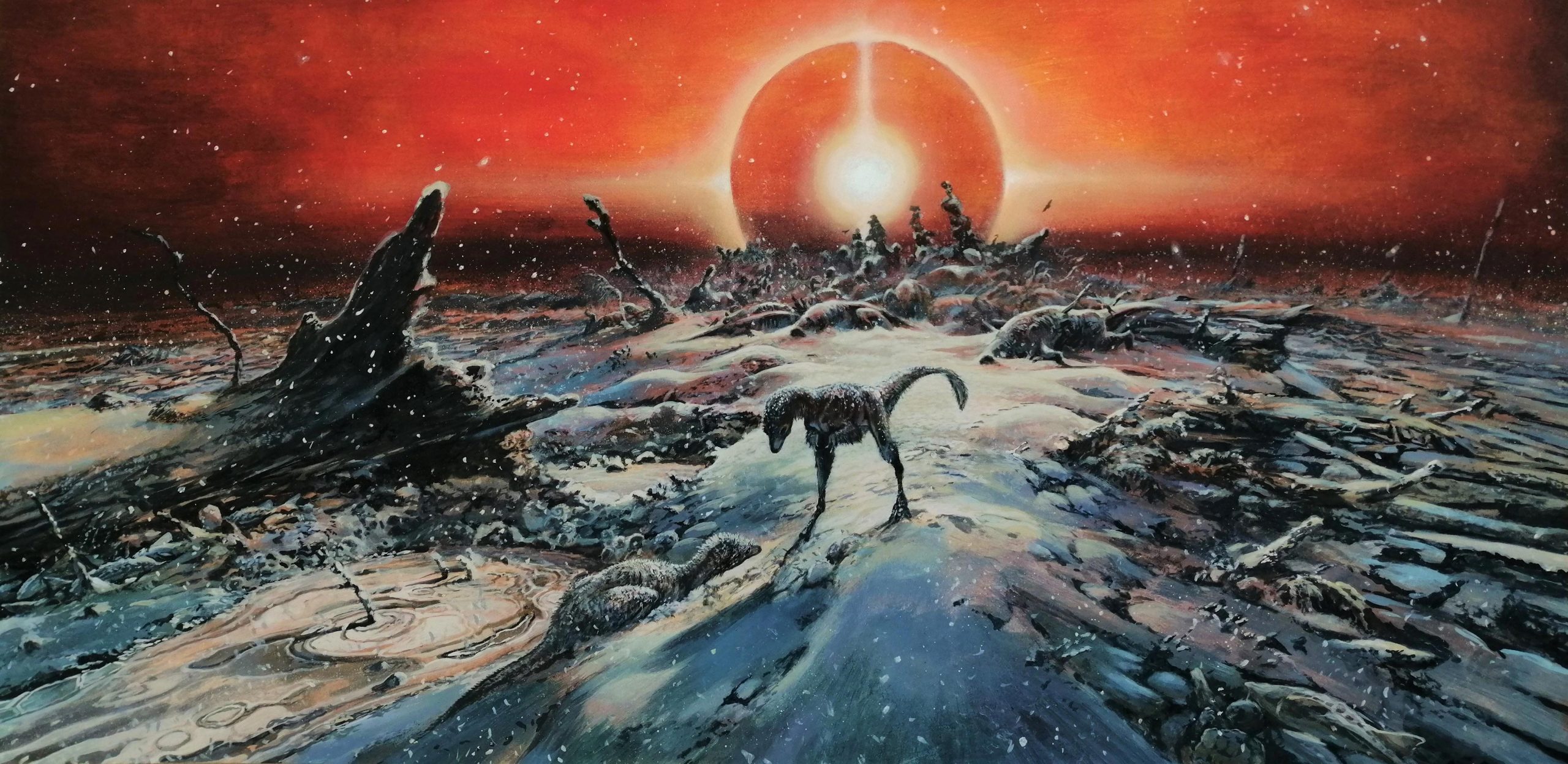

This picture illustrates a scene from northern Laurentia (North America) in the period a few weeks after the Chicxulub impact showing the onset of freezing weather and skies loaded with sulfur aerosols. The focus is on the last surviving dinosaurs – here a pair of T-Rex chicks, which somehow survived the initial impact phenomena, but which will soon succumb to the cold. Credit: ©James McKay – Creative Commons
While the popular Netflix movie “Don’t Look Up” has raised public consciousness to the potential catastrophic effects of asteroid impact to planet Earth, new research sheds light on how the Chicxulub impact 66 million years ago resulted in extinction of 75 percent of animals on Earth, including the dinosaurs.
A large asteroid, approximately 10 kilometers in diameter, struck Mexico’s northern Yucatán peninsula, an impact that ejected material roughly equivalent to an area the size of Connecticut and more than twice as tall as Mt. Everest, redistributing it over the globe.
“The impact blast and fallout ignited widespread fires, which together with rock dust, soot and volatiles ejected from the crater, blotted out the sun globally in an impact winter that may have lasted years, resulting in the extinction,” says Christopher Junium, an associate professor of Earth and Environmental Sciences who leads the Geobiology, Astrobiology, Paleoclimate, Paleoceanography research group in the College of Arts and Sciences at Syracuse University.
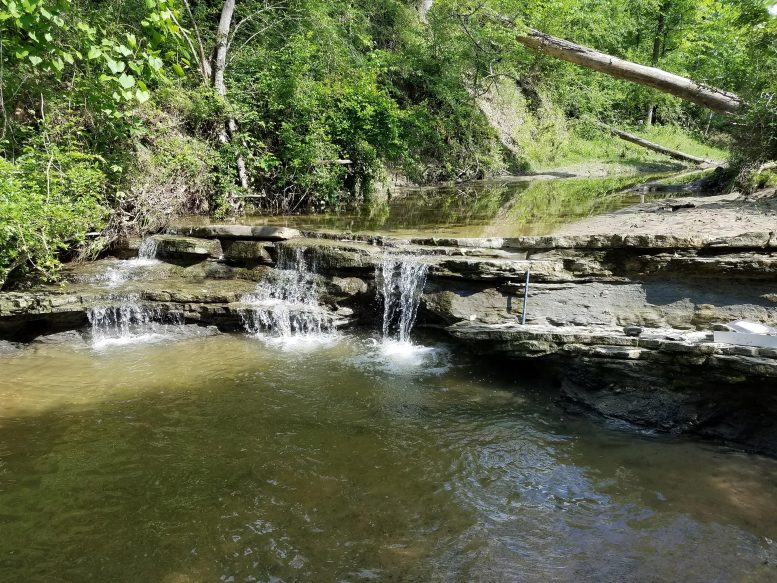
Outcrop location containing the K-Pg boundary event deposits in Rosebud, Texas along Darting Minnow Creek, a tributary of the Brazos River. Credit: James Witts
Scientists have long implicated fine particles of sulfate in the stratosphere as the primary agent of massive climate change and resulting mass extinction but were uncertain as to the fate of the sulfur. “There has been uncertainty regarding how much reached the stratosphere where its effects on climate would have been greatly magnified,” says Junium.
In research published this month in PNAS, a team from Syracuse University, the University of St Andrews in Scotland, the University of Bristol in England and Texas A&M University links high levels of stratospheric sulfur to the impact and its location, which was rich in the sulfate mineral gypsum.
While impacts of comets, asteroids, and other planetary bodies are common during Earth’s history, the geologic record reveals little about how those impacts changed the course of life. The Chicxulub impact is unique in rearranging the balance of Earth’s biosphere and in the geologic record left behind, a thin layer of sediment called the K-Pg boundary, found throughout the world in marine and terrestrial rocks.
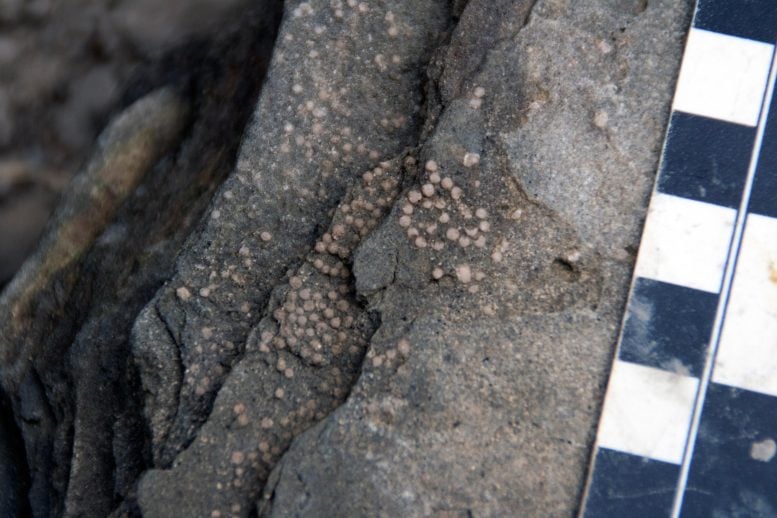
Closeup of the rocks exposed along Darting Minnow Creek. The round, white ejecta “spherules” condensed out of ejecta plume from the vaporized Chicxulub rocks and rained down on the Earth in the period after the impact. The ejecta materials at Darting Minnow Creek contain the sulfur that was derived from the Chicxulub crater and the sulfur isotope anomalies that confirm the formation of abundant stratospheric sulfur aerosols that caused extended cooling after the impact. Credit: Benjamin Uveges
With funding from the National Science Foundation, Junium, Syracuse colleague Linda Ivany, professor and associate chair of Evolutionary Paleoecology and Paleoclimate, James Witts from the University of Bristol and Syracuse graduate students conducted fieldwork along the Brazos River in Central Texas to collect samples of rock that record the immediate aftermath of the Chicxulub impact. Junium received a St. Andrews Global Fellowship to spend six weeks at St. Andrews, where Aubrey Zerkle, Mark Claire, and colleagues analyzed the samples with funding from the European Union. New geochemical techniques allowed researchers to trace the unique transformations undergone by sulfur aerosols when they rise above Earth’s ozone layer and are exposed to UV radiation, creating diagnostic signatures in the stable isotopes of the sulfur gases.
“The unique fingerprints we’ve measured in these impact sediments provide the first direct evidence for the importance of sulfur aerosols in catastrophic climate change and cooling,” says Zerkle, an expert in sulfur isotopes and the sulfur cycle.
Junium explains that the presence of these signatures requires extraordinary amounts of sulfur aerosols in the stratosphere, which slowly returned to Earth as acid rain and washed into shallow marine seas in the aftermath of the impact. “These sulfur aerosols would have extended the duration of post-impact climate change, taking an already beleaguered biosphere to the brink of collapse,” he says.
Reference: “Massive perturbations to atmospheric sulfur in the aftermath of the Chicxulub impact” by Christopher K. Junium, Aubrey L. Zerkle, James D. Witts, Linda C. Ivany, Thomas E. Yancey, Chengjie Liu and Mark W. Claire, 21 March 2022, Proceedings of the National Academy of Sciences.
DOI: 10.1073/pnas.2119194119