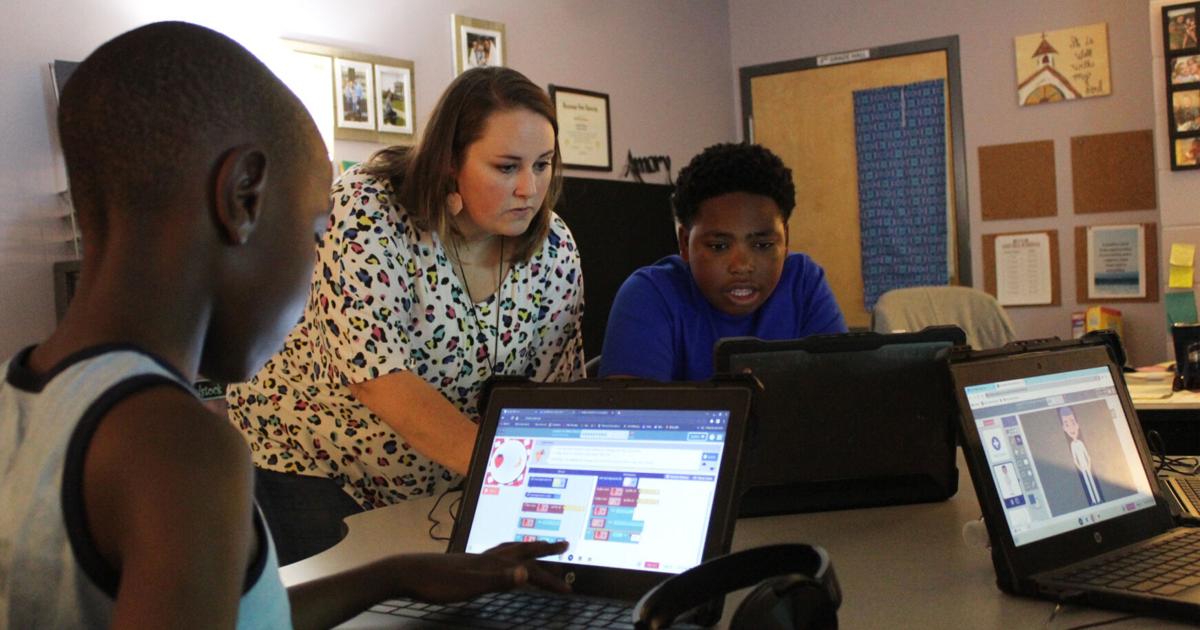

Local schools are working this year to build a new culture for engaging students in robotics and computer science. In the process, the new curriculum is providing foundational workforce development lessons for technical fields.
During summer break, several local elementary school teachers participated in a workshop at Mississippi State University to learn about advances in computer robotics based on the Code.org platform.
Statewide, 572 elementary teachers participated in the two-day event, which is helping school districts meet requirements of state legislation passed in 2021 mandating computer science instruction at each grade level by the ‘24-’25 school year, according to MSU Center for Cyber Education Director Shelly Hollis.
Created in collaboration with engineers from Amazon, Google and Microsoft, the platform’s versatility extends beyond traditional educational settings and focuses on increasing participation by young women and students from other underrepresented groups in high-tech fields dominated by males.
“I’m researching Amazon right now, and they use robots every day in their facilities, and they have to have people to set that up. There are so many jobs open for computer science, and there’s no introduction to it until middle school or high school. The whole point of getting this curriculum through is to get everybody interested and to show everybody can do it. It’s not just one certain race or one certain gender,” said East Amory Elementary School computer science teacher Kayla Hathcock.
“I think this opens their minds to more jobs. It’s not just a firefighter or policeman. It’s not just our basic community helpers. It opens their eyes to the surrounding jobs so much more. They can actually say, ‘Hey, I like computer science. I’d like to see how far I can go with it,’ and they can go all the way to NASA and take it as far as they want with it,” she added.
Hatchcock said statistics on ethnicity and gender indicate the majority of those in the computer science field are white and Asian males. Hollis said in a press release females represent 25 percent or less of the computing workforce.
“Studies show that students make up their mind about what they are good at by middle school. If they haven’t had consistent, positive exposure to computer science during their elementary years, they may feel like they don’t belong in that space and are less likely to show interest in computing topics during middle school and beyond, making it much harder to recruit students into computer science fields,” she said.
From classrooms to careers
Hathcock was part of the elementary integration guide task force for the curriculum that went with the standards. She traveled throughout Mississippi with a team to train more than 400 teachers last summer.
“This was to help teachers when they go into the classroom to be able to be able to say, ‘Okay, I can teach main events, main idea and I can use this site to help teach.
“We have adapted computer coding lessons into regular curriculum in subjects, such as English Language Arts, math and science. Where our computer lab teaches keyboarding, our robotics curriculum has spun off a separate class to teach students coding, digital citizenship and keeping a healthy balance between real life and virtual life. Technology is so addicting,” she said.
Hathcock had a year’s worth of experience before teaching the curriculum, which gives her an advantage.
Hatley’s topics include digital literacy, keyboarding, digital citizenship, coding, robotics and unplugged. Students will receive one hour of computer science each week, in addition to elements in the ELA, math and science curriculum. Students will receive computer science instruction in the computer lab, the regular classroom and the library.
“I believe this a great opportunity for Hatley’s students,” said the school’s librarian Debbie Leech, who will work alongside computer teacher Ashley Long for the lessons. “The goal of the program is for all students to understand computer science is something they can learn successfully. Not all students will become computer scientists, but understanding how it will impact their daily personal life and career field will be vital to preparing students to graduate college and to be career-ready.”
Computer coding exercises begin as fun activities that cultivate problem-solving skills with familiar animated icons with names and titles applied in a new way, ushering in the language used by today’s computer generation.
“Later in their junior high and high school years, students will be involved in higher level courses and have the opportunity to develop their skills further. There are so many different opportunities for students in the field of computer sciences,” said Kim Honnell, who teaches fifth- and sixth-grade social studies and computer science at Hamilton Attendance Center.
According to Belle Shivers Middle School instructor Ashley Ridings, computer science is a content area that has been primarily offered in upper grade levels.
“Now, (the Mississippi Department of Education) has a long-term plan to implement computer science in elementary grades,” she said.
Ridings was selected as the trainer for fourth and fifth grades at Belle-Shivers Middle School after attending a workshop at Delta State University.
“The training provided details of how exposure to the curriculum would benefit students long term. Elementary (K-5) computer science would teach fundamentals of the course, whereas middle school (grades 6-8) would focus on discoveries. Then, additional advanced courses follow in high school (grades 9-12),” she said.
Smithville Elementary School fifth-grade math and science teacher LaShae Pritchett and fifth-grade ELA and social studies teacher Cate Kennedy are sharing what they learned with other teachers.
“We were not aware of all of the computer science jobs that are available in our state that are not being filled due to lack of computer science interest and experience. Each year, we have many students that enjoy video games, such as ‘Minecraft’ and ‘Fortnite.’ Through video games, students have already experienced some sort of coding. Through coding, the students can experience problem-solving situations, as well as critical thinking. Having them follow the steps and situations, it shows the students why we have procedures and why we follow specific rules,” Pritchett said.
Kennedy shared her excitement to incorporate computer science in their classrooms and school to see the creativity that comes from it.
Since early in the school year, Honnell said students have worked at their own pace through a variety of lessons to become familiar with coding.
“The lessons students are completing now are familiarizing them to the aspects of simple coding, as well as digital citizenship. Although it looks and feels like a game to students, it is actually building their skill set of cause/effect and problem solving. If at first the code they select doesn’t work, the program allows them to troubleshoot and find a solution. These skills are beneficial in all aspects of education and in developing life skills,” she said.
Ridings debunked the notion that computer science is thought of as just computers.
“Computer science is composed of many elements that help build skills in students, such as critical thinking, strategic planning and much more. An additional benefit of computer science is the support obtained with cross-curricular material. For example, math applications can be used to learn about geometrics and measurements. There are many connections with English Language Arts and science as well. Computer science helps with team building and technological learning by using robots or online resources. Incorporating these skills in early years gives support to students to have a better understanding of possible career fields. Computer science is a fairly new field with small scope of diversity. Therefore, allowing access to additional content areas like computer science would give more equity and inclusion to students, especially female students,” she said.
This curriculum is a new area for fifth- and sixth-graders, so Honnell is starting from the ground up.
“Students are only completing simple tasks at this time; however, throughout the course of the year, the assignments will become longer and more complex. They will even be coding through a platform provided by Massachusetts Institute of Technology. My students are really excited, as am I,” she said.
Nettleton fifth-grade teacher Anna Klemm was one of two instructors from the district to attend this summer’s workshop.
“My ultimate goal is to see students create an interactive experience, such as a video. I will help them do the research. The ability to harness modern technology gives them a leg up on the competition,” she said.
Success! An email has been sent to with a link to confirm list signup.
Error! There was an error processing your request.