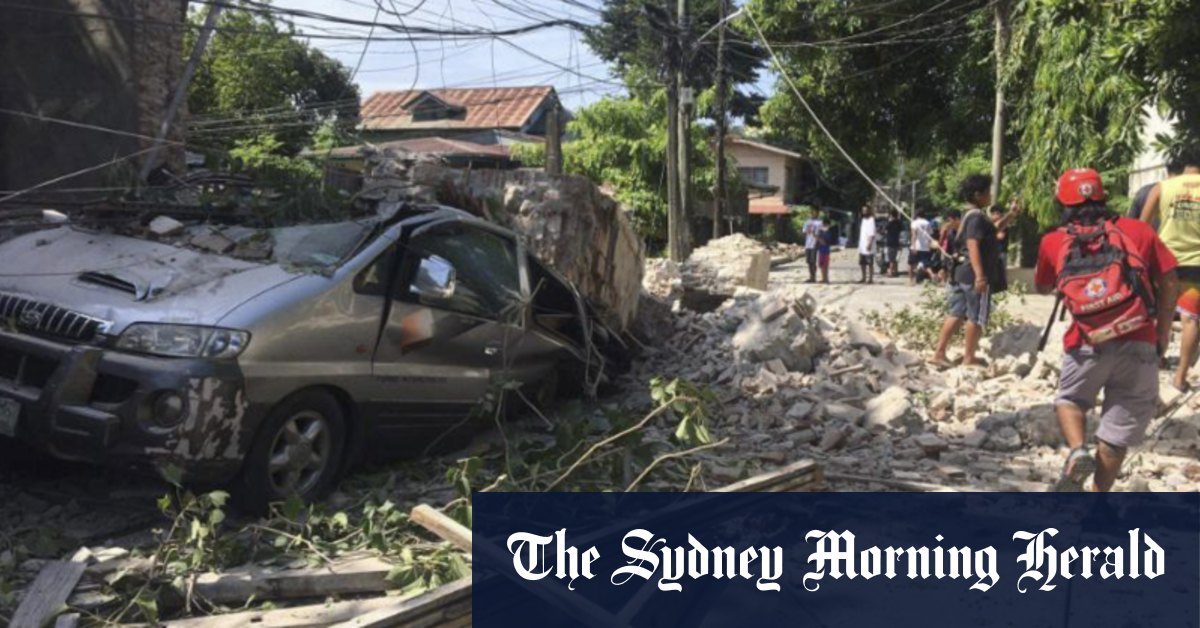

A strong earthquake struck the Philippines’ largest and most populous island on Wednesday, prompting evacuations, triggering landslides and damaging historic tourist spots.
The magnitude-7.1 (revised from 7) tremor hit at a depth of 10km and was recorded at 8.43am Manila time. It originated in Abra province on the main Luzon island’s northern portion, the Philippine Institute of Volcanology and Seismology said. Aftershocks were expected, it added.
Two people were killed in Benguet province, one in Abra province, and one more in another province, Interior Secretary Benjamin Abalos told a news conference. At least sixty people were injured, he said.

Rescuers try to pull out a trapped resident from under a collapsed structure after a strong earthquake struck La Trinidad, Benguet province, northern Philippines on Wednesday.Credit:Bureau of Fire Protection/AP
The earthquake was considered a “major” one, and “can be devastating”, CNN Philippines quoted the institute’s director Renato Solidum as saying. It’s the strongest inland earthquake since the tremor in central Philippines in 2013, he said at a televised briefing.

A damaged building after a strong quake hit Bangued, Abra province, northern Philippines on Wednesday.Credit:AP
New President Ferdinand Marcos jnr, who hails from northern Philippines, would fly to affected areas once it was safe for him to do so, press secretary Trixie Cruz-Angeles said. The leader has ordered rescue and relief teams be dispatched to Abra, she added.
Abra, home to nearly 250,000 people, is a landlocked province. Its deep valleys and sloping hills are enclosed by rugged mountains.

Boulders fall as a vehicle negotiates a road during an earthquake in Bauko, Mountain Province, Philippines on Wednesday.Credit:AP
Eric Singson, mayor of Candon City in Ilocos Sur province, asked constituents to leave their houses, anticipating after shocks, he told DZMM radio. Patients in a hospital in Abra were transferred to tents, set up as a temporary evacuation facility.