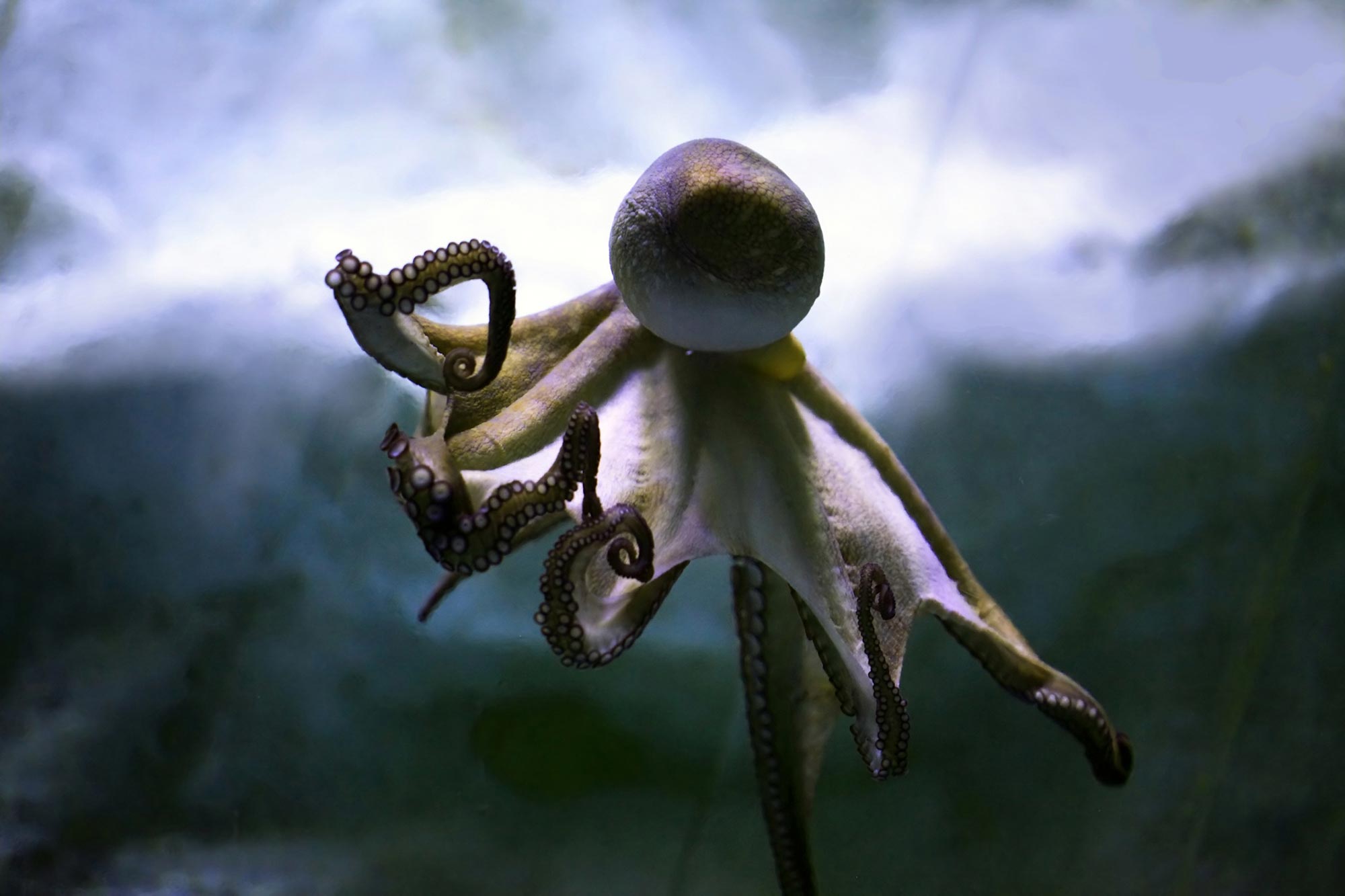
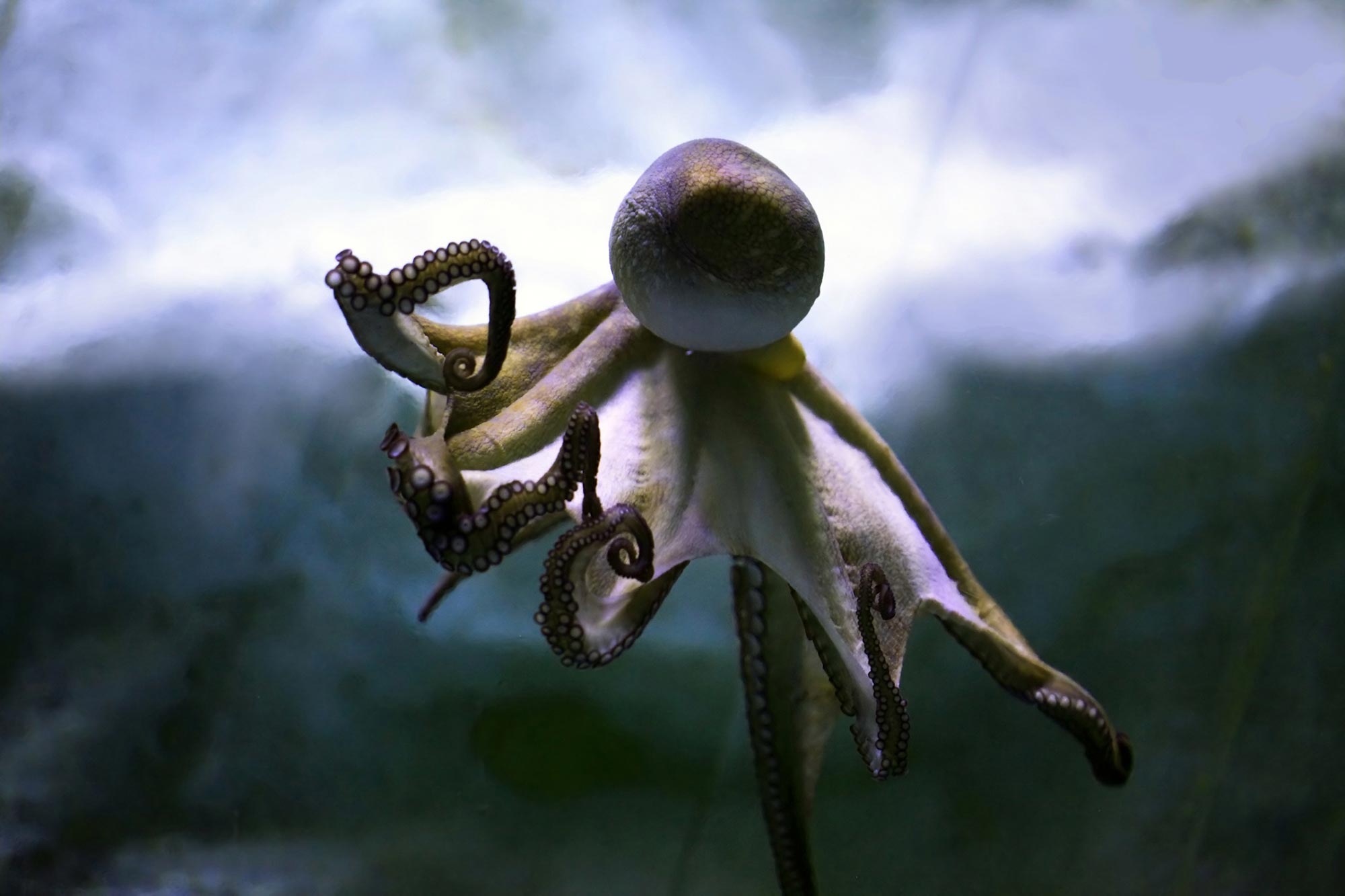
According to a new study, the neural and cognitive complexity of the octopus could originate from a molecular analogy with the human brain.
New research has identified an important molecular analogy that could explain the remarkable intelligence of these fascinating invertebrates.
An exceptional organism with an extremely complex brain and cognitive abilities makes the octopus very unique among invertebrates. So much so that it resembles vertebrates more than invertebrates in several aspects. The neural and cognitive complexity of these animals could originate from a molecular analogy with the human brain, as discovered by a research paper that was recently published in BMC Biology and coordinated by Remo Sanges from Scuola Internazionale Superiore di Studi Avanzati (SISSA) of Trieste and by Graziano Fiorito from Stazione Zoologica Anton Dohrn of Naples.
This research shows that the same ‘jumping genes’ are active both in the human brain and in the brain of two species, Octopus vulgaris, the common octopus, and Octopus bimaculoides, the Californian octopus. A discovery that could help us understand the secret of the intelligence of these remarkable organisms.
Sequencing the human genome revealed as early as 2001 that over 45% of it is composed of sequences called transposons, so-called ‘jumping genes’ that, through molecular copy-and-paste or cut-and-paste mechanisms, can ‘move’ from one point to another of an individual’s genome, shuffling or duplicating.
In most cases, these mobile elements remain silent: they have no visible effects and have lost their ability to move. Some are inactive because they have, over generations, accumulated mutations; others are intact, but blocked by cellular defense mechanisms. From an evolutionary point of view even these fragments and broken copies of transposons can still be useful, as ‘raw matter’ that evolution can sculpt.

Drawing of an octopus. Credit: Gloria Ros
Among these mobile elements, the most relevant are those belonging to the so-called LINE (Long Interspersed Nuclear Elements) family, found in a hundred copies in the human genome and still potentially active. It has been traditionally though that LINEs’ activity was just a vestige of the past, a remnant of the evolutionary processes that involved these mobile elements, but in recent years new evidence emerged showing that their activity is finely regulated in the brain. There are many scientists who believe that LINE transposons are associated with cognitive abilities such as learning and memory: they are particularly active in the hippocampus, the most important structure of our brain for the neural control of learning processes.
The octopus’ genome, like ours, is rich in ‘jumping genes’, most of which are inactive. Focusing on the transposons still capable of copy-and-paste, the researchers identified an element of the LINE family in parts of the brain crucial for the cognitive abilities of these animals. The discovery, the result of the collaboration between Scuola Internazionale Superiore di Studi Avanzati, Stazione Zoologica Anton Dohrn and Istituto Italiano di Tecnologia, was made possible thanks to next-generation sequencing techniques, which were used to analyze the molecular composition of the genes active in the nervous system of the octopus.
“The discovery of an element of the LINE family, active in the brain of the two octopuses species, is very significant because it adds support to the idea that these elements have a specific function that goes beyond copy-and-paste,” explains Remo Sanges, director of the Computational Genomics laboratory at SISSA, who started working at this project when he was a researcher at Stazione Zoologica Anton Dohrn of Naples. The study, published in BMC Biology, was carried out by an international team with more than twenty researchers from all over the world.
“I literally jumped on the chair when, under the microscope, I saw a very strong signal of activity of this element in the vertical lobe, the structure of the brain which in the octopus is the seat of learning and cognitive abilities, just like the hippocampus in humans,” tells Giovanna Ponte from Stazione Zoologica Anton Dohrn.
According to Giuseppe Petrosino from Stazione Zoologica Anton Dohrn and Stefano Gustincich from Istituto Italiano di Tecnologia “This similarity between man and octopus that shows the activity of a LINE element in the seat of cognitive abilities could be explained as a fascinating example of convergent evolution, a phenomenon for which, in two genetically distant species, the same molecular process develops independently, in response to similar needs.”
“The brain of the octopus is functionally analogous in many of its characteristics to that of mammals,” says Graziano Fiorito, director of the Department of Biology and Evolution of Marine Organisms of the Stazione Zoologica Anton Dohrn. “For this reason, also, the identified LINE element represents a very interesting candidate to study to improve our knowledge on the evolution of intelligence.”
Reference: “Identification of LINE retrotransposons and long non-coding RNAs expressed in the octopus brain” by Giuseppe Petrosino, Giovanna Ponte, Massimiliano Volpe, Ilaria Zarrella, Federico Ansaloni, Concetta Langella, Giulia Di Cristina, Sara Finaurini, Monia T. Russo, Swaraj Basu, Francesco Musacchia, Filomena Ristoratore, Dinko Pavlinic, Vladimir Benes, Maria I. Ferrante, Caroline Albertin, Oleg Simakov, Stefano Gustincich, Graziano Fiorito and Remo Sanges, 18 May 2022, BMC Biology.
DOI: 10.1186/s12915-022-01303-5