When we think of the “cloud,” we often imagine data floating invisibly in the ether. But the reality is far more tangible: the cloud is located in huge buildings called data centers, filled with powerful, energy-hungry computer chips. Those chips, particularly graphics processing units (GPUs), have become a critical piece of infrastructure for the world of AI, as they are required to build and run powerful chatbots like ChatGPT.
As the number of things you can do with AI grows, so does the geopolitical importance of high-end chips—and where they are located in the world. The U.S. and China are competing to amass stockpiles, with Washington enacting sanctions aimed at preventing Beijing from buying the most cutting-edge varieties. But despite the stakes, there is a surprising lack of public data on where exactly the world’s AI chips are located.
A new peer-reviewed paper, shared exclusively with TIME ahead of its publication, aims to fill that gap. “We set out to find: Where is AI?” says Vili Lehdonvirta, the lead author of the paper and a professor at Oxford University’s Internet Institute. Their findings were stark: GPUs are highly concentrated in only 30 countries in the world, with the U.S. and China far out ahead. Much of the world lies in what the authors call “Compute Deserts:” areas where there are no GPUs for hire at all.
The finding has significant implications not only for the next generation of geopolitical competition, but for AI governance—or, which governments have the power to regulate how AI is built and deployed. “If the actual infrastructure that runs the AI, or on which the AI is trained, is on your territory, then you can enforce compliance,” says Lehdonvirta, who is also a professor of technology policy at Aalto University. Countries without jurisdiction over AI infrastructure have fewer legislative choices, he argues, leaving them subjected to a world shaped by others. “This has implications for which countries shape AI development as well as norms around what is good, safe, and beneficial AI,” says Boxi Wu, one of the paper’s authors.
The paper maps the physical locations of “public cloud GPU compute”—essentially, GPU clusters that are accessible for hire via the cloud businesses of major tech companies. But the research has some big limitations: it doesn’t count GPUs that are held by governments, for example, or in the private hands of tech companies for their use alone. And it doesn’t factor in non-GPU varieties of chips that are increasingly being used to train and run advanced AI. Lastly, it doesn’t count individual chips, but rather the number of compute “regions” (or groups of data centers containing those chips) that cloud businesses make available in each country.
Read More: How ‘Friendshoring’ Made Southeast Asia Pivotal to the AI Revolution
That’s not for want of trying. “GPU quantities and especially how they are distributed across [cloud] providers’ regions,” the paper notes, “are treated as highly confidential information.” Even with the paper’s limitations, its authors argue, the research is the closest up-to-date public estimate of where in the world the most advanced AI chips are located—and a good proxy for the elusive bigger picture.
The paper finds that the U.S. and China have by far the most public GPU clusters in the world. China leads the U.S. on the number of GPU-enabled regions overall, however the most advanced GPUs are highly concentrated in the United States. The U.S. has eight “regions” where H100 GPUs—the kind that are the subject of U.S. government sanctions on China—are available to hire. China has none. This does not mean that China has no H100s; it only means that cloud companies say they do not have any H100 GPUs located in China. There is a burgeoning black market in China for the restricted chips, the New York Times reported in August, citing intelligence officials and vendors who said that many millions of dollars worth of chips had been smuggled into China despite the sanctions.
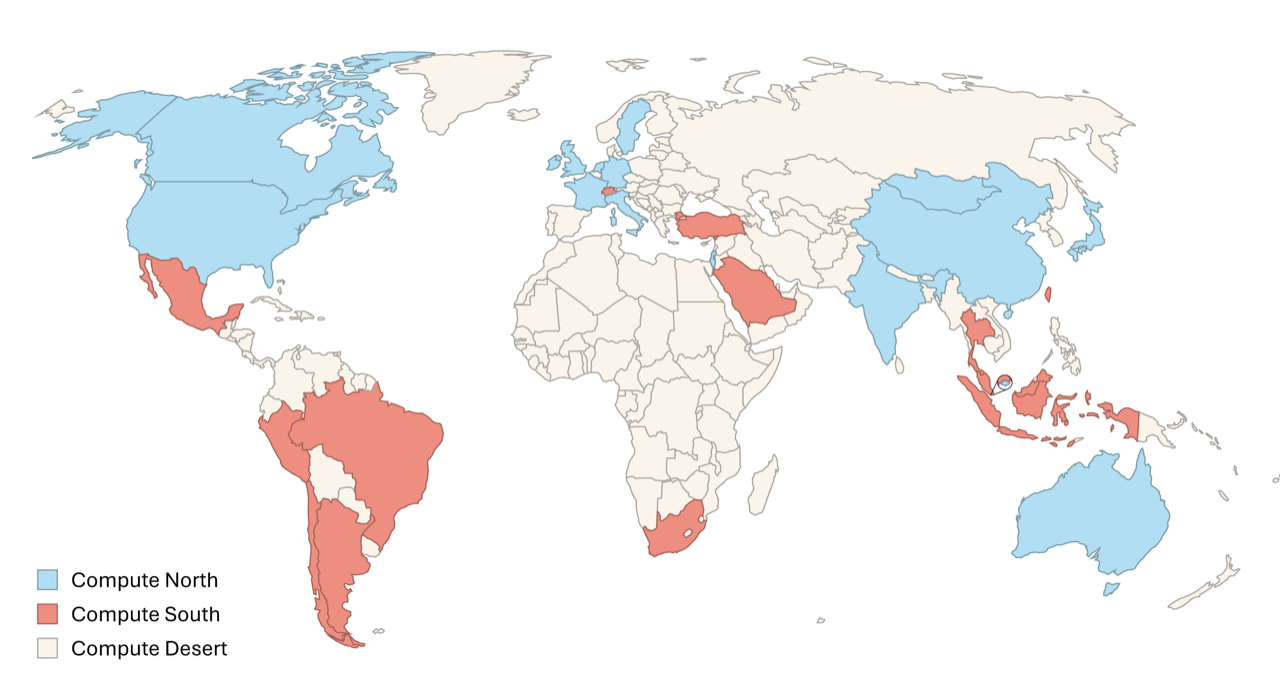
The paper’s authors argue that the world can be divided into three categories: “Compute North,” where the most advanced chips are located; the “Compute South,” which has some older chips suited for running, but not training, AI systems; and “Compute Deserts,” where no chips are available for hire at all. The terms—which overlap to an extent with the fuzzy “Global North” and “Global South” concepts used by some development economists—are just an analogy intended to draw attention to the “global divisions” in AI compute, Lehdonvirta says.
The risk of chips being so concentrated in rich economies, says Wu, is that countries in the global south may become reliant on AIs developed in the global north without having a say in how they work.
It “mirrors existing patterns of global inequalities across the so-called Global North and South,” Wu says, and threatens to “entrench the economic, political and technological power of Compute North countries, with implications for Compute South countries’ agency in shaping AI research and development.”