


Differences in facial musculature between wolves and dogs suggests facial expressions played a role in selective breeding and domestication of dogs.
Can’t resist your pup’s adoring expression when he begs for a treat? A new study reveals key anatomical features that could explain what makes dogs’ faces so appealing. The findings also suggest that humans contributed to dogs’ ability to form facial expressions through thousands of years of selective breeding.
“Dogs are unique from other mammals in their reciprocated bond with humans which can be demonstrated though mutual gaze, something we do not observe between humans and other domesticated mammals such as horses or cats,” said said Anne Burrows, PhD, professor in the department of physical therapy at Rangos School of Health Sciences at Duquesne University in Pittsburgh, the study’s senior author. “Our preliminary findings provide a deeper understanding of the role facial expressions play in dog-human interactions and communication.”
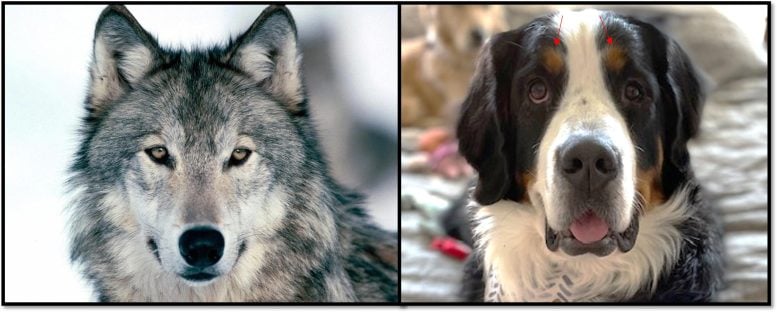
A wild gray wolf (left) and a domesticated Bernese Mountain dog (right), highlighting some common facial differences between the wolf and domesticated dogs. Most domesticated dog breeds have ears that lie flat, display a range of fur patterns and colors, and have a shortened snout. Red arrows indicate the levator anguli occuli medialis muscle, a muscle not found in the gray wolf that supports eye gaze communication between dogs and humans. Credit: Anne Burrows, Duquesne University; left image copyright Defenders of Wildlife, Washington, DC
Burrows will present the research at the American Association for Anatomy annual meeting during the Experimental Biology (EB) 2022 meeting, held in Philadelphia on April 2-5, 2022. The research team also included Madisen Omstead, laboratory manager for the Rangos School of Health Sciences department of physical therapy.
Dogs and wolves are closely related. Though the exact timing is unclear, scientists estimate that the two species diverged genetically some 33,000 years ago as humans began selectively breeding wolves, the first species ever to be domesticated.
The new study focuses on the anatomy of tiny muscles used to form facial expressions, called mimetic muscles. In humans, these muscles are dominated by “fast-twitch” myosin fibers that contract quickly but also fatigue quickly, which explains why we can form facial expressions rapidly but not hold them for long. Muscle cells with more “slow-twitch” fibers are more efficient for long, controlled movements and don’t tire as quickly.
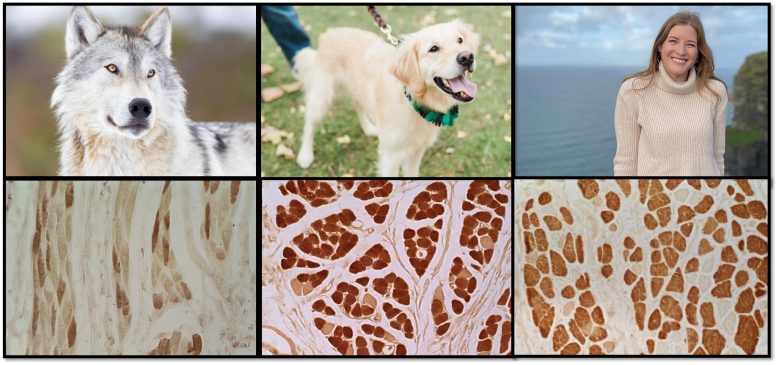
Faces of a wild gray wolf, a Golden Retriever domesticated dog, and a human, along with tissue samples from the orbicularis oris muscle for each species. In the photos the dog and human are actively using the zygomaticus and orbicularis muscles (note the dog’s upturned lip, which mimics smiling). The stained muscle samples reveal similarities in muscle content between dogs and people that likely contribute to their facial flexibility compared to wolves. Credit: Anne Burrows, Duquesne University, iStock
For the study, researchers compared the myosin fibers in facial muscle samples from wolves and domesticated dogs. The results revealed that, like humans, both dogs and wolves have facial muscles that are dominated by fast-twitch fibers, but wolves have a higher percentage of slow-twitch fibers relative to dogs.
“These differences suggest that having faster muscle fibers contributes to a dog’s ability to communicate effectively with people,” said Burrows. “Throughout the domestication process, humans may have bred dogs selectively based on facial expressions that were similar to their own, and over time dog muscles could have evolved to become ‘faster,’ further benefiting communication between dogs and humans.”
Having more fast-twitch fibers allows greater facial mobility and faster muscle movement, enabling small movements such as a raised eyebrow and the short, powerful muscle contractions involved in barking. Slow-twitch fibers, on the other hand, are important for extended muscle movements such as those wolves use when howling.
https://youtube.com/shorts/4GTucWE0VKg
A dog barking. Fast-twitch muscle fibers are important for rapid contractions such as those used in barking. By contrast, slow-twitch fibers are important for long, controlled movements such as those used in howling (as demonstrated in the video at https://www.youtube.com/watch?v=KhQGo2IdA9s, for example). Credit: Anne Burrows, Duquesne University
In previous research, the team discovered that dogs have an additional mimetic muscle that is absent in wolves and contributes to the “puppy-dog eye” expression. The scientists note that further research is needed to confirm their new findings with antibody stains suitable for differentiating additional myosin fiber types, which could shed new light on the anatomical differences between dogs and wolves.
Burrows will present this research from 1:45–2:00 p.m. Tuesday, April 5, in Room 105 AB, Pennsylvania Convention Center (abstract). Contact the media team for more information or to obtain a free press pass to attend the meeting.
Meeting: Experimental Biology