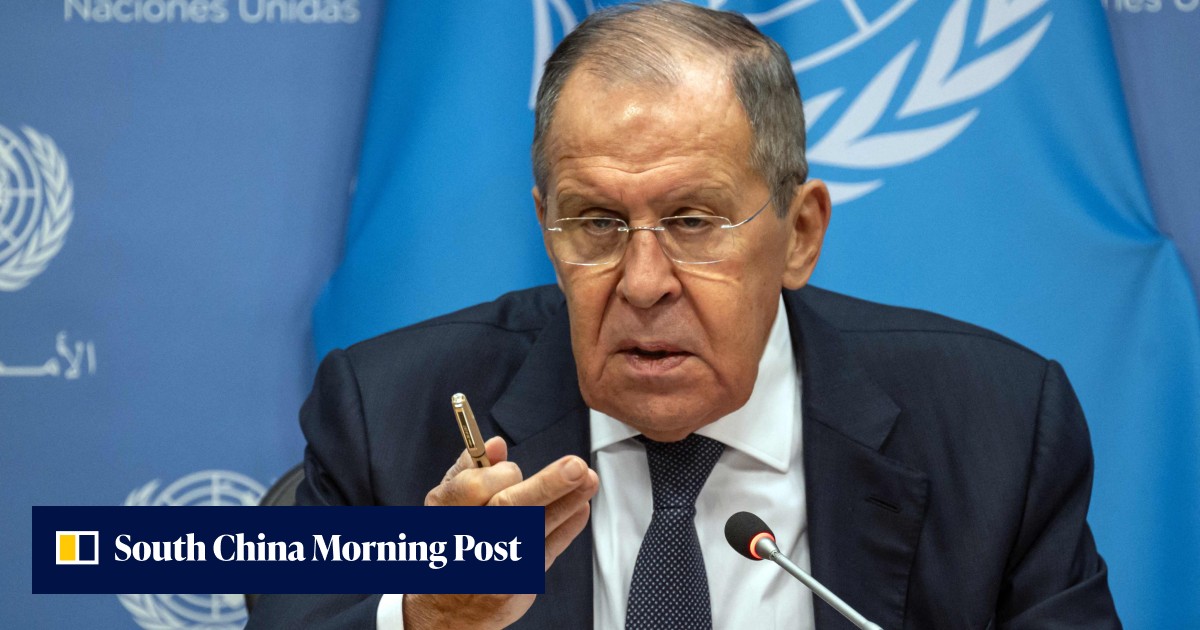

Russian Foreign Minister Sergey Lavrov called Ukrainian proposals for restoring its pre-invasion territory “unrealisable” and said that if Ukraine’s allies want war, they can have it.
Lavrov’s comment jibes with a view taking hold among Ukraine’s allies that the war will is likely to go on for years.
Speaking at a news conference at the United Nations on Saturday, the minister called a 10-point peace blueprint promoted by Kyiv “completely not feasible”. “It is not possible to implement this. It’s not realistic and everybody understands this, but at the same time, they say this is the only basis for negotiations.”
“If you insist on the battlefield, OK, let’s decide it on the battlefield,” Lavrov said.
04:15
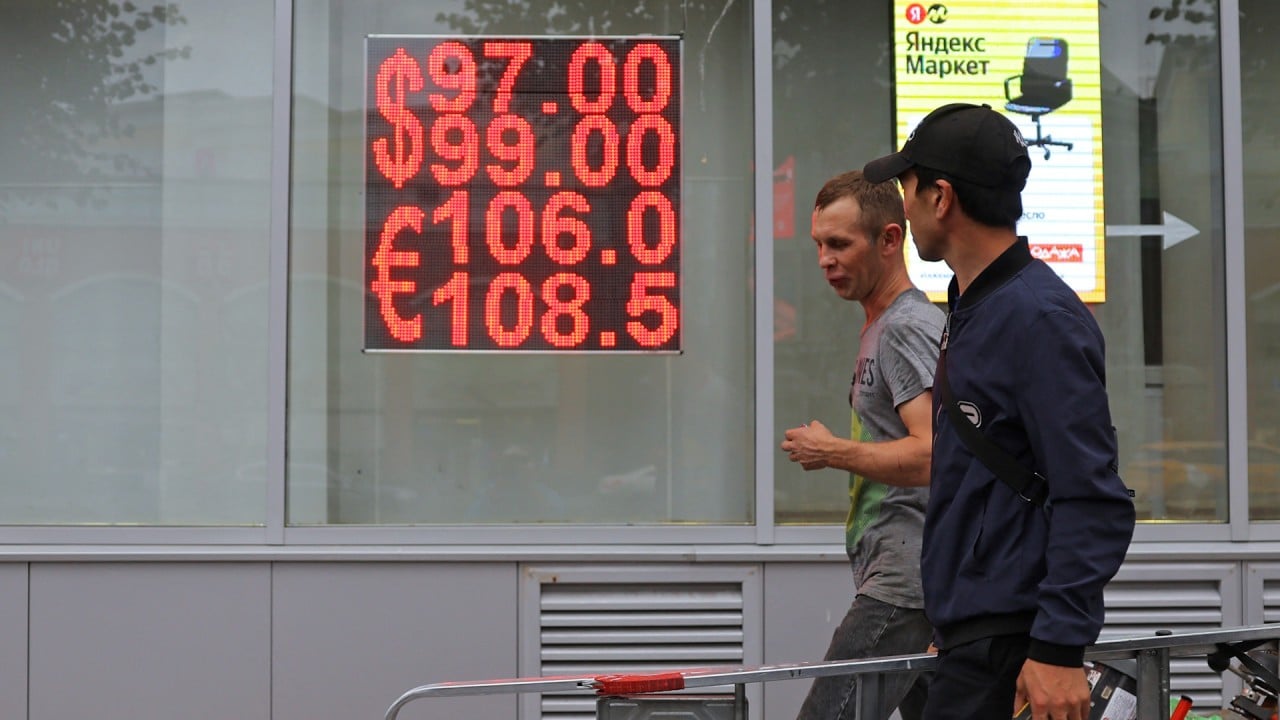
Russia’s rouble falls to lowest value against US dollar since Ukraine war began
Russia’s rouble falls to lowest value against US dollar since Ukraine war began
The diplomat renewed long-standing Russian claims that the West was to blame for the war, which erupted into a full-scale conflict with Russia’s invasion last year. He also said a UN proposal to revive a deal to allow safe passage for Ukrainian grain exports would not work.
Lavrov added that Moscow left the Black Sea grain initiative because promises made to Russia – including on removing sanctions on a Russian bank and reconnecting it to the global Swift system – had not been met.
He said the latest UN proposals to revive that export corridor for Ukrainian agricultural products were “simply not realistic”.
Lavrov said he would visit Pyongyang next month to continue negotiations with his counterpart there off the back of recent agreements made by Russian President Vladimir Putin and North Korean leader Kim Jong-un in Moscow.
At UN, Ukraine’s Zelensky says strip ‘criminal’ Russia of veto power
At UN, Ukraine’s Zelensky says strip ‘criminal’ Russia of veto power
Earlier in the day, the minister denounced the United States and the West as self-interested defenders of a fading international order.
“The US and its subordinate Western collective are continuing to fuel conflicts which artificially divide humanity into hostile blocks and hamper the achievement of overall aims. They’re doing everything they can to prevent the formation of a genuine multipolar world order,” Lavrov said in his address to the UN General Assembly.
“They are trying to force the world to play according to their own self-centred rules.”
As for the 19-month war in Ukraine, he recapped some historical complaints going back to the 1991 break-up of the Soviet Union, and alluded to the billions of dollars that the US and Western allies have spent in supporting Kyiv. But he did not delve into the current fighting.
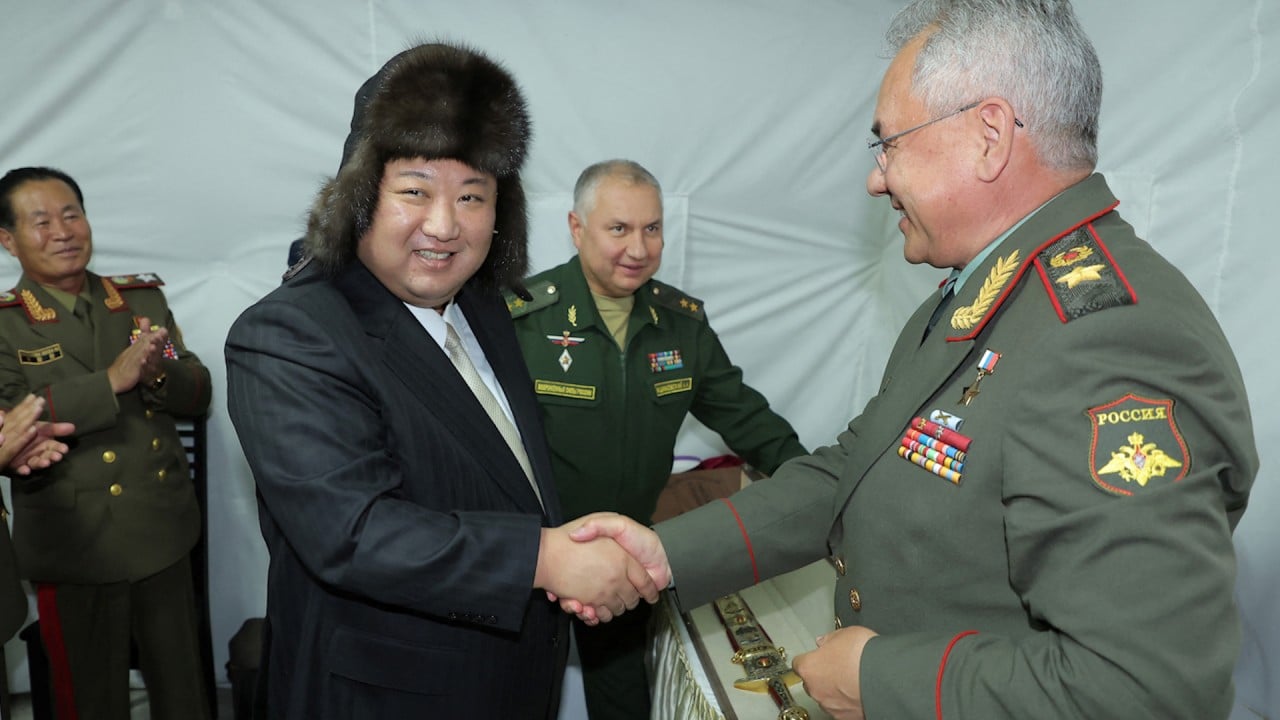
04:28
North Korea releases 90-minute documentary on leader Kim Jong-un’s trip to Russia
North Korea releases 90-minute documentary on leader Kim Jong-un’s trip to Russia
For a second year in a row, the General Assembly is taking place with no end to the war in sight. A three-month-long Ukrainian counteroffensive has gone slower than Kyiv hoped, making modest advances but no breakthroughs.
Ukraine’s seats in the assembly hall were empty for at least part of Lavrov’s speech. An American diplomat wrote on a notepad in her country’s section of the audience.
Since invading in February 2022, Russia has offered a number of explanations for what it calls the “special military operation” in Ukraine.
Among them: claims that Kyiv was oppressing Russian speakers in Ukraine’s east and so Moscow had to help them, that Ukraine’s growing ties with the West in recent years pose a risk to Russia, and that it is also threatened by Nato’s eastward expansion over the decades.
EU says up to 70% of hi-tech imports reaching Russia come via China
EU says up to 70% of hi-tech imports reaching Russia come via China
Lavrov hammered on those themes in his General Assembly speech last year, and he alluded again Saturday to what Russia perceives as Nato’s improper encroachment.
But his address looked at it through a wide-angle lens, surveying a landscape, as Russia sees it, of Western countries’ efforts to cling to outsize influence in global affairs. He portrayed the effort as doomed.
The rest of the planet is sick of it, Lavrov argued: “They don’t want to live under anybody’s yoke any more”.
That shows, he said, in the growth of such groups as Brics – the developing-economies coalition that currently includes Brazil, Russia, India, China and South Africa and recently invited Argentina, Egypt, Ethiopia, Iran, Saudi Arabia and the United Arab Emirates to join next year.
“Our future is being shaped by a struggle, a struggle between the global majority in favour of a fairer distribution of global benefits and civilised diversity and between the few who wield neocolonial methods of subjugation in order to maintain their domination which is slipping through their hands,” he said.
Bloomberg, Reuters and Associated Press