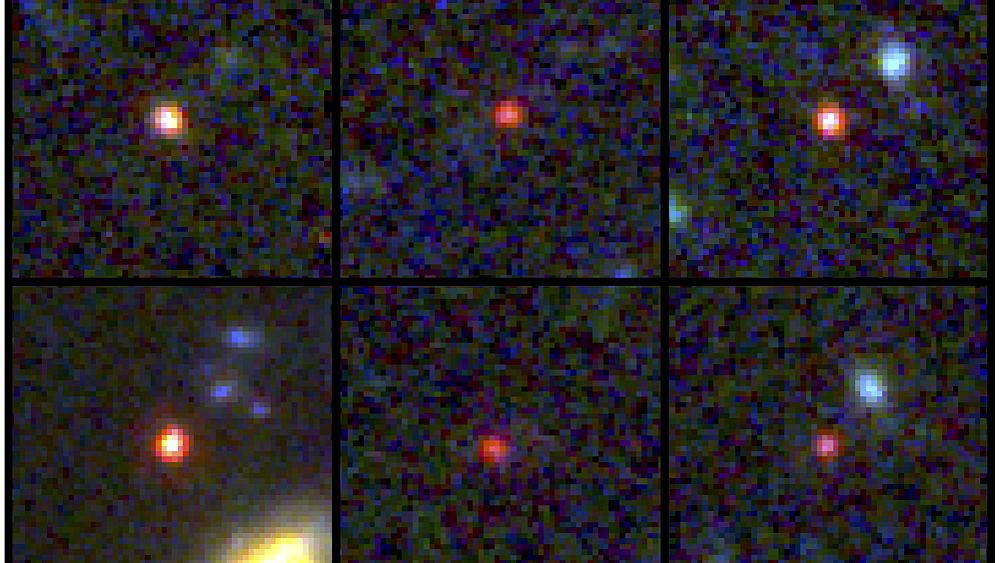

Astronomers have detected what appear to be six massive and very ancient galaxies, a discovery they say could upend our understanding of how galaxies formed at the very beginning of the universe.
While the new James Webb Space Telescope has already spotted even older galaxies, it’s the size and maturity of these six apparent mega-galaxies that have stunned scientists.
The latest objects, which appear to date back to roughly 600 million years after the Big Bang, are far bigger than was believed to be possible for galaxies so soon after the dawn of the universe.
“These objects are way more massive than anyone expected,” said Joel Leja, assistant professor of astronomy and astrophysics at Penn State, who modelled light from these galaxies.
“We expected only to find tiny, young, baby galaxies at this point in time, but we’ve discovered galaxies as mature as our own in what was previously understood to be the dawn of the universe”.
Using the first dataset released from NASA’s Webb Telescope, the international team of scientists discovered objects as mature as the Milky Way – when the universe was only 3 per cent of its current age, about 500-700 million years after the Big Bang.
Each of the six objects appears to weigh billions of times more than our Sun. In one of them, the total weight of all its stars may be as much as 100 billion times greater than our Sun, according to the scientists, who published their findings in the journal Nature on Wednesday.
‘Mind-blown’ by findings
Yet these galaxies are believed to be extremely compact, squeezing in as many stars as our own Milky Way, but in a relatively tiny slice of space, according to lead researcher Ivo Labbe, of Australia’s Swinburne University of Technology.
Labbe said he and his team didn’t think the results were real at first – that there couldn’t be galaxies as mature as the Milky Way so early in time – and they still need to be confirmed. The objects appeared so big and bright that some team members thought they had made a mistake.
“We were mind-blown, kind of incredulous,” Labbe said.
Leja said it’s possible that a few of the objects might not be galaxies, but obscured supermassive black holes. For now, the team has been referring to these objects as “universe breakers”.
“The revelation that massive galaxy formation began extremely early in the history of the universe upends what many of us had thought was settled science,” Leja said in a statement.
“It turns out we found something so unexpected it actually creates problems for science. It calls the whole picture of early galaxy formation into question”.
Peering deeper and deeper into space
These galaxy observations were among the first data set that came from the $10 billion (€9.4 billion) Webb telescope, launched just over a year ago by NASA and the European Space Agency. It’s considered the successor to the Hubble Space Telescope, coming up on the 33rd anniversary of its launch.
Unlike Hubble, the bigger and more powerful Webb can peer through clouds of dust with its infrared vision and discover galaxies previously unseen. Scientists hope to eventually observe the first stars and galaxies formed following the creation of the universe 13.8 billion years ago.
The researchers still are awaiting official confirmation through sensitive spectroscopy, careful to call these candidate massive galaxies for now.
While some may prove to be smaller, “odds are good at least some of them will turn out to be” galactic giants, Labbe said. “The next year will tell us”.
One early lesson from Webb is “to let go of your expectations and be ready to be surprised,” he said.