
A groundbreaking study in nanophotonics introduces a method for measuring light interaction at the nanoscale. This method uses single molecules to probe nanoantennas, resulting in a significant enhancement of light interaction. This advancement is pivotal for future technologies in quantum computing and medical fields. Credit: SciTechDaily.com
Scientists have made a breakthrough in nanophotonics by developing a method to measure nanoscale light interaction, paving the way for advancements in quantum computing and medical diagnostics.
In an era where understanding and manipulating light at the nanoscale is increasingly crucial, a groundbreaking paper in Nature: Light Science & Applications reveals a significant leap forward.
A team of scientists from the Institut Langevin, ESPCI Paris, PSL University, CNRS have developed a sophisticated method to measure the enhancement of light interaction at the nanoscale using single molecules as probes. Central to this research are dielectric gap nanoantennas—developed and fabricated at the Imperial College London. Such structures are made of gallium phosphide (GaP), a material chosen for its high refractive index and low optical losses.
This collaborative work involves an innovative approach using single molecules to probe the enhanced interaction of light facilitated purely by these nanoantennas without modification of the nanosystem with near-field probes, achieving a noticeable 30-fold enhancement in radiative decay rates at the single molecule level.
The scientists explain, “Our work focuses on the precise measurement of how light interacts with nanostructures. By using single molecules as probes, we’ve been able to observe and quantify the enhancement in light interaction, a crucial aspect for advancing nanophotonic technologies.”
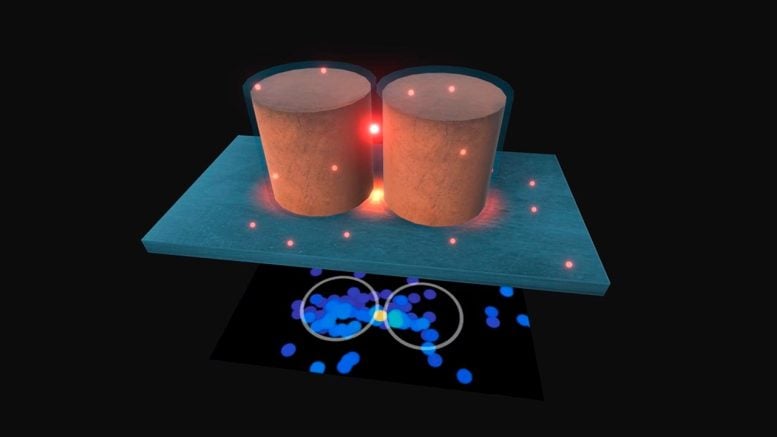
The interaction between single molecules and a gap nanoantenna made of gallium phosphide is measured thanks to single-molecule fluorescence lifetime imaging microscopy (smFLIM). This technique provides spatial and temporal information at the nanoscale of the radiative decay rate of single fluorescent molecules in the near-field of the nanoantenna and highlights the potential of dielectric materials in nanophotonics. An artistic view of the sample, that presents a nice intensity hotspot in the gap, is shown in the figure. The antenna is labeled with fluorescent molecules. The decay rate of each emitting molecule is measured together with their super-resolved position. A super-resolved map of the radiative decay rate is reported below the structure. Molecules in the gap (yellow dot) experience a 30-fold enhancement of the radiative decay rate. Credit: R. Margoth Córdova-Castro, Bart van Dam, Alberto Lauri, Stefan A. Maier, Riccardo Sapienza, Yannick De Wilde, Ignacio Izeddin, and Valentina Krachmalnicoff
The research goes beyond mere theoretical exploration, offering practical insights into light-matter interactions. “This isn’t just about observing enhanced light interaction; it’s about measuring it at the single-molecule level with remarkable spatial precision. Our findings are pivotal for future applications in fields where understanding and controlling light at such a small scale are essential.”
The study’s methodology and results underscore the effectiveness of advanced measurement techniques in nanophotonics. “Our research has successfully mapped the spatial distribution of radiative decay rate enhancement, revealing that while there is some mislocalization of single molecules due to their interaction with the structure, this effect is minimal within the gap of the nanoantenna, providing a precise control of bright single-photon emission source,” the scientists explain.
“This precision in measurement opens up new avenues for the characterization of highly sensitive optical devices and deepens our understanding of the interaction enhancement of a quantum emitter with a nanostructure.”
In conclusion, the scientists emphasize the broader implications of their work: “Our research provides a new lens through which to view nanophotonic interactions. The ability to measure light interaction with such precision paves the way for breakthroughs in various applications, from quantum computing, quantum sensing to medical diagnostics.”
Reference: “Single-emitter super-resolved imaging of radiative decay rate enhancement in dielectric gap nanoantennas” by R. Margoth Córdova-Castro, Bart van Dam, Alberto Lauri, Stefan A. Maier, Riccardo Sapienza, Yannick De Wilde, Ignacio Izeddin and Valentina Krachmalnicoff, 2 January 2024, Light: Science & Applications.
DOI: 10.1038/s41377-023-01349-2