


I have a Raspberry Pi on my home network running Pi-hole, a flight tracking setup, and a few services around them, with an external solid-state drive attached to it. When I first described the machine to my coding agent, I said there was nothing particularly complicated or compute intensive running on it, or so I thought. Every so often, the Pi would stop responding, and a reboot was the only way I could bring it back. Eventually it became annoying enough that I really wanted to find out what had happened. The logs I needed seemed to disappear with the restart, so I had a way to recover the machine and very little idea of how to investigate the failure.
My Linux knowledge covers the things I’ve needed for server-side Java development over the years, and I can find my way around a terminal or follow familiar procedures. System-wide container configuration, service dependencies, and the details of IPv4 and IPv6 take me well beyond that experience. I knew enough to recognize that changing some of those settings could cut off my access and leave me running up the stairs to wire my computer up to the Pi. My dad also depends on this machine for his flight radar app and enjoys watching planes go by, so I had to consider how a change would affect him too.
Before I could consider changing any of those settings, I needed help deciding where to look. Somebody had to turn “The Pi has stopped responding” into questions I could investigate, and I decided that asking the agent was a reasonable way to do that.
It went a little too well, to be honest. The agent configured persistent logging and regular health samples so there would be information to examine after a restart. We moved to Ethernet and disabled Wi-Fi, and it checked the services, storage, and connection to the router. It later repaired forwarding for local name queries and identified a problem in the order in which the Pi-hole container stopped and its external drive was unmounted.
The container needed the drive to stay mounted until the service had stopped, so the agent added an explicit dependency on the drive’s mount to put those events in the right order. After I later installed updates and rebooted, I asked it to check again, and it found log entries showing the service stopping, followed by a successful unmount of the drive.
I could follow those steps once the agent explained them to me: finding the missing dependency, expressing it in the service configuration, and choosing the log entries to examine all required knowledge I was getting from the agent. I trusted its assessment of that reboot, relying on it to judge changes it had made with the root access I had given it over SSH. That felt very weird and gave me reason to think more carefully about the advice to “trust, but verify.”
Checking a repair I needed help to make
The agent also suggested the configuration backups and checks after changes, so I relied on it for the precautions as well as the repair. Judging whether I could recover from a failed change required some of the same Linux knowledge I just didn’t have.
In “Code Review After Code Gets Cheap,” I described starting with intended behavior, evidence, and the effects of a change elsewhere in the system. Adjusting enough of the specification to make correctness checkable also depends on knowing what to expect. With my Pi challenges, I needed help establishing those expectations while deciding whether to accept the change, which left me wondering how likely this approach was to succeed and how much trust was justified.
I had given my agent the ability to act on the assessment I was asking it to make. With root access over SSH, it could change the operating system and services, including settings that determined whether I could reach the machine again. My willingness to let it proceed depended partly on what I thought a mistake would cost me. This was my Pi on my home network, with no services exposed directly to the internet, and I was prepared to spend time repairing it if necessary. I expected that to mean writing a fresh image onto an SD card and configuring the handful of things I had done a couple of times before.
The flight radar was the closest thing to a production dependency, and interrupting it would mean a couple of disappointed messages from my dad almost immediately. A Pi-hole change could also interrupt name resolution for devices on my home network. With upstream fallbacks configured in the router, this would probably mean my kids complaining about too many ads in their favorite apps. Thinking through those dependencies was part of deciding how much disruption I was prepared to accept, and another reason to ask for help understanding the machine.
Deciding how much to hand over
The quadrant below brings together the two things I was trying to judge: how much I understood about the task and what a mistake could affect. Across the horizontal axis is my knowledge of a particular task: how well I can explain the expected behavior, recognize a plausible failure, and assess a check. Up the vertical axis are the consequences of a mistake, including who would be affected and what recovery would involve. I place the Pi toward the lower-left, based on what I understand about it and the disruption I am prepared to accept.
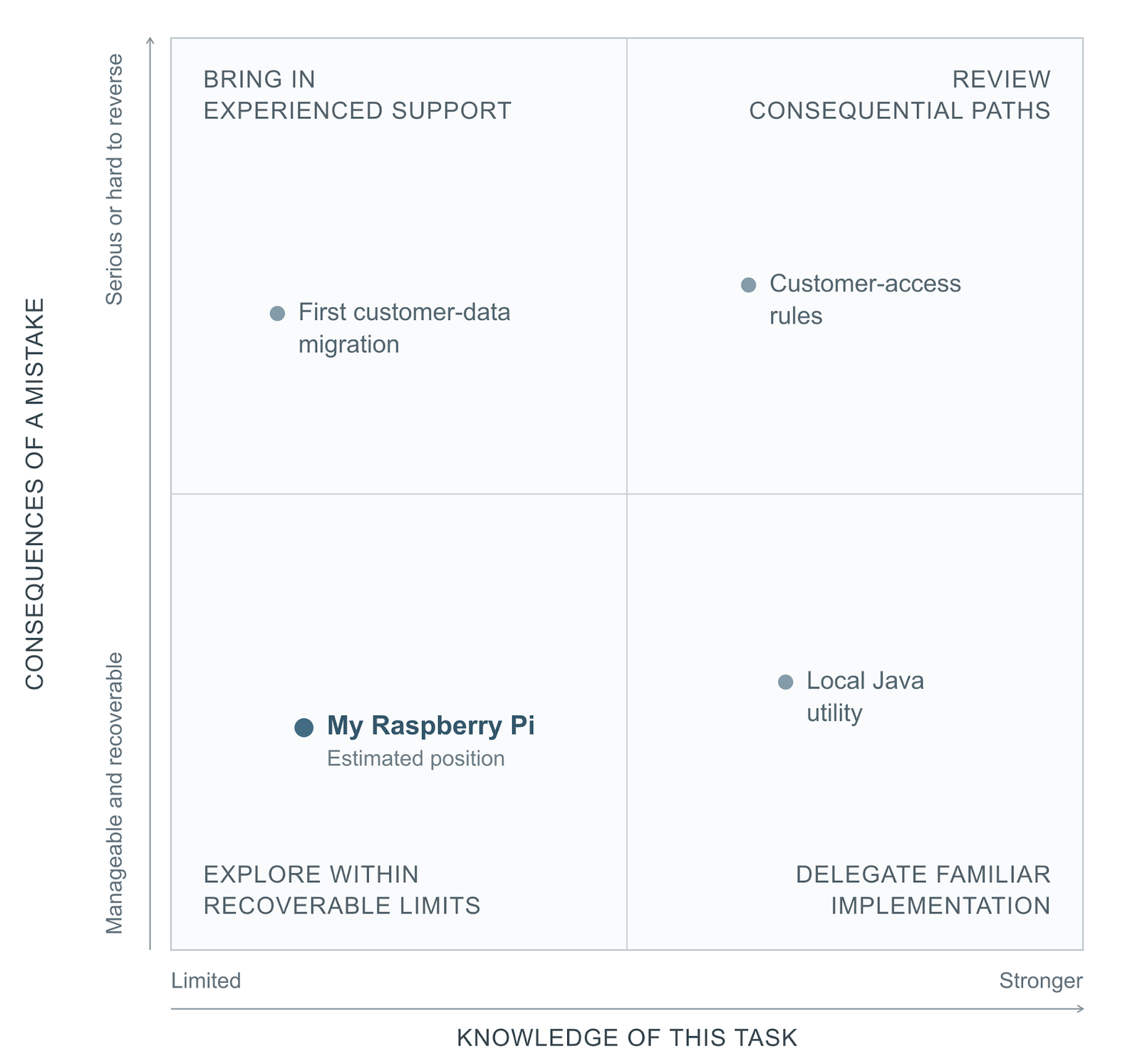
For the Pi, that suggests keeping each change small enough to follow and making sure I can recover before the next one. A developer learning an unfamiliar library in an isolated project with disposable data would be in the same quadrant, with room to try changes whose effects they can contain.
Moving to the right, imagine a local Java utility with familiar inputs and expected outputs. I can give the agent more freedom over the implementation because I know how to assess the result and expect a mistake to have limited effects. My attention can go to whether it does what I asked and what else it changed.
Moving upward changes what I need from the people and systems around me. A developer attempting their first migration of customer data needs somebody who understands the data and its recovery process to review the assumptions with them. The agent can help prepare the migration against a copy, with access controls keeping it away from the live database, while the developer discusses the changes with that experienced colleague.
An experienced maintainer changing customer-access rules would be toward the upper right. Knowing the service helps them anticipate failures and choose representative tests. The consequences for customers also call for review by another person and control over how the change reaches them.
I can be on the right for a familiar Java task and on the left for the Pi’s service configuration. When choosing somebody to review a change, consider their experience with that system and the task, including where they need help.
Learning enough for the next change
Letting my agent operate as root on a Linux machine gave me another small “It can do that too?” moment, along with the discomfort of doing something I ask developers to avoid. I felt I had missed an opportunity to learn, which bothered me because I’ve always loved learning. I had let the agent do its thing and watched the results, so for further changes to my environment I want to use more of my own understanding and judgment.
In a randomized experiment with 52 developers learning the unfamiliar Python library Trio, half were given access to an AI assistant during the coding task. On a quiz taken immediately afterwards without AI, that group scored about four points lower, on average, on a 27-point scale. The result gives me another reason to think about how much I learn while an agent helps me complete an unfamiliar task.
For my next Pi change, I could break the problem down before asking for help, starting with the shutdown sequence. I could describe which events I expect to see and why, before asking the agent for an interpretation. Discussing that prediction with the agent or somebody familiar with the service manager would help me find the parts I need to understand better. I could then follow those parts through the configuration and the result, giving myself something to bring to the next investigation.
Taking those steps would require more effort than asking an agent to “fix things”; and the reward would be a better understanding of the system and, over time, more ability to judge the agent’s decisions and predictions. A team can make room for the same practice by giving a developer a small change, time to understand it, and a colleague to discuss it with. Existing acceptance tests can provide expectations the team has already agreed on, and the colleague can explain what they cover and identify a failure worth investigating. That support needs to be part of asking somebody to review the agent’s changes.
Trusting the next change
I will probably ask for the same help next time, given that all the changes on my Pi had the intended result. The flight radar kept running, and my dad sent me no text messages complaining about it. That success could make me more comfortable letting the agent take over again, so making time to understand the next change will need to be part of that decision.
If more services and people came to depend on the machine while my understanding changed little, I could find myself allowing more consequential decisions on the strength of repairs I had only partly understood. I would need to consider whether that experience justified giving the agent the same freedom.
If agents become better at planning, making changes, and checking the results, they may carry out more of an investigation before involving us. We could spend years accepting those results while getting less practice investigating systems ourselves. An outage would announce that something had gone wrong; recognizing a more subtle error could require knowledge we have stopped using or never developed. I can imagine needing the agent to tell me that its own solution is wrong.
More capable agents may also prevent and detect failures I would miss today, and relying on their checks could be reasonable. I would then need to consider how a mistake in the checking itself could be discovered, who could question the assessment, and what they would need to understand.
So the amount of trust I can justify depends on the particular task, the evidence available, and the cost of being wrong. A history of successful repairs can support confidence in similar changes. Before giving an agent more freedom on a system with a larger blast radius, build enough understanding to assess the change, bring in somebody who can, or limit what the agent is allowed to affect.
For me, trusting an agent includes the uncertainty I accept on behalf of the people using the system. I want that trust to grow alongside my ability to question its decisions, so as I hand over more of the technical judgment, I need to choose what I make time to learn. That understanding shapes how much authority I am prepared to give it and how I take responsibility for the result.