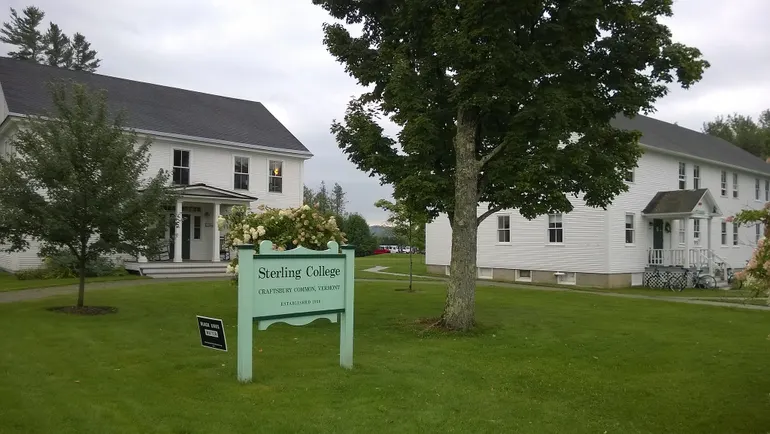
Editor’s note: The College Closure Files is an occasional column chronicling why institutions shuttered and what lessons higher education leaders can glean from those shutdowns.
Tucked away in Vermont’s Green Mountains, Sterling College began as a preparatory school before becoming a college roughly half a century ago. Always small, the environmentally focused Sterling provided students with hands-on outdoor and agricultural experiences. But post-COVID enrollment declines took their toll. The college closed following its spring term this year.
The early years
Before it was a college, the institution that became Sterling was a boys’ preparatory school tucked away in Vermont’s remote Northeast Kingdom. Its “students wore coats and ties, played soccer and chess, studied French, history, and mathematics,” according to a 1983 article by Ann Ingerson, then a faculty member. They were also expected to work hard and, beginning in the 1960s, went on an extended outdoor expedition through Vermont’s backwoods called Bounder.
Its transition to a college came partly in response to a demographic upheaval as the Baby Boomer generation advanced out of K-12 schooling.
In the early 1970s, William Manning was teaching at a college in Maryland when he first visited the Sterling school, which was in deep decline by then. “The handwriting was on the wall,” Manning said. “They were down to less than 20 students. It was a boys’ prep school set in the middle of nowhere.”
Sterling College at a glance:
Founded: 1958
Closed: Spring 2026
Location: Craftsbury, Vermont
Institution type: Private nonprofit
Student body: 57 (fall 2024)
Mission statement: “To advance ecological thinking and action through affordable experiential learning that prepares people to be knowledgeable, skilled, and responsible leaders in the communities in which they live.”
Several years later, Sterling transitioned to higher education. Manning was recruited to spearhead the transformation, initially as the leader of the Grassroots Project — a one-year program that began in 1974 featuring outdoor and environmental curriculum — and as the first president of the college once it was established as a two-year degree granting institution in 1983.
Ingerson wrote that Sterling “turned its weakness into its greatest strength, making its isolated rural environment in northeast Vermont a laboratory for teaching both specific skills and general work attitudes.”
From the beginning, the reimagined Sterling made its remote, northerly setting a key feature of its education. Its Grassroots Project, which Ingerson described as “Sterling’s major program,” taught agriculture, forestry and wildlife management. “Teaching takes place in classroom, workshop, barn and woodlot in groups ranging in size from one to eighty,” Ingerson wrote.
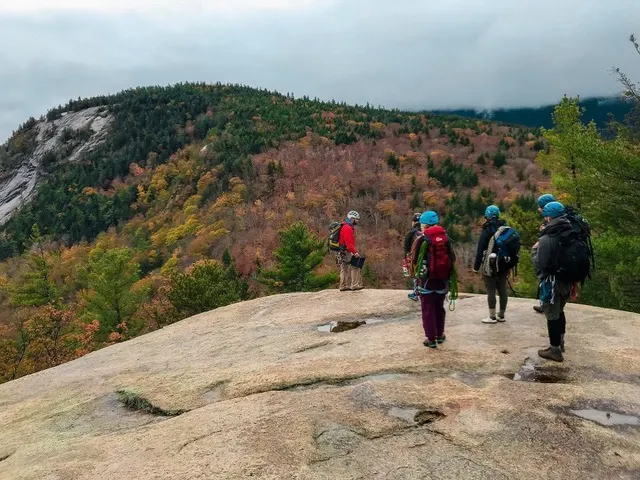
Outdoor expeditions were integral to Sterling’s approach to education.
Permission granted by Sterling College
Students could complement the Grassroots program and complete their associate degree with courses in communication, land use, resource management, economics and literature. Along the way, students might also go white water canoeing and backpacking, and would wake early to do chores around campus.
Sterling continued the Bounder program after it transitioned to higher education, holding three trips a year. The Winter Expedition — one of the Bounder trips — was a key element to life at Sterling. All students had to go on the four-day frigid, rugged journey, trekking by snow shoe and building makeshift shelters.
The excursions’ “real emphasis is on group problem solving,” Manning told The New York Times in 1985. “We like to think that we mold students who can look at a challenge and turn it into an opportunity.”
Along with the outdoor focus, physical work was foundational at Sterling from the start. Its motto was “Working hands. Working minds.” The college would eventually become one of just 10 federally recognized work colleges, which require all resident students to work a certain amount per year through their studies. In recent years, Sterling students had to work 80 hours a semester.
The college’s kitchen and farm were central to the daily student experience.
“A new Sterling College student may arrive in September having never really thought about how food makes it to a plate,” journalist Julia Shipley wrote for a 2011 book about the student farm movement.
“By the time she leaves Sterling, however, she will undoubtedly have harvested potatoes behind a team of horses; she will have washed carrots for the kitchen in a bicycle-powered carrot washer; she will have hauled buckets of food waste from the kitchen to the farm compost and eaten beans or cabbage or beets fertilized by that compost.”
Working in the campus kitchen or on its farm meant that students produced much of their own food, from seed to plate. All told, the campus generated about a third of the food consumed there, according to Laura Spence, who became Sterling’s dean of academics in 2018.
“The kitchen at Sterling has really prided itself in what you could call real food since before that was fashionable,” Spence said.

Students at Sterling worked across campus, including in the kitchen and often cooking with ingredients cultivated on the campus.
Permission granted by Sterling College
In recent years, Sterling’s emphasis on both environmental and liberal arts education coalesced around a single major. It offered associate and bachelor’s degrees only in environmental studies, with required courses in ecology, biodiversity, environmental philosophy and other areas. Students had the option to design a concentration within the major, such as in social justice, natural resource management or sustainable agriculture.
Sterling moved to the single major model in 2023. The shift was meant to focus the institution and prepare it for an age of fewer traditional-aged students, but ultimately even the pared-down academic focus proved too expensive to maintain amid the college’s financial troubles.
Path to closure
In its last few years, Sterling faced challenges similar to those that drove its transformation from a preparatory school to a college.
One is demographic. The pipeline of traditional-aged college students is shrinking. In the Northeast, the population of high school graduates fell 4% to 612,000 between 2012 and 2024, according to the latest count from the Western Interstate Commission for Higher Education.
And WICHE projects Vermont will see a 15% decline in high school graduates by 2041 compared to 2023.
Vermont projected to see deep decline in traditional-age college students
Projected changes in the high school graduate population from 2023 to 2041 by state

Another challenge was perhaps even more existential for Sterling: The college’s remoteness made recruitment difficult. But its location also defined the Sterling identity and experience.
“It’s really interwoven with the fabric up here in the northeast corner of Vermont,” Spence said. “It is filling this niche in this particular area.”
Recruiting into the northern reaches of the state became especially challenging during the pandemic, when precautionary measures slowed down campus visits — historically a key means of converting the college’s recruits to enrollees.
“It particularly hit Sterling hard because we are pretty remote in Vermont. So we’re a little hard to get to, especially when you’ve got all this lockdown stuff happening,” Spence said. “While it does look cool on paper, you don’t really get a sense of the place unless you visit.” As for virtual campus visits, they were “rubbish,” in her view.
Cultural trends could have played a role as well. “You’re trying to get students to choose to come to an isolated location,” said Larry Ladd, a higher ed consultant. “And for decades, cities have been more popular.” He pointed to urban experiences — concerts, museums, sports and the like — that many students want access to without having to travel for hours.
And then there’s Sterling’s size. It was always especially diminutive, even for a small liberal arts school. Historically, it had fewer than 150 students. And enrollment shrank after the pandemic. Just between 2021 and 2023, the already slim enrollment tumbled by 38.1% to 78 students, according to federal data. That dropped again the next fall, to only 57 students in 2024 — essentially dealing a death blow to the college.
Sterling’s downward enrollment slide
The college’s fall headcount from 2014 to 2024.
“Our size has been definitely a weakness in some ways, where we’ve had to do all the same things that a normal institute of higher education has to do,” said Seth Hayden, was the college’s director of operations.
Hayden pointed to broad costs like managing financial aid operations and accreditation. “We’re having to do that with at most 100 students, but we still have to carry a lot of those costs.”
Meanwhile, as Spence pointed out, Sterling’s margins were typically thin. In fiscal 2023, the college’s operating surplus was a little over $300,000 while it had less than $2 million in cash and investments. “There’s not much money to be made in outdoor, experiential education,” she said.
Small colleges like Sterling lack economies of scale that can hedge the finances of larger institutions, Ladd said. “Decisions by a small number of potential students have huge impact, whereas they don’t at a big place,” he said. “You don’t need many students, but you have to get those students. And so you have no buffer.”
Ladd argued that both its small stature and geographic isolation could potentially have been mitigated by migrating online. He pointed to Unity Environmental University, in Maine, which occupies a similar subject matter niche as Sterling. However, unlike its Vermont peer, Unity leaned into online learning and has seen substantial growth in recent years. Between 2019 and 2024, the institution’s fall enrollment skyrocketed by nearly eightfold, reaching 7,165 students.
“Unity is an online version of an environmental university,” Ladd said. “It’s teaching the same things in radically different ways.”
But such a model would run nearly antithetical to Sterling’s ethos as a place where students come to work in the kitchen and on the farm, and to backpack through the woods in the tough northern weather.
Sterling instead looked for ways to save itself that — true to its history — drew on its environmental and geographic heritage.
The college had conversations with other institutions about partnerships or a possible merger. One idea was for Sterling to provide outdoor experiential education as a partner or satellite campus of another institution.
“Their students would come here for a semester, have this special experience and go back,” Spence explained.
Other institutions showed interest in Sterling, but it seemed conditions weren’t ripe given their own financial challenges.
“We heard from all the schools it wasn’t the right time for them,” said Hannah Rushing, Sterling’s director of advancement at the time of closure. “It was a challenging external environment — not a great time to take that kind of risk.”
Without a partner or an infusion of funding, Sterling couldn’t make the economics work. In November 2025, the college announced it would close after the spring 2026 term.
What comes next?
Even while preparing to permanently shutter the college, stakeholders have been trying to secure some kind of future life for Sterling’s legacy.
That’s not uncommon when a nonprofit college closes. In Sterling’s case, the institution has already made one such substantial transformation in its past — from a fairly typical boys’ preparatory school to a niche college focused on agriculture, work, ecology and the land.
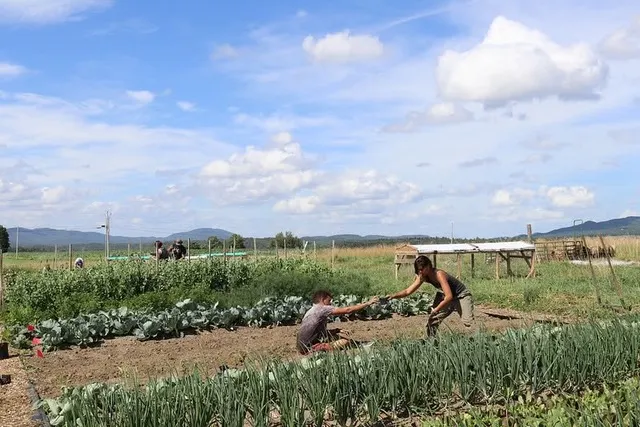
Sterling’s farm acted as an experiential classroom for students.
Permission granted by Sterling College
“Anything that can be done to keep on bringing young people into this area, as well as to keep this education going would be great,” Spence said.
For now, the college’s board is still working on managing the wind-down, a fiduciary matter that has legal priorities attached to it, not least among them repaying creditors. That will have a large impact on what happens to the college’s campus real estate, which went on the open market around mid-June.
Its campus includes “10 to 20” buildings, depending on how you count them, according to Hayden. And those buildings have “a lot of deferred maintenance,” Rushing said. The college also owns a farm, forest, wetlands, a yurt, a climbing wall and over 300 acres in nearby Bear Swamp.
The farm is a tricky asset to manage through this transition. While integral to Sterling’s educational philosophy over the years, it has living animals on it that require costly care.
In the spring, lambs were still being born daily on the property. At the time, Sterling had 18 ewes, 15 lambs and 80 egg-laying hens, along with two up-for-sale cows. The college was searching for homes for all that livestock as faculty were teaching the final semester of classes.
Meanwhile, several stakeholders are moving quickly to form a new organization to house Sterling’s legacy.
The fledgling entity — tentatively named the Sterling Institute for Conservation and Community Leadership — plans to focus on environmental education and workforce development, according to Manning, who’s been involved in its formation.
The idea behind it is to recruit young people to initially work on conservation and restoration projects in the Northeast Kingdom. As they progress through the institute’s programs, their experience could look much like Sterling — with culinary and garden work, as well as humanistic and arts elements, Manning said.
Instead of depending so dearly on tuition to survive, though, the institute would house multiple enterprises that would generate pay for students and income for the institute. Those would include a food service program that could operate in the area, and an innovation hub that might work on everything from environmental restoration to outdoor gear development, Manning said.
Ideally, those ventures would be economically self-sustaining. “This is not an ivory tower where we’re going to do 75% discounts on tuition and be underwater all the time,” he said.
Access to the Sterling campus has been key to the institute’s plan.
That outcome may be in sight. In mid-September, the Headwaters Community Trust and Sterling signed a sale agreement for the college’s campus. Headwaters has started due diligence on a final sale agreement and expects to close on the property by the end of the year.
In its announcement, Headwaters described the deal as “another step forward in a community effort to reimagine the future of a vital asset in the heart of the Northeast Kingdom.”
Headwaters Community Trust emerged earlier this year as an interested buyer of the campus — and one friendly to a potential revival of the Sterling name and educational philosophy.
Both community members and Sterling faculty have seen Headwaters as a potential steward of the property — and the college’s legacy, according to reporting from local Orleans County newspaper the Chronicle. Manning worked through the summer to help facilitate Headwaters’ acquisition of the campus, seeing the organization as a viable partner for the new Sterling Institute.
In its release, Headwaters said it would continue talking with “former Sterling College faculty and staff interested in launching educational programs on a portion of the campus.”
Measured in pure statistics, Sterling might look exactly like the kind of college fated to close in the demographic cliff era. It’s a small — very small — liberal arts college tucked away in the wilds of northern New England. But at the same time, the college is distinct in an era when institutions are keen to differentiate. And it prided itself on creating deep, memorable experiences for students long before the term “experiential education” came into wide use.
The determination to keep alive Sterling’s model of education feels palpable among those closest to the institution.
“The story I want to emerge from this is the launch of the institute,” Manning said. “All the statistics on the colleges that are closing, especially small colleges — well, guess what: This one isn’t.”