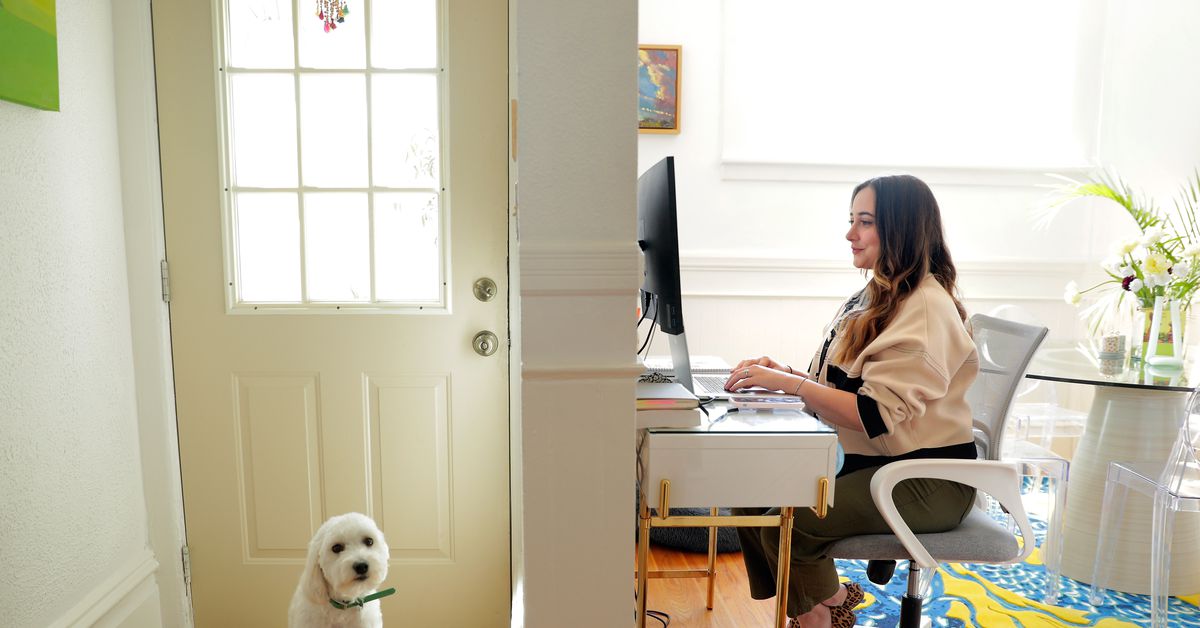
For the minority of Americans who’ve been fortunate enough to work from home over the past couple of years, the ride might seem like it’s coming to an end. Employers big and small are asking their employees to return to the office — just as those employees have gotten really good at working from home.

People who work remotely are reporting being more productive than they were early on in the pandemic, according to data from Stanford University professor Nicholas Bloom. Bloom, who’s been studying remote work since before it was cool, has teamed up with other academics from the University of Chicago, ITAM, and MIT since May 2020, to conduct a huge ongoing survey about employees’ work arrangements and attitudes toward remote work. In April, people who worked remotely at least some of the time reported being about 9 percent more efficient working from home than they were working from the office. That’s up from 5 percent in the summer of 2020.
Why? Bloom says we’ve gotten better at it.
“When we flipped to working from home back in March 2020, we were completely unprepared,” Bloom told Recode. “We didn’t have management systems, performance review systems, meeting structures, workflows, equipment.”
Now we’re much better set up, and productivity should continue to improve as technology makes it easier, according to Bloom.
Additionally, and perhaps more importantly, as the worst parts of the pandemic fade, our support systems outside of work — day care, friends and family, the ability to do literally anything besides staying home — have largely returned, too.
“Whatever you were doing during the pandemic and its stilted aftermath, it was not working from home,” Anne Helen Petersen and Charlie Warzel note at the start of their book Out of Office: The Big Problem and the Bigger Promise of Working from Home. “You were laboring in confinement and under duress.”
Of course, this data on productivity is self-reported, and most people report wanting to keep working from home, so take it with a grain of salt. There is, however, objective data — like more calls per minute for call center workers, engineers submitting more changes to code, and Bureau of Labor Statistics data on growing output per hours worked — that has generally shown that people are, in fact, more productive working from home. But even the idea that people feel more productive is important.
Around 40 percent of American workdays are currently done from home, according to Bloom’s data. This figure tracks with data from the office keycard company Kastle, which is seeing office buildings at 43 percent occupancy. Bloom expects it to remain at around 25 to 30 percent after the pandemic, meaning that working from home will by no means go away. So while traffic has mostly returned to pre-pandemic levels at hotels, movie theaters, and restaurants, the offices remain a holdout.
Many employers have conceded that productivity is fine at home, but they’re still worried about other immeasurables, like workers’ ability to collaborate and to be creative from home. A December report from Northeastern University found that over half of C-suite executives across industries were concerned about their workforce’s ability to be creative and innovative while working remotely. They also worry about how continued remote work will affect their company culture and loyalty. Interestingly, Slack’s Future Forum found that executives are more likely to say they want to work from the office than non-executives, but are less likely to be doing so full time. The study also found that since a third of office workers have returned to the office five days a week — the highest since the survey began in June 2020 — these workers are also reporting their worst employee experience.
But in this current tight labor market, many workers are getting their way with remote work, and bosses aren’t exactly in a position to push back. Interest in remote jobs is consistently higher than that of onsite work. About 20 percent of paid job listings on LinkedIn were remote in March, but they saw the majority of applications (52 percent), according to the company. And some 60 percent of knowledge workers said they would quit their job for a fully remote one.
Indeed, employers seem to be conceding to employees’ desire to work from home. According to the Bloom surveys, office workers say their employers are planning to let them do so on average 2.3 days per week after the pandemic. That’s up from 1.6 days in the summer of 2020.
Apple had said it would make workers come into the office three days per week, but has since postponed and modified that plan after worker pushback and after a prominent machine learning engineer resigned over the company’s lack of flexibility. Even the office stalwarts like big banks are changing their tune and increasingly offering remote work. JPMorgan Chase CEO Jamie Dimon, who has been vocal about his disdain for remote work, said in his latest shareholder letter that only half of the company’s workers would be in the office full time.
Anecdotally, we’re hearing from people who are required to go into the office a few days per week that it’s not actually happening. Tech companies, law offices, and insurance firms are telling employees to come in two or three days per week, and they’re showing up one or two. Companies could, of course, fire workers for failing to comply with office mandates, but that doesn’t seem to be happening.
It’s less clear what happens when the economy turns sour and when people don’t have as much leverage as they do now. In that case, employers might be better able to force workers back into the office — or perhaps they’ll go the other way and get rid of more office space.
As it stands, 52 percent of the 185 office companies recently surveyed by the real estate services company CBRE said they intend to decrease their office real estate in the next three years, compared with 39 percent who say they’re expanding (9 percent say they’re maintaining their existing footprint). The survey found that most companies, 73 percent, plan to follow a hybrid work plan wherein people work from home and the office, while 19 percent are office only and 8 percent are fully remote. Amid the uncertainty, coworking spaces, which can be unloaded much more quickly than traditional office space, are thriving.
For now, many office workers are doing a pretty good job of working from home.
This story was first published in the Recode newsletter. Sign up here so you don’t miss the next one!