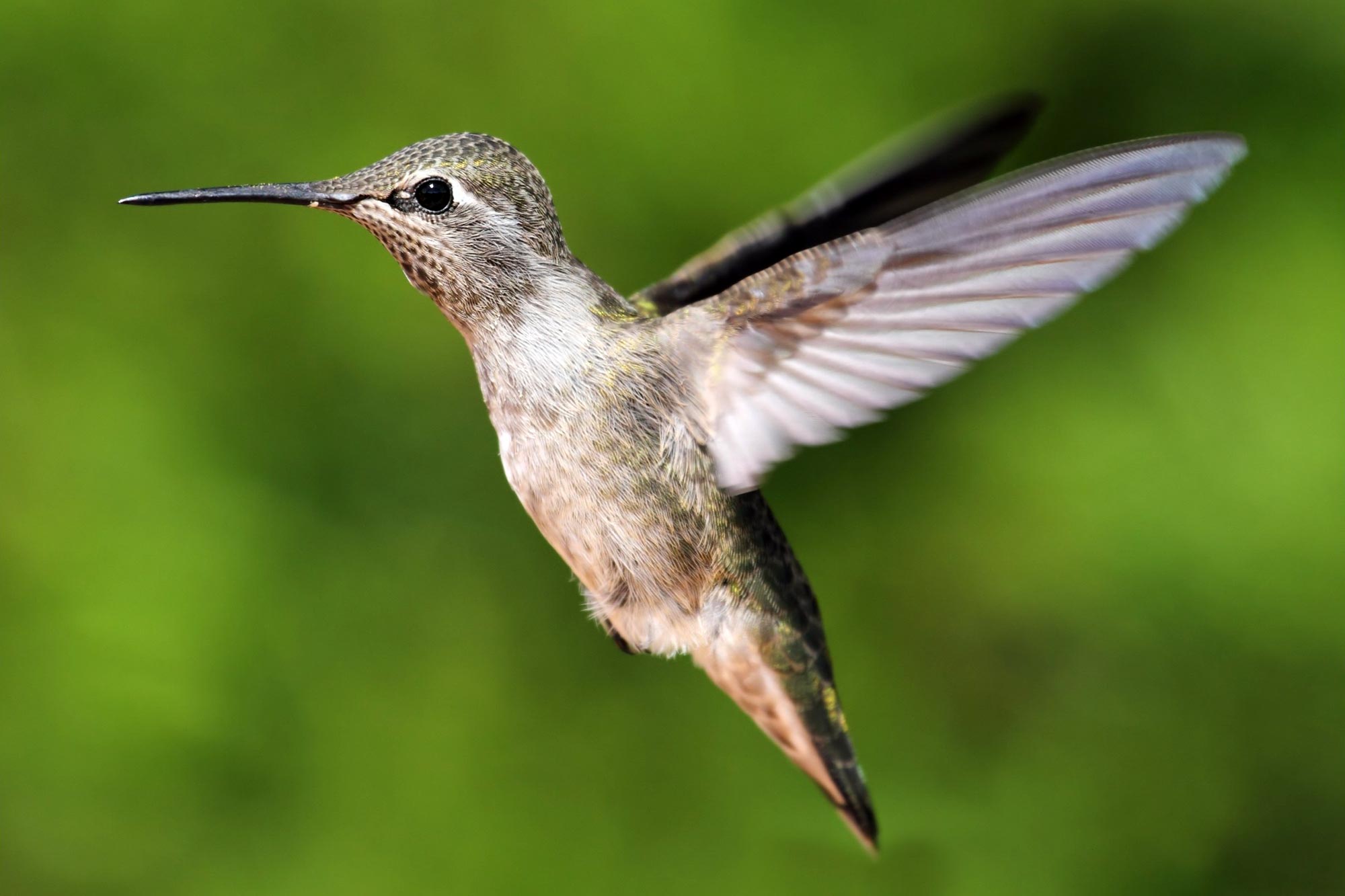

Anna’s hummingbird (Calypte anna). New research shows that hummingbirds would struggle to cope if climate changes drives them to much higher elevations.
Any animal ascending a mountain experiences a double whammy of difficulties: the air gets thinner while it also becomes colder, which is particularly problematic for creatures striving to keep warm when less oxygen is available. For tiny animals with the highest-octane lives, such as hovering hummingbirds, the challenges of migrating to higher levels to evade climate change may be too much, but no one knew whether these incredible aviators may have more gas in the tank to keep them flying at higher altitudes.
As Anna’s hummingbirds (Calypte anna) are comfortable up to elevations of ~2,800 m (~9200 feet), Austin Spence from the University of Connecticut, USA, and Morgan Tingley from the University of California, Los Angeles, USA, were curious to find out how hummingbirds that originated from close to sea level and those that live at the loftier end of the range would cope when transported well above their natural habitat to an altitude of 3,800m (12,500 feet). They published their discovery in the Journal of Experimental Biology that the birds struggle to hover and suffer a 37% drop in their metabolic rate at that height – in addition to becoming torpid for most of the night to conserve energy – making it unlikely that they can relocate to higher altitudes.
To find out how the agile aeronauts fared at high altitudes, Spence first lured the animals into net traps, from sites 10m (33 feet) above sea level (Sacramento, CA) up to 2,400m (7,900 feet) (Mammoth Lakes, CA). Then he and Hannah LeWinter (Humboldt State University, USA) transported them to an aviary in western California at 1,215m (4,000 feet). Once the birds had spent a few days in their new home, the scientists set up a tiny funnel into which the birds could insert their heads as they hovered while sipping tasty syrup, and measured the birds’ O2 consumption (metabolic rate).
Spence and LeWinter also measured the hummingbird’s CO2 production (another measure of metabolic rate) overnight, as the tiny creatures allowed their metabolism to tumble when they became torpid – a form of mini hibernation – to conserve energy while they slept. Then, the duo relocated the birds to a nearby research station near the peak of Mount Barcroft, CA (3800m/12,500 feet) where the air is thinner (~39% less oxygen) and colder (~5°C), and after ~4days at the new altitude, Spence and LeWinter remeasured the birds’ metabolic rates as they hovered and how often and deeply the birds went into torpor as they slumbered.
Even though the hovering hummingbirds should have been working harder to remain aloft in the thin air 1000m above their natural range, the birds actually experienced a 37% drop in their metabolic rate. And when the team compared the energy used by birds that originated close to sea level and from the higher end of their range, they all struggled equally on the mountain top. “Overall, these results suggest low air pressure and oxygen availability may reduce hovering performance in hummingbirds when exposed to the acute challenge of high-elevation conditions,” says Spence.
In addition to struggling to hover, the birds resorted to dropping their metabolic rate and became torpid for lengthier periods at night, spending more than 87.5% of the chilly high-altitude night in torpor. “It means that even if they’re from a warm or cool spot, they use torpor when its super-cold, which is cool,” says Spence. And when the team checked the size of the animals’ lungs, to find out whether the birds that originated from higher altitudes had larger lungs to compensate for their meager oxygen supply, they did not. But the birds did have larger hearts to circulate oxygen around the body.
What does this mean for the hummingbird’s future as climate change forces them to find more comfortable conditions? “Our results suggest lower oxygen availability and low air pressure may be difficult challenges to overcome for hummingbirds,” says Spence, meaning that the birds will likely have to shift north in search of cooler climes.
Reference: “Anna’s hummingbird (Calypte anna) physiological response to novel thermal and hypoxic conditions at high elevations” by Austin R. Spence, Hannah LeWinter and Morgan W. Tingley, 26 May 2022, Journal of Experimental Biology.
DOI: 10.1242/jeb.243294
Funding: National Science Foundation, Society for Integrative and Comparative Biology (SICB), White Mountain Research Center