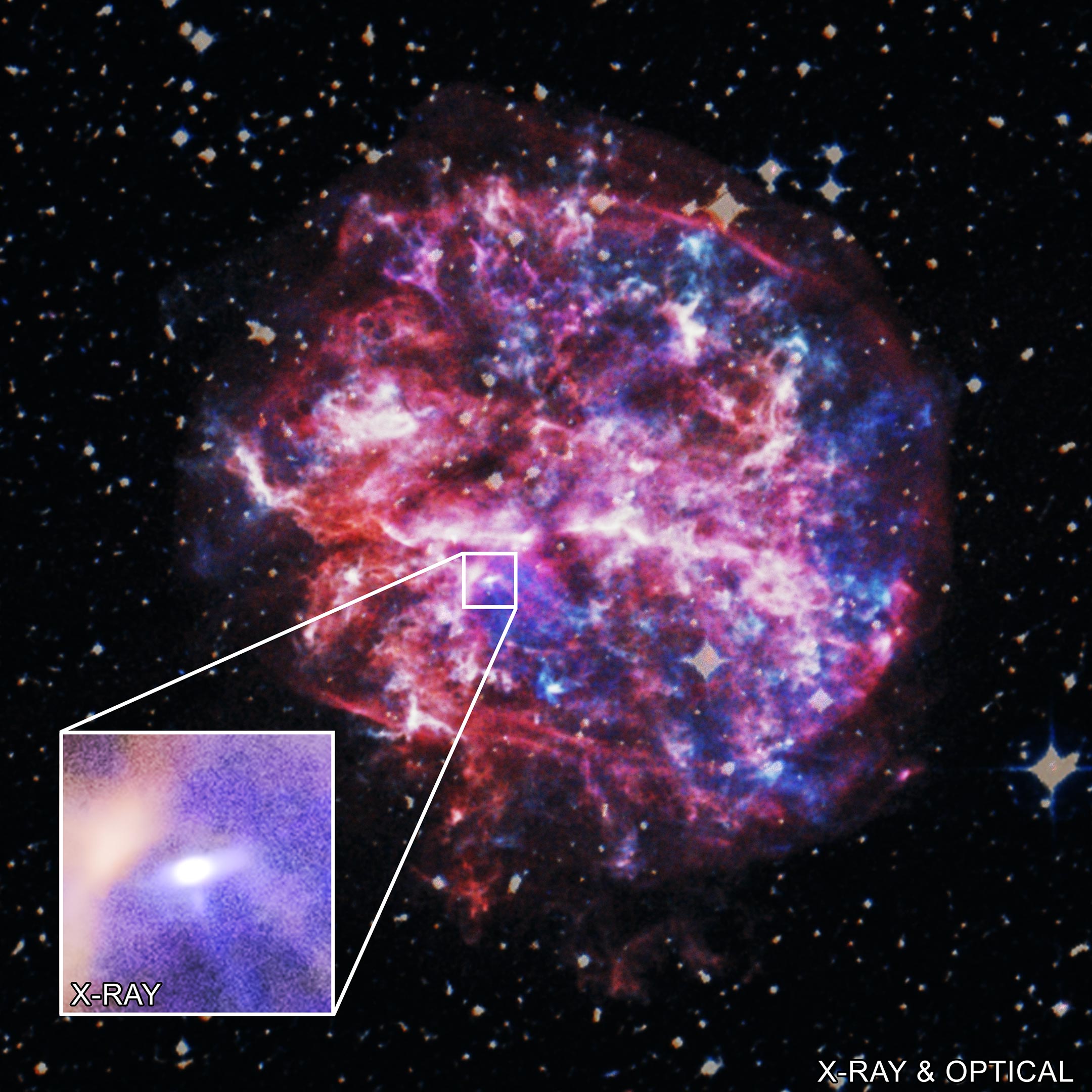
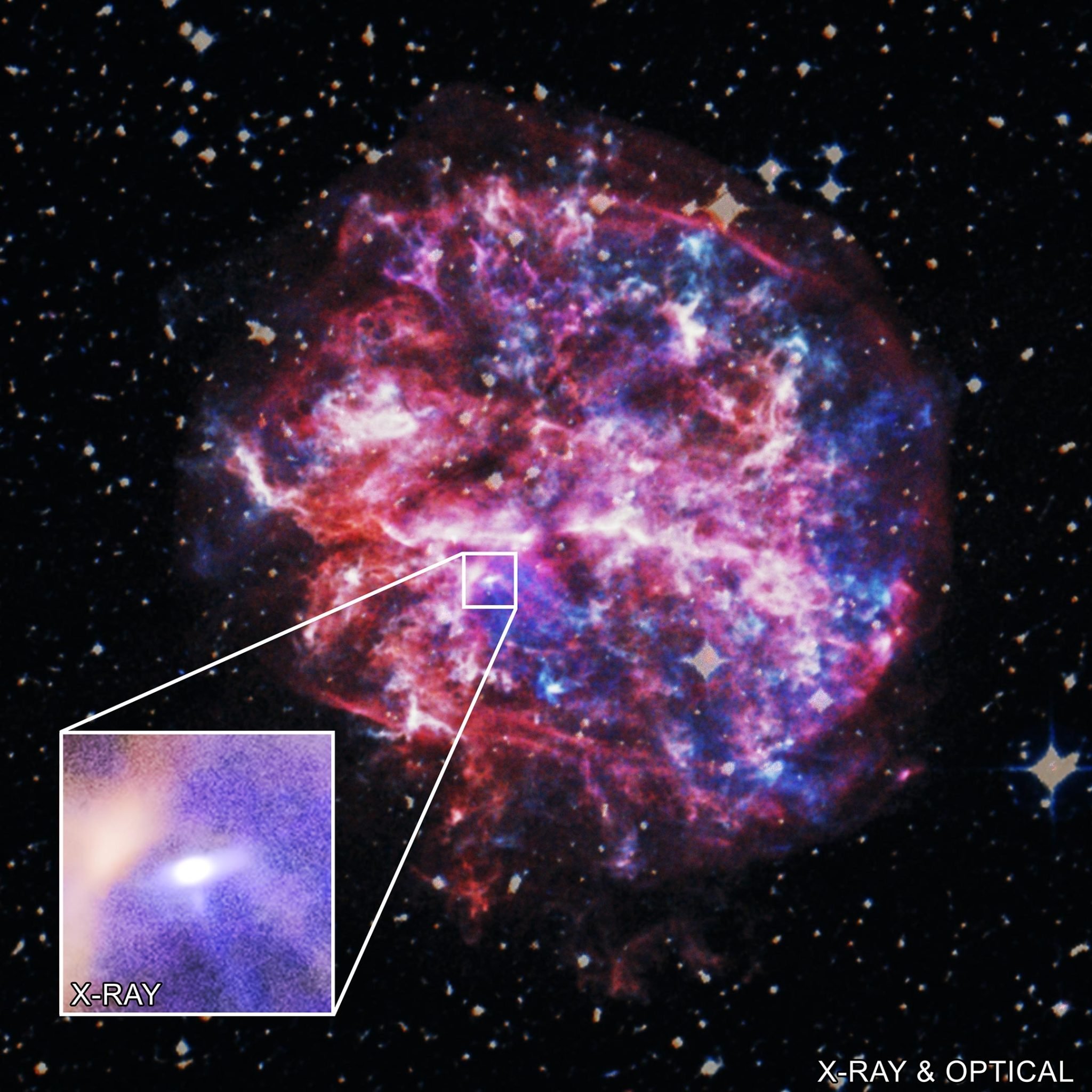
The G292.0+1.8 supernova remnant contains a pulsar moving at over a million miles per hour, as seen in the Chandra image along with an optical image from the Digitized Sky Survey. Pulsars are rapidly spinning neutron stars that can form when massive stars run out of fuel, collapse, and explode. Sometimes these explosions produce a “kick,” which sent this pulsar racing through the remains of the supernova explosion. Additional images show a close-up look at this pulsar in X-rays from Chandra, which observed it both in 2006 and 2016 to measure this remarkable speed. The red crosses in each panel show the position of the pulsar in 2006. Credit: X-ray: NASA/CXC/SAO/L. Xi et al.; Optical: Palomar DSS2
- A pulsar is racing through the debris of an exploded star at a speed of over a million miles per hour.
- To measure this, researchers compared NASA Chandra X-ray Observatory images of G292.0+1.8 taken in 2006 and 2016.
- Pulsars can form when massive stars run out of fuel, collapse, and explode — leaving behind a rapidly spinning dense object.
- This result may help explain how some pulsars are accelerated to such remarkably high speeds.
The G292.0+1.8 supernova remnant contains a pulsar moving at over a million miles per hour. This image features data from NASA’s Chandra X-ray Observatory (red, orange, yellow, and blue), which was used to make this discovery. The X-rays were combined with an optical image from the Digitized Sky Survey, a ground-based survey of the entire sky.
Pulsars are rapidly spinning neutron stars that can form when massive stars run out of fuel, collapse and explode. Sometimes these explosions produce a “kick,” which is what sent this pulsar racing through the remains of the supernova explosion. An inset shows a close-up look at this pulsar in X-rays from Chandra.
To make this discovery, the researchers compared Chandra images of G292.0+1.8 taken in 2006 and 2016. A pair of supplemental images show the change in position of the pulsar over the 10-year span. The shift in the source’s position is small because the pulsar is about 20,000 light-years from Earth, but it traveled about 120 billion miles (190 billion km) over this period. The researchers were able to measure this by combining Chandra’s high-resolution images with a careful technique of checking the coordinates of the pulsar and other X-ray sources by using precise positions from the Gaia satellite.

Pulsar Positions, 2006 & 2016. Credit: X-ray: NASA/CXC/SAO/L. Xi et al.
The team calculated the pulsar is moving at least 1.4 million miles per hour from the center of the supernova remnant to the lower left. This speed is about 30% higher than a previous estimate of the pulsar’s speed that was based on an indirect method, by measuring how far the pulsar is from the center of the explosion.
The newly determined speed of the pulsar indicates that G292.0+1.8 and its pulsar may be significantly younger than astronomers previously thought. The researchers estimate that G292.0+1.8 would have exploded about 2,000 years ago as seen from Earth, rather than 3,000 years ago as previously calculated. This new estimate of the age of G292.0+1.8 is based on extrapolating the position of the pulsar backward in time so that it coincides with the center of the explosion.
Several civilizations around the globe were recording supernova explosions at that time, opening the possibility that G292.0+1.8 was directly observed. However, G292.0+1.8 is below the horizon for most northern hemisphere civilizations that might have observed it, and there are no recorded examples of a supernova being observed in the southern hemisphere in the direction of G292.0+1.8.

A close-up view of the center of the Chandra image of G292+1.8. The direction of motion of the pulsar is shown (arrow), and the position of the center of the explosion (green oval) based on the motion of debris seen in optical data. The position of the pulsar is extrapolated back 3,000 years and the triangle depicts the uncertainty in the angle of the extrapolation. Agreement of the extrapolated position with the center of the explosion gives an age of about 2,000 years for the pulsar and G292+1.8. The center of mass (cross) of X-ray-detected elements in the debris (Si, S, Ar, Ca) is on the opposite side of the center of the explosion from the moving pulsar. This asymmetry in the debris to the upper right of the explosion resulted in the pulsar being kicked to the lower left, by conservation of momentum. Credit: X-ray: NASA/CXC/SAO/L. Xi et al.; Optical: Palomar DSS2
In addition to learning more about the age of G292.0+1.8, the research team also examined how the supernova gave the pulsar its powerful kick. There are two main possibilities, both involving material not being ejected by the supernova evenly in all directions. One possibility is that neutrinos produced in the explosion are ejected from the explosion asymmetrically, and the other is that the debris from the explosion is ejected asymmetrically. If the material has a preferred direction the pulsar will be kicked in the opposite direction because of the principle of physics called the conservation of momentum.
The amount of asymmetry of neutrinos required to explain the high speed in this latest result would be extreme, supporting the explanation that asymmetry in the explosion debris gave the pulsar its kick.
The energy imparted to the pulsar from this explosion was gigantic. Although only about 10 miles across, the pulsar’s mass is 500,000 times that of the Earth and it is traveling 20 times faster than Earth’s speed orbiting the Sun.
The latest work by Xi Long and Paul Plucinksky (Center for Astrophysics | Harvard & Smithsonian) on G292.0+1.8 was presented at the 240th meeting of the American Astronomical Society meeting in Pasadena, CA. The results are also discussed in a paper that has been accepted for publication in The Astrophysical Journal. The other authors of the paper are Daniel Patnaude and Terrance Gaetz, both from the Center for Astrophysics.
Reference: “The Proper Motion of the Pulsar J1124-5916 in the Galactic Supernova Remnant G292.0+1.8” by Xi Long, Daniel J. Patnaude, Paul P. Plucinsky and Terrance J. Gaetz, Accepted, The Astrophysical Journal.
arXiv:2205.07951
NASA’s Marshall Space Flight Center manages the Chandra program. The Smithsonian Astrophysical Observatory’s Chandra X-ray Center controls science operations from Cambridge, Massachusetts, and flight operations from Burlington, Massachusetts.