
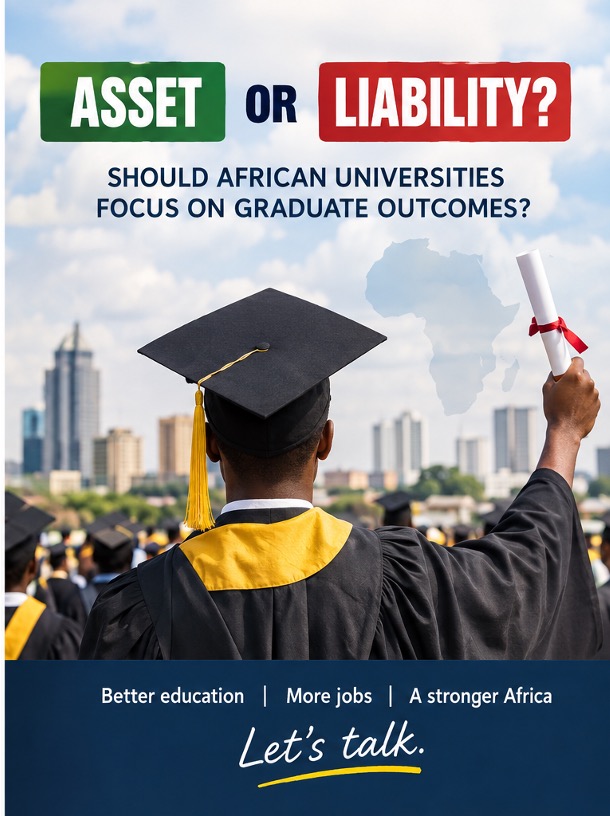
Should a University Degree Be an Asset or a Liability? Trump’s Student-Loan Experiment Raises a Question Africa Can’t Ignore
By Grant Bulmuo | Education & Africa

For generations, the African university degree has carried almost mythical status.
It is the ticket to a better life. It is the certificate parents sacrifice for. It is the framed document displayed proudly on the wall. For many families, sending a son or daughter to university represents one of the biggest investments they will ever make.
But here is the uncomfortable question:
What if the degree does not lead to a job, income, enterprise or meaningful economic opportunity?
And perhaps an even harder question:
Should universities and students begin treating every degree as an economic investment—with an expected “asset” or “liability” outcome?
That debate has been reignited by a significant change in the United States.
Trump’s higher-education experiment
According to The New Republic, the Trump administration is moving to restrict federal student-loan eligibility for university programmes whose graduates fail to meet specified earnings benchmarks. The U.S. Department of Education describes the policy as an earnings-accountability framework, arguing that students and taxpayers should not be financing programmes that routinely leave graduates with poor financial returns.
The final regulations introduce earnings benchmarks for programmes seeking access to federal Direct Loans. In broad terms, undergraduate programmes can lose loan eligibility when their graduates fail to meet the specified earnings threshold relative to people with only a high-school education; graduate programmes face a comparison with bachelor’s-degree holders.
The changes are expected to have implications for programmes where earnings may traditionally be lower, including areas such as social work, arts, religious studies and some education-related programmes. The New Republic argues that this raises concerns about society undervaluing professions whose importance cannot be measured simply through salaries.
There is therefore a fascinating tension at the heart of this debate:
Should the value of education be measured by what graduates earn—or by what graduates contribute?
That question matters enormously for Africa.
Africa has a different problem—but perhaps the same warning
Africa is not America.
Our university systems, labour markets, public finances, student-financing arrangements and economic structures are very different.
Yet the underlying problem is remarkably familiar.
The World Bank estimates that roughly 10–12 million young people enter Africa’s labour force each year, while only around 3 million formal jobs are created annually. It says the continent faces a significant mismatch between education systems and rapidly changing labour-market needs.
Another World Bank analysis highlights a persistent skills mismatch in Africa, noting that university education is too often disconnected from the skills employers require.
So we must ask ourselves:
Are African universities producing graduates—or producing employable graduates?
There is a difference.
A student can graduate with a first-class degree and still struggle to find meaningful work.
A student can spend four years studying a subject, only to discover that the economy has very few opportunities for that qualification.
And a family can invest thousands of dollars, pounds, cedis, naira or shillings in university education without ever asking the most basic investment question:
“What economic and social return can we reasonably expect from this investment?”
The case for treating degrees as assets
There is a powerful argument for this approach.
1. Students deserve better information
Before committing four, five or six years of their lives—and potentially significant amounts of money—students should know what typically happens to graduates from that programme.
How many find employment?
How long does it take?
What are the typical earnings?
What percentage become entrepreneurs?
What industries employ them?
What additional qualifications are normally required?
What skills do employers actually demand?
That information should not be a secret.
Universities should publish graduate-outcome data in language that parents and students can understand.
2. It could force universities to become more accountable
For too long, universities in many countries have been able to measure success by enrolment numbers, graduation numbers and academic prestige.
But perhaps the conversation should also include:
Where are our graduates five years after graduation?
Rwanda provides an interesting example. Its Priority Skills for Growth programme shifted towards market-driven training, industry partnerships and programmes connected to sectors such as energy, transport, logistics and agro-processing. The World Bank reports that the programme created or upgraded 46 TVET and degree programmes aligned with selected economic sectors.
Tunisia has similarly pursued industry-linked degree programmes, graduate tracer studies and stronger university-employer connections.
The lesson is not that universities should become factories for producing workers.
It is that education and economic opportunity cannot be completely separated.
But here is where the argument becomes dangerous
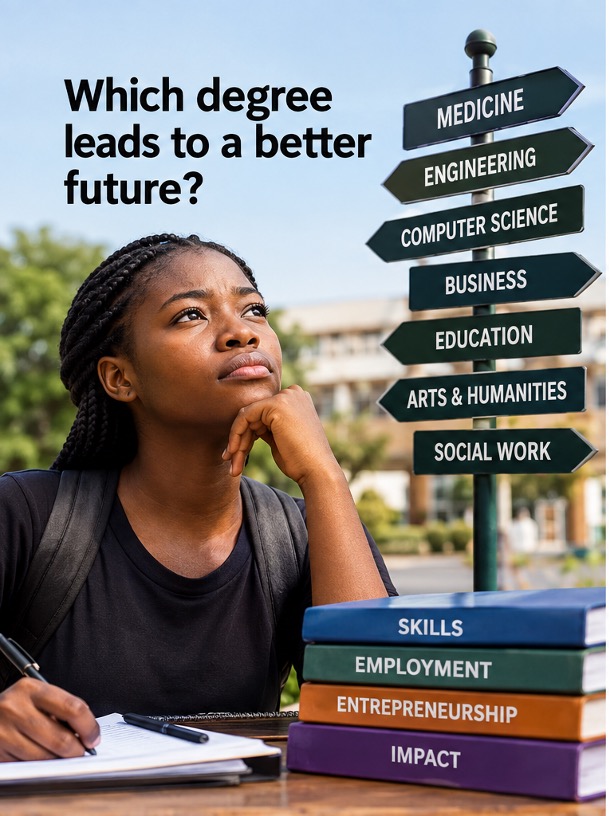
If we make salary the ultimate measure of a degree, we could create another problem.
Who decides what is valuable?
Imagine a country where every young person is encouraged to study only medicine, engineering, computer science, finance or artificial intelligence because those professions currently pay more.
Who then becomes the teacher?
Who studies history?
Who researches African languages?
Who becomes the social worker?
Who creates music?
Who becomes the artist?
Who studies philosophy?
Who develops the next generation of educational thinkers?
Who serves communities where financial rewards are limited but social needs are enormous?
A society cannot function entirely according to salary tables.
A teacher may not earn as much as a technology executive, yet that teacher may influence thousands of children.
A social worker may not generate millions in revenue, but may help keep vulnerable families together.
A historian may not create a technology start-up, but can help a nation understand where it came from.
Economic value and social value are not always the same thing.
This is one of the strongest criticisms of using earnings as the sole test of educational value. The New Republic reports concerns from higher-education figures that some socially valuable professions and humanities disciplines cannot be adequately judged by immediate earnings.
So what should Africa do?
Perhaps the answer is not to copy Trump.
Perhaps the answer is to learn from the question.
Every African university degree should be examined through both an ASSET and LIABILITY lens.
Not because education should be reduced to money—but because students and families deserve honesty.
The ASSET test
Before launching or expanding a degree programme, universities could ask:
- What skills will students acquire?
- What sectors need these skills?
- What jobs currently exist?
- What future jobs are emerging?
- Can graduates create businesses with these skills?
- Can the qualification support international opportunities?
- Does it develop transferable skills?
- Does it address an important national or continental challenge?
- Does it provide opportunities for postgraduate development?
- What do graduates actually do three and five years after graduation?
The LIABILITY test
Universities should also ask:
- Are we enrolling students simply because there is demand for the course?
- Are we producing more graduates than the economy can absorb?
- Are graduates leaving with large financial obligations?
- Are curricula outdated?
- Are students gaining practical experience?
- Are employers involved in curriculum design?
- Are graduates acquiring digital and entrepreneurial skills?
- Are we measuring employment and enterprise outcomes?
- Are we honestly telling prospective students about the risks?
This is not about killing degrees.
It is about killing educational complacency.
The bigger issue: Africa needs more than degrees
There is another uncomfortable truth.
Africa does not simply have a university problem.
Africa has a jobs problem.
The World Bank says approximately one million young Africans enter the labour market every month, while much of the continent’s employment remains informal.
Therefore, telling every young African to choose a “high-paying degree” is not enough.
If there are no jobs, even the most carefully selected degree can become a frustrating piece of paper.
That means governments, universities and businesses must share responsibility.
Universities need stronger relationships with industry.
Businesses need to help shape curricula.
Governments need to create environments in which businesses can grow and employ people.
Students need access to career information before choosing courses.
And universities need to embrace entrepreneurship, internships, apprenticeships, digital skills and practical experience alongside academic knowledge.
The World Bank’s recent work on Africa’s skills challenge similarly argues for stronger employer involvement, practical experience and better alignment between education and labour-market demand.
Perhaps the real question is bigger than Trump
President Trump’s policy has triggered an American debate about whether taxpayers should finance degrees that produce weak financial returns.
Africa should have its own debate.
Not:
“Which degrees make the most money?”
But:
“What kind of education does Africa need—and how do we make sure that education creates opportunity, productivity, innovation and human flourishing?”
A degree should ideally be an asset to the individual, the family, the economy and society.
But when a university knowingly produces thousands of graduates for a labour market that cannot absorb them, without providing practical skills, career pathways or transparent outcome information, that degree risks becoming a liability.
And perhaps the most painful part is that the liability is often not carried by the university.
It is carried by the young graduate—and by the family that sacrificed everything to send them there.
SchoolWorld Media asks: What do YOU think?
Should African universities begin publishing the five-year employment, earnings, entrepreneurship and further-study outcomes of every degree programme?
Should governments continue funding university places regardless of graduate outcomes?
Should students choose degrees partly on their expected Asset vs Liability outcome?
Or would such a system unfairly turn education into a marketplace where only highly paid professions are considered valuable?
And perhaps most importantly:
If your son or daughter came to you today and said, “I want to study this subject at university,” would you ask them what job it leads to?
We want to hear from you.
Are you a student? Parent? Teacher? University lecturer? Employer? Education policymaker? Graduate struggling to find work?
What has been your experience?
💬 Leave your comments and reactions below. Let the African education conversation begin.
SchoolWorld Media is interested in the future of African education—not simply the number of graduates Africa produces, but the opportunities, skills and impact those graduates create.